On this day in military history…
On 9 October 1914, the defence of Antwerp collapsed, bringing one of the opening campaigns of the First World War to a dramatic end. Behind the Belgian city’s rings of forts, exhausted soldiers had fought to preserve their country’s most important stronghold, supported in the final days by British Royal Marines and naval reservists. Although the surrender proceedings were completed on 10 October, the previous day is commonly remembered as the fall of the city. It was a German victory, but much of the Belgian field army escaped to continue the struggle.
Following Germany’s invasion of neutral Belgium in August, King Albert I’s army had withdrawn towards Antwerp. Known as the National Redoubt, its extensive defences offered a final refuge from which resistance could continue, while its position threatened the flank and communications of German armies advancing into France. Belgian sorties forced the invaders to retain substantial forces nearby. The decisive bombardment began on 28 September under General Hans von Beseler, whose 420 mm German mortars and 305 mm Austro-Hungarian siege guns battered the outer forts. Concrete shattered, armoured gun positions were disabled and ammunition magazines exploded, allowing German infantry to advance towards the River Nete and threaten the remaining escape routes.
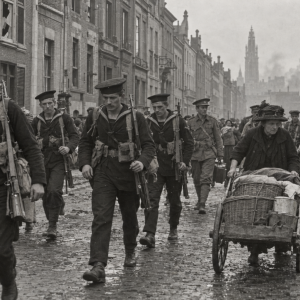
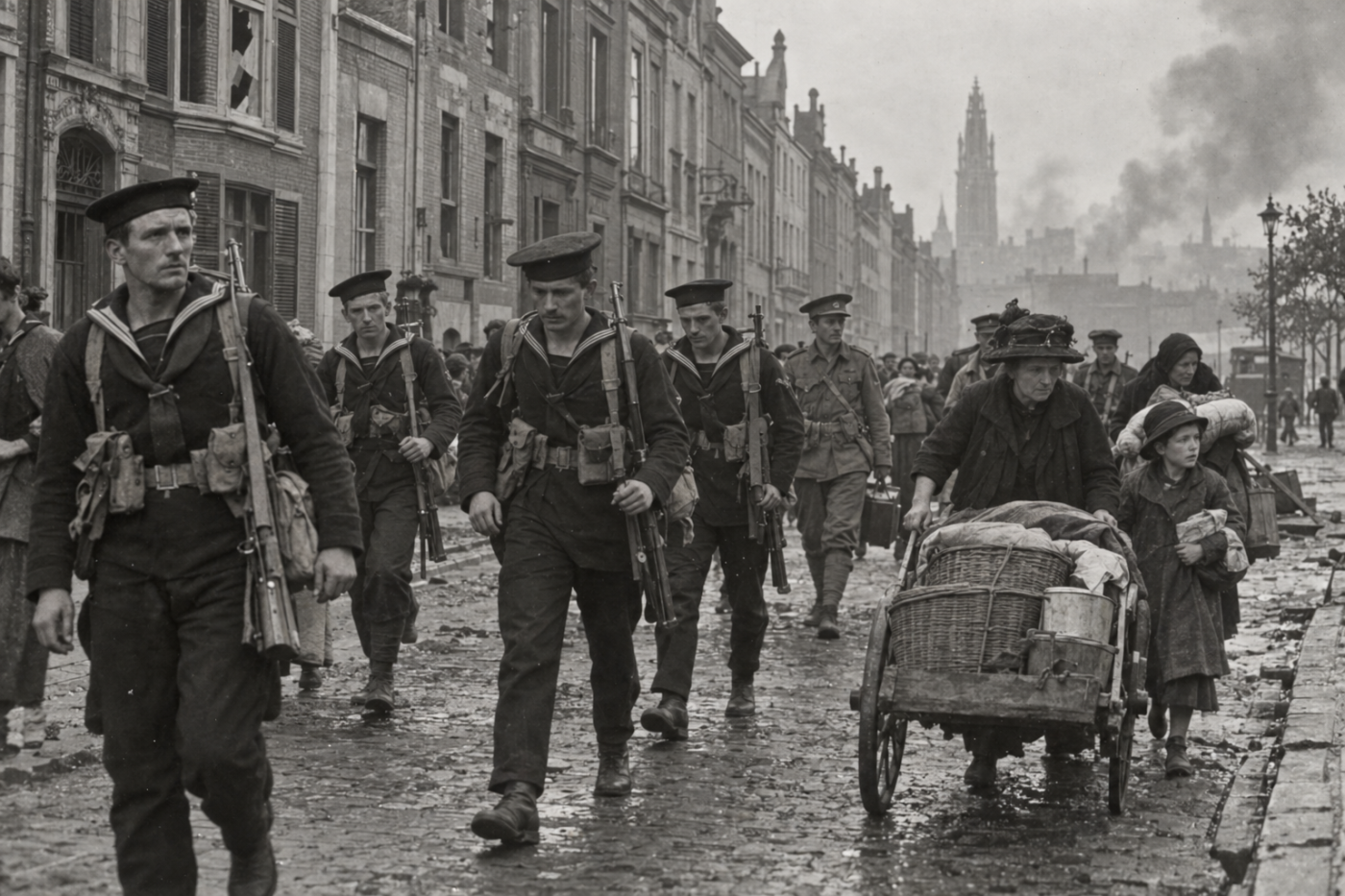
Britain’s intervention was driven by Winston Churchill, then First Lord of the Admiralty, who travelled to Antwerp and urged continued resistance while reinforcements were arranged. The newly formed Royal Naval Division, commanded by Major-General Archibald Paris, included Royal Marines and naval reservists serving ashore as infantry. Its Marine Brigade, approximately 2,200 strong, arrived during the night of 3–4 October and entered trenches alongside Belgian troops facing Lier. Their presence strengthened morale, but German troops crossed the Nete and the position deteriorated despite a Belgian counter-attack. Two naval brigades arrived during the night of 5–6 October, only to face withdrawal towards the inner defensive line.
During the night of 7–8 October, shells fell heavily on Antwerp itself. Fires spread through streets where the water supply had been cut, leaving little means of extinguishing them. With the forts failing and German troops threatening the route west, Paris ordered a withdrawal on the evening of 8 October. Soldiers struggled along roads congested with refugees, carts and livestock, while darkness, exhaustion and disrupted communications broke up formations. Some British troops escaped and returned home, but others were captured or cut off from the retreat.
Approximately 1,500 men of the 1st Royal Naval Brigade crossed into the neutral Netherlands rather than fall into German hands. They were disarmed and interned under the rules of neutrality, many remaining there for the rest of the war. Tens of thousands of Belgian soldiers also crossed the Dutch border, while the main field army withdrew westwards towards the coast. Antwerp’s surrender therefore did not destroy Belgian resistance: the surviving army established itself behind the River Yser and defended the last unoccupied corner of its homeland.
The British intervention failed to save Antwerp and Churchill’s involvement became controversial, but Field Marshal Sir John French credited the naval force with delaying the Germans and helping the Belgian army withdraw in a condition to fight again. For the naval troops, the siege was a harsh introduction to land warfare; for Belgium, it meant the loss of a great city, followed by a determined stand that continued until liberation in 1918.