On this day in military history…
On 6 October 1973, at approximately 2pm, Egyptian and Syrian forces launched a coordinated surprise attack against Israeli positions in the Sinai Peninsula and on the Golan Heights. It was Yom Kippur, the holiest day in the Jewish calendar, when much of Israel had come to a standstill for fasting and prayer. Within hours, the country was fighting on two fronts, its forward defences under enormous pressure as reservists hurried to join their units. Known in Israel as the Yom Kippur War and in much of the Arab world as the October or Ramadan War, the conflict would transform the military and political balance of the Middle East.
The roots of the fighting lay in the Six-Day War of June 1967, when Israel captured the Sinai Peninsula from Egypt and the Golan Heights from Syria. Both countries rebuilt their armed forces with extensive Soviet equipment and prepared to recover their lost territory. Egyptian President Anwar Sadat also wanted to break the diplomatic stalemate surrounding the occupation of Sinai. Rather than depending upon an immediate conquest of the entire peninsula, his opening plan aimed to establish a defensible foothold beyond the Suez Canal and force the international powers to take Egypt’s demands seriously.
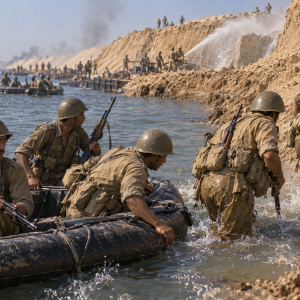
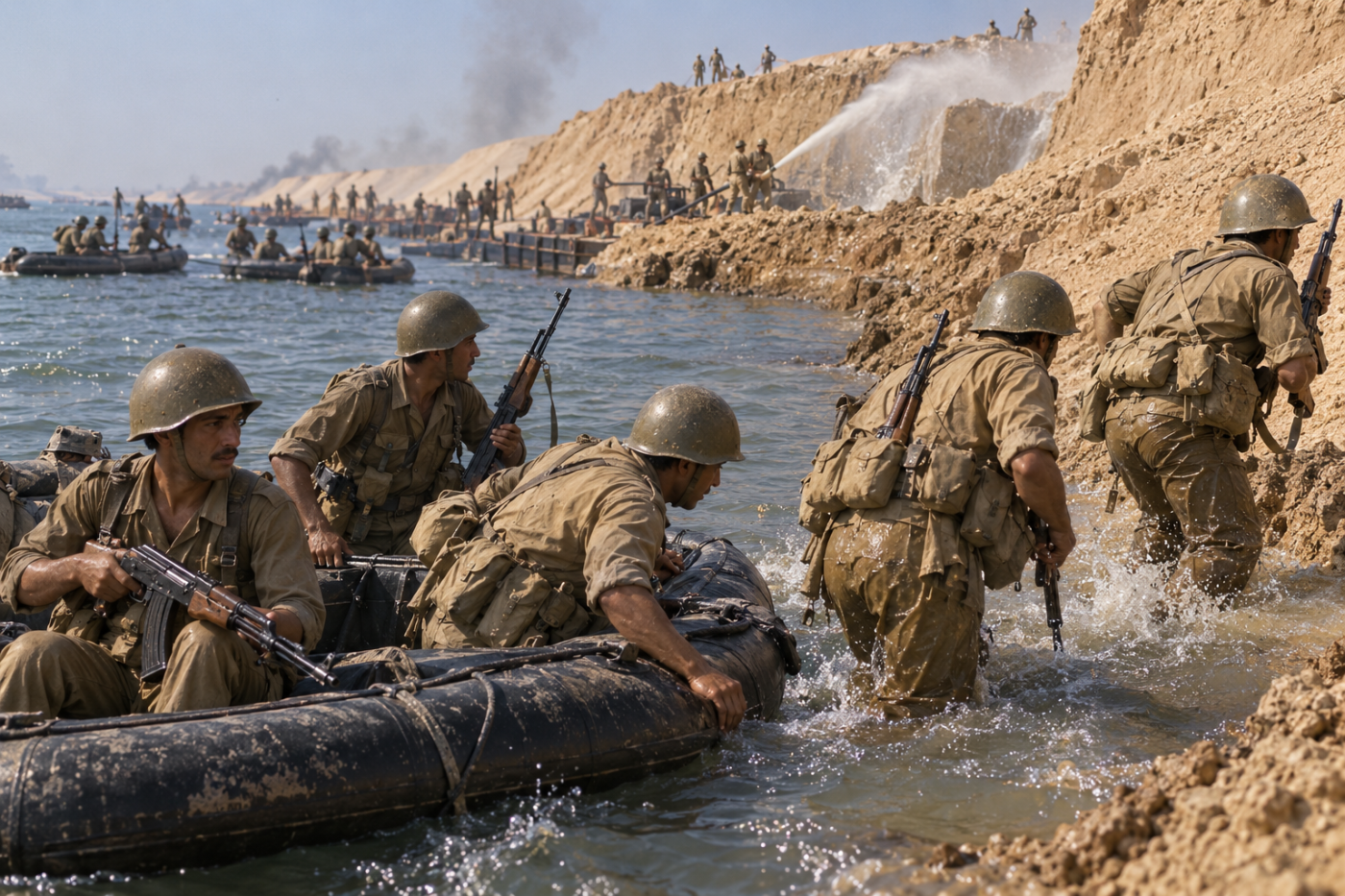
Along the canal’s eastern bank stood the Israeli Bar-Lev Line, a system of fortified strongpoints backed by a formidable sand embankment. Egyptian planners knew that crossing the water was only the first obstacle: they also had to open routes through the bank before tanks, artillery and supply vehicles could follow. Their solution was remarkably practical. Engineers would use powerful water pumps to wash away the sand, cutting passages that explosives alone would have taken much longer to create.
The assault, codenamed Operation Badr, began with air strikes and a massive artillery bombardment. Egyptian infantry crossed in assault boats, climbed the embankment and attacked the Israeli positions while engineers worked beneath covering fire. Ferries and pontoon bridges followed, allowing heavier equipment to reach the eastern bank. Years of preparation and repeated exercises paid off as the Egyptians established bridgeheads in Sinai and isolated many of the canal strongpoints. The speed and organisation of the crossing shattered assumptions that the waterway and its defences would hold back a major attack.
Egyptian infantry were equipped to meet the Israeli armoured response. Soviet-designed Sagger guided missiles and RPG-7 weapons gave soldiers on foot the ability to destroy tanks, particularly when those tanks advanced without sufficient infantry and artillery support. Israeli counterattacks suffered heavily, including a major unsuccessful effort on 8 October. Above the battlefield, Egyptian surface-to-air missiles challenged another Israeli advantage by making close air support dangerous. The opening battles demonstrated how carefully prepared infantry and modern missile systems could disrupt an army accustomed to relying upon rapid armoured manoeuvre.
Meanwhile, Syrian forces attacked across the Golan Heights, where the defenders faced powerful armoured formations on a much narrower front. Israeli tank crews fought from prepared positions, sometimes continuing through repeated engagements with little rest. In the northern sector, the struggle of 6–9 October became known as the Battle of the Valley of Tears. The Syrians made dangerous gains elsewhere, but the resistance bought time for Israeli reserves to arrive. As reinforcements entered the battle, the defenders recovered the initiative, pushed Syrian forces back and eventually advanced beyond the pre-war ceasefire line towards Damascus.
The balance also began to change in Sinai. On 14 October, Egyptian armour advanced beyond the protection of much of its established air-defence umbrella and suffered serious losses against prepared Israeli forces. Israel then exploited a gap between the Egyptian Second and Third Armies near the Great Bitter Lake. During the night of 15–16 October, troops from Major General Ariel Sharon’s 143rd Division began crossing to the western bank of the Suez Canal. Establishing and supplying this bridgehead required bitter fighting, but it opened the way for a wider Israeli advance into Egypt.
What had begun as an Egyptian crossing into Sinai now became a battle on both sides of the canal. Israeli forces expanded their western bridgehead, attacked Egyptian positions and cut supply routes, eventually encircling the Third Army on the eastern bank. Egypt nevertheless retained substantial forces in its original bridgeheads. The military position was therefore more complicated than a simple reversal of the opening attack: Israel had recovered from its early setbacks and gained the battlefield advantage, while Egypt had demonstrated that the canal could be crossed and the occupation challenged.
The war also drew the Cold War superpowers into a dangerous confrontation. The Soviet Union resupplied Egypt and Syria, while the United States organised a major airlift to Israel. United Nations Security Council Resolution 338 called for a ceasefire on 22 October, but fighting continued and further resolutions followed. As the crisis surrounding the trapped Egyptian army intensified, a Soviet suggestion of intervention prompted the United States to raise its military alert level. The ceasefire finally took firmer hold by 25 October, after almost three weeks of fighting.
The human cost was severe. Israel lost approximately 2,700 military personnel, while Egyptian and Syrian deaths numbered many thousands, although estimates vary. Large quantities of tanks, aircraft and other equipment were destroyed. In Israel, the surprise attack and initial failures led to a national inquiry and lasting anger towards the political and military leadership. For Egyptian soldiers, the successful opening crossing restored pride after the defeat of 1967 and became a defining moment in their country’s military history.
Its consequences reached far beyond the battlefield. Arab oil restrictions and an embargo against countries supporting Israel helped trigger an international energy crisis. At the same time, the fighting created new pressure for negotiations. Subsequent diplomacy led to disengagement agreements, the Camp David Accords of 1978 and the Egyptian–Israeli peace treaty of 1979, followed by Israel’s withdrawal from Sinai. The war that began on 6 October 1973 left a legacy of heavy losses and profound shock, but it also helped open the path towards peace between two of its principal opponents.