On this day in military history…
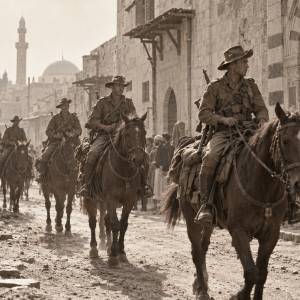
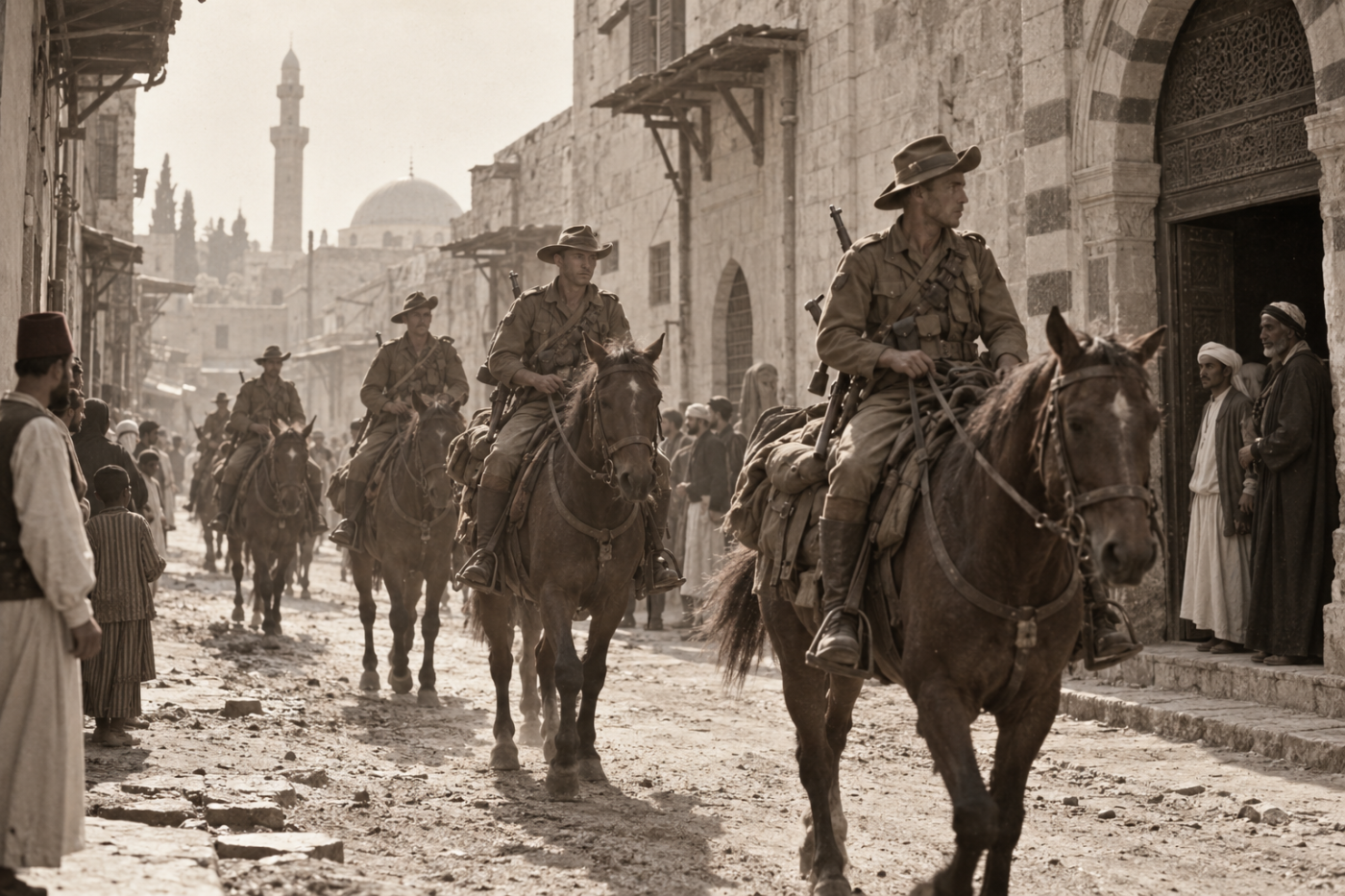
On 1 October 1918, Australian Light Horsemen rode into Damascus as the Ottoman army retreated north through Syria. Their arrival marked the end of Ottoman rule in one of the region’s most important cities and the culmination of a remarkable mounted advance. In less than two weeks, Allied forces had broken through the Ottoman front in Palestine and pursued its retreating armies across hundreds of miles. Damascus also held a powerful meaning for the Arab forces fighting alongside them. To Prince Feisal and his supporters, the city offered the chance to establish an Arab government after years of rebellion against Ottoman rule.
The advance began with General Sir Edmund Allenby’s offensive at Megiddo on 19 September. British Empire infantry attacked the Ottoman line near the Mediterranean coast and opened a gap for the cavalry. Lieutenant General Sir Harry Chauvel’s Desert Mounted Corps rode through it and swept into the country behind the defenders. Mounted troops seized important roads and railway junctions, making it increasingly difficult for Ottoman units to escape or organise a new defensive line. Allied aircraft struck columns caught on the roads. The speed of the attack turned an Ottoman withdrawal into a rout, with large numbers of men and equipment falling into Allied hands.
The campaign had required careful planning as well as speed. Horses needed water and fodder, while the men depended on supplies being brought forward over increasingly long distances. The mounted units could not afford to pause for long enough to let the retreating army recover. As they drove north, they crossed ground that had been fought over for years, moving beyond Palestine and into Syria. Many of the Light Horsemen had served through the hard campaigns in Sinai and the Jordan Valley. By September 1918, they were taking part in an offensive unlike the slow, costly advances that had characterised much of the First World War.
Prince Feisal’s Arab forces were approaching Damascus from another direction. Since the Arab Revolt began in 1916, they had attacked Ottoman outposts, disrupted communications and raided the Hejaz railway. T. E. Lawrence, a British officer serving as an adviser and liaison, had become closely associated with their campaign. Arab attacks around the railway helped complicate the Ottoman retreat as Allenby’s army advanced. Yet the two forces did not have identical aims. For the British-led army, Damascus was a major objective in the defeat of the Ottoman Empire. For Feisal, entering the city offered a claim to govern Syria when the fighting ended.
By 30 September, Chauvel’s mounted troops had reached the approaches to Damascus. Australian Light Horsemen fought Ottoman cavalry at Kaukab, driving them back towards the city, while other units sought to cut the roads by which the remaining Ottoman forces might escape. Inside Damascus, authority was breaking down as the army withdrew. In the early hours of 1 October, men of the 10th Australian Light Horse Regiment entered the city on their way to secure the road north to Homs. Major Arthur Olden met the acting governor, Emir Said, and received its surrender. The Australians continued towards their objective rather than remaining to occupy the streets.
Their entry created a difficult political situation. Allenby had ordered his mounted troops to pass around Damascus, intending Feisal’s Arab forces to enter and assume authority there. The Light Horsemen had ridden through because it was the practical route to the Homs road. Lawrence arrived shortly afterwards and worked to place an administration loyal to Feisal in charge. In the days that followed, there were competing claims about who had been first into Damascus and who should be credited with its liberation. The military facts and the political ambitions of those involved did not fit neatly together.
The city’s capture was a triumph, but it was not the end of the campaign. Allied mounted forces continued their pursuit north towards Aleppo, while the Ottoman army struggled to re-form after its defeat. At the end of October, the Ottoman Empire agreed to an armistice. For the men who had ridden through Sinai, Palestine and Syria, Damascus stood as one of the defining achievements of their war. For its people, 1 October 1918 ended centuries of Ottoman rule but left an uncertain future. The fighting had decided who controlled the city that morning; the question of who would govern Syria would take much longer to settle.