On this day in military history…
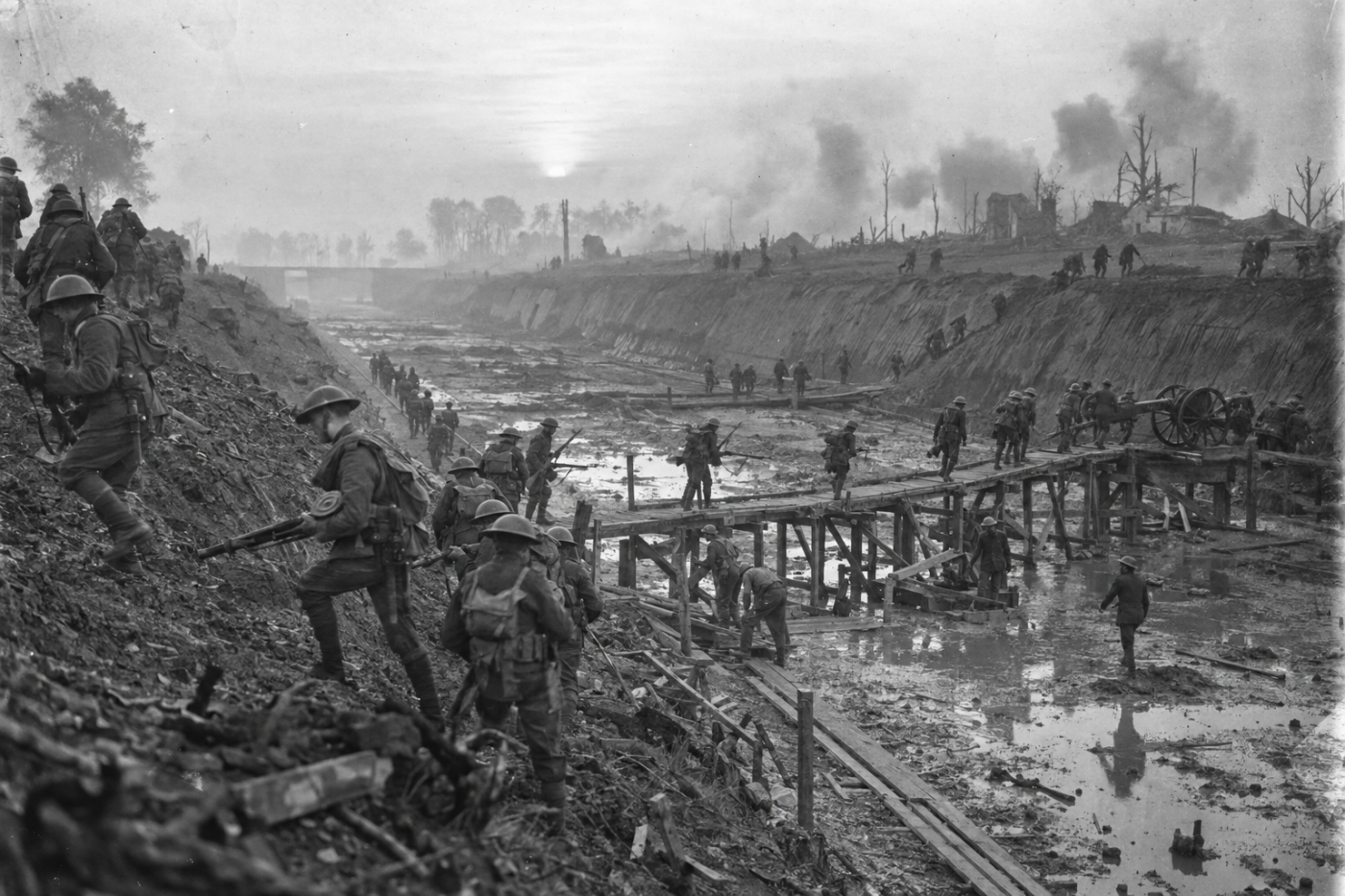
On 27 September 1918, British and Canadian troops launched one of the most daring operations of the First World War when they attacked across the Canal du Nord in northern France. The battle formed part of the Allied Hundred Days Offensive, the great series of attacks that finally broke the German Army’s defensive system and helped bring the war to an end. Thousands of soldiers, guns, horses and vehicles had to pass through a dangerously narrow crossing before spreading out to attack the powerful German positions protecting Cambrai.
By September 1918, Germany’s spring offensives had failed and the Allies had regained the initiative. British, Commonwealth, French and American armies were attacking along much of the Western Front, forcing the exhausted German forces back towards the Hindenburg Line. This enormous defensive system consisted of trenches, concrete bunkers, machine-gun positions, barbed wire and carefully prepared artillery zones. Near Cambrai, the Canal du Nord formed an additional obstacle. Construction of the canal had begun before the war but was abandoned in 1914, leaving some sections filled with water and others dry but protected by steep banks and German machine-gun posts. The enemy expected an attack where the canal was dry and concentrated its defences there.
The Canadian Corps, commanded by Lieutenant-General Sir Arthur Currie and serving with General Sir Henry Horne’s British First Army, was ordered to force the crossing, capture Bourlon Wood and protect the northern flank of the British Third Army as it advanced towards Cambrai. Currie believed a broad frontal assault would produce enormous casualties, so he planned to send the leading troops through a dry section of the canal approximately 2,700 yards wide. Once across, they would spread rapidly north and south, widening the bridgehead so the remaining divisions, artillery and supplies could follow.
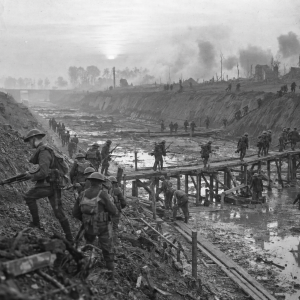
The plan was extremely dangerous. Thousands of men would be concentrated in a confined area and could be devastated by German artillery if discovered. Canadian engineers secretly constructed wooden bridges, prepared crossing equipment and marked routes through the darkness. Artillery positions were concealed, ammunition was brought forward and troops rehearsed their movements. The operation required precise cooperation between infantry, engineers, artillery, machine-gun units and aircraft.
At 5.20 am on 27 September, four Canadian battalions advanced in darkness behind a powerful creeping artillery barrage. They entered the canal cutting, climbed the opposite bank and attacked the German positions beyond. Although the defenders were initially surprised, resistance soon hardened around trenches, villages and concrete strongpoints. The Canadians pushed forward through machine-gun fire, crossed belts of wire and cleared enemy positions with rifles, grenades and bayonets.
As soon as the first objectives were secured, engineers began laying bridges across the canal. Infantry reinforcements, artillery, ammunition wagons and medical personnel were funnelled through the narrow crossing. Severe congestion developed, but the bridgehead continued to expand and by the afternoon guns were being moved across to support the advance. One of the most important objectives was Bourlon Wood, an area of commanding high ground overlooking the approaches to Cambrai. German observers there could direct artillery fire across the surrounding countryside, making its capture essential.
Canadian troops fought towards the wood while other formations attacked Marquion, Bourlon and the surrounding defensive positions. German machine-gun teams continued fighting until they were surrounded or destroyed, but by the end of the first day the Canadian Corps had crossed the canal, advanced nearly five miles in places and captured Bourlon Wood and the village of Bourlon. The British 11th Division fought alongside the Canadians while formations of the British Third Army advanced farther south.
The battle continued as German commanders rushed reinforcements into the area and launched determined counter-attacks. Between 28 September and 1 October, British and Canadian troops advanced through strongly defended villages, trenches and railway positions. Much of the fighting was at close quarters and progress became increasingly difficult as German resistance stiffened. Exhausted infantrymen continued moving forward while engineers repaired roads and bridges and artillery batteries struggled to keep pace.
Numerous acts of extraordinary bravery took place during the battle. Men continued leading attacks after their officers had been killed, captured machine-gun posts single-handedly, carried messages through intense shellfire and rescued wounded comrades from exposed ground. Several Victoria Crosses were awarded for actions during the Canal du Nord operations, reflecting both the ferocity of the fighting and the courage of those involved.
By 1 October, the principal objectives had been secured. The Canadian Corps had captured more than 7,000 German prisoners and over 200 guns, but victory came at a terrible price. More than 10,000 Canadian soldiers were killed, wounded or reported missing during five days of fighting. British units also suffered heavily, while German losses included thousands of casualties and prisoners.
The capture of the Canal du Nord and Bourlon Wood broke another major section of the German defensive system and placed Allied troops around several sides of Cambrai. The city was liberated on 9 October after German forces withdrew, leaving parts of it damaged and burning. The advance continued through northern France and into Belgium, with the Canadian Corps reaching Mons shortly before the Armistice on 11 November 1918.
Today, the Bourlon Wood Canadian Memorial stands on ground captured during the battle. It commemorates the soldiers who forced the Canal du Nord before advancing through Cambrai, Denain, Valenciennes and Mons. The battle remains one of the outstanding achievements of the final Allied offensive—a carefully planned but extremely hazardous attack that overcame a formidable obstacle, shattered powerful German defences and helped open the road to victory.