On this day in military history…
On 23 September 1944, the Battle of Arnhem entered one of its most desperate stages. Field Marshal Walter Model, commanding the German forces resisting Operation Market Garden, ordered the civilian population of Arnhem to leave their homes. At the same time, Polish paratroopers were attempting to cross the River Rhine in small boats to reinforce the exhausted remnants of the British 1st Airborne Division, now surrounded and steadily being depleted at Oosterbeek. Operation Market Garden had begun on 17 September with the ambitious aim of seizing a series of bridges through the Netherlands and opening a route into northern Germany. The British 1st Airborne Division had been given the most distant objective, the road bridge at Arnhem. Lieutenant-Colonel John Frost’s 2nd Parachute Battalion reached the northern end of the bridge, but the remainder of the division became trapped several miles away around Oosterbeek.
The British airborne troops had expected to be relieved by XXX Corps within two or three days, but delays further south and unexpectedly strong German resistance left them isolated. By 23 September, Frost’s defence at the bridge had been overwhelmed, while Major-General Roy Urquhart’s remaining force was compressed into a shrinking perimeter west of Arnhem. Ammunition, food, water and medical supplies were running dangerously low, while hundreds of wounded men were being treated in overcrowded houses, churches and makeshift aid stations. German armour, mortars and artillery continually struck the perimeter, communications were unreliable and many units had been reduced to small groups of exhausted men. Yet the airborne soldiers continued to hold their positions, knowing that the Rhine behind them was their only possible escape route and that relief forces were attempting to reach them from the south.
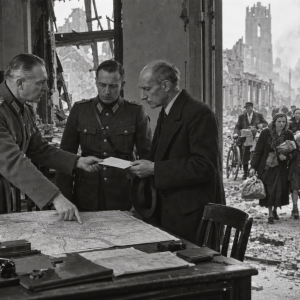
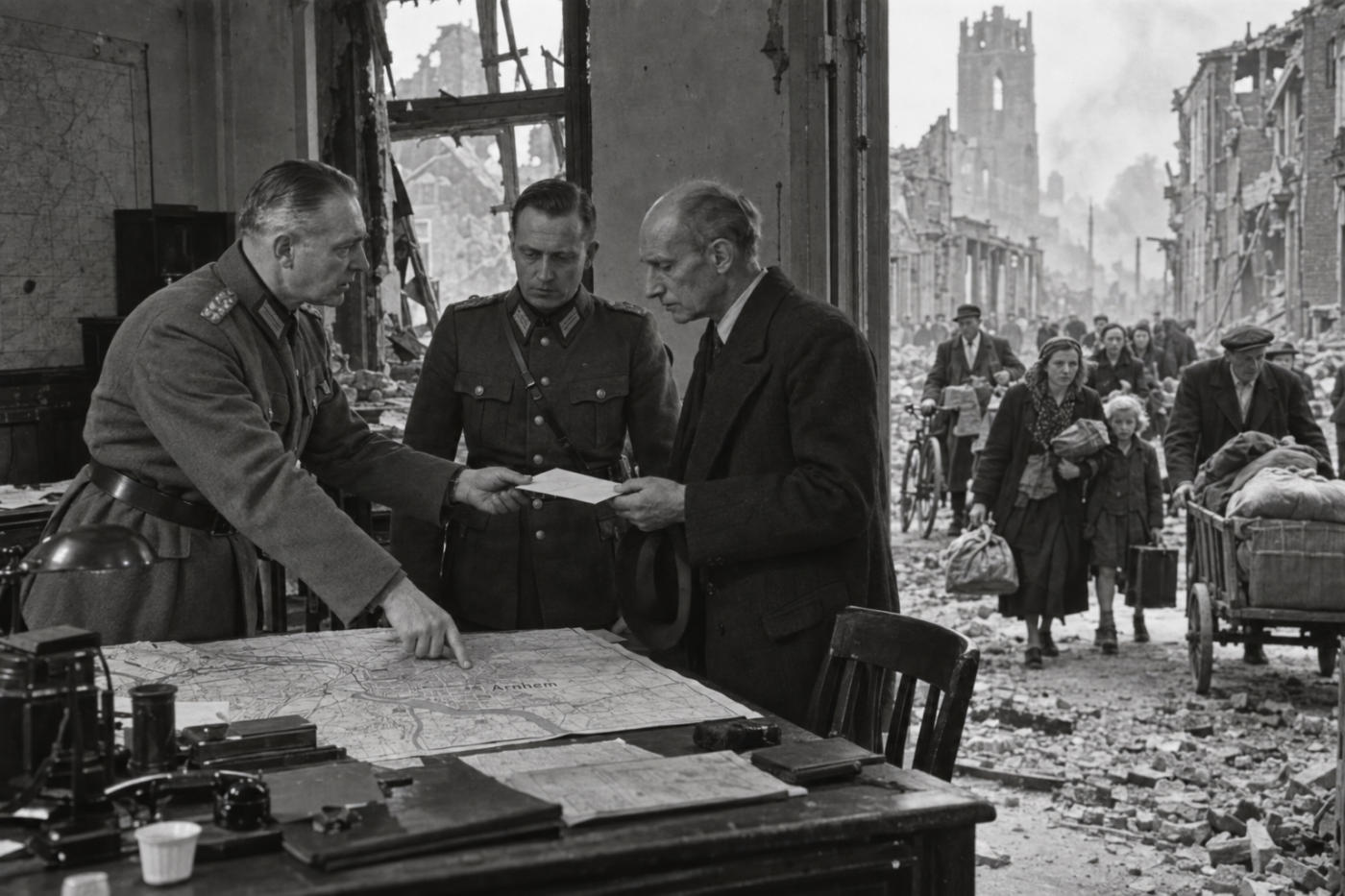
Arnhem had been devastated by days of bombardment and street fighting. Model’s evacuation order forced tens of thousands of Dutch civilians to abandon the city, many taking only what they could carry or load onto bicycles and handcarts. The order was announced on 23 September and implemented over the following days, driving families north and west into German-held territory. Many believed they would return within days, but Arnhem would not be liberated until April 1945. After the population had gone, homes and businesses were widely looted and the ruined city became part of the German defensive line north of the Rhine.
South of the river, Major-General Stanisław Sosabowski’s 1st Polish Independent Parachute Brigade had landed near Driel on 21 September. Their arrival had been delayed by bad weather and transport difficulties in Britain. The brigade had originally been intended to land north of the Rhine close to the British positions, but the worsening situation forced the drop zone to be moved to the southern bank. Sosabowski quickly discovered that the ferry at Driel, which was supposed to carry his men across the river, was missing and its cable had been cut. During the night of 22–23 September, the Poles attempted to cross in a small number of rubber dinghies. The Rhine was wide and fast-flowing, while German machine guns, mortars and artillery covered the northern bank. The boats were difficult to control, their paddles were inadequate and several were swept downstream. Around 55 men managed to cross, but only about 35 successfully reached the British perimeter.
Later on 23 September, troops of the 43rd Wessex Division reached Driel with assault boats, although these arrived too late and in insufficient numbers for the large reinforcement attempt that had been planned. During the following night, approximately 150 more Polish paratroopers crossed the river and joined the depleted British defenders, particularly around the southern approaches to the Oosterbeek perimeter. They were too few to change the outcome, but their crossing was an act of exceptional courage. The men entered overloaded boats in darkness, crossed a river swept by enemy fire and then fought beside soldiers who had endured almost a week of continuous attacks. Other Polish troops remained at Driel, protecting the southern bank and helping to keep open the route by which the survivors would eventually escape.
By 23 September, the attempt to hold Arnhem was nearing its end. Civilians were being driven from their city, the British airborne force was exhausted and surrounded, and Polish paratroopers were risking their lives to reach their trapped comrades. Two nights later, the remaining defenders were ordered to withdraw across the Rhine during Operation Berlin. Of approximately 10,000 men of the British 1st Airborne Division who had landed at Arnhem, fewer than 2,400 escaped. Although the attempt to secure the bridge had failed, the determination of the British and Polish airborne troops became one of the most enduring stories of courage and sacrifice during the Second World War.