On this day in military history…
The Battle of Lone Pine, fought on the Gallipoli Peninsula between 6 and 9 August 1915, became one of the most savage and celebrated actions fought by Australian troops during the First World War. On a battlefield little more than a maze of trenches, tunnels and shattered earth, Australian soldiers fought at such close quarters that rifles were often almost useless and the battle was decided with bayonets, hand grenades, fists and anything else that came to hand. By the time the fighting ended, more than 2,000 Australians had been killed or wounded and Ottoman losses were several thousand. From those few terrible days came an extraordinary record of courage: seven Victoria Crosses were awarded to Australian soldiers for their actions at Lone Pine.
By August 1915 the Gallipoli campaign had reached a bloody stalemate. Since the Allied landings on 25 April, British, Australian, New Zealand and French forces had been unable to break through the strongly defended Ottoman positions dominating the peninsula. The Australians and New Zealanders at Anzac Cove occupied a narrow and exposed foothold surrounded by steep ridges held by Ottoman troops. Months of fighting had produced enormous casualties without achieving the decisive breakthrough the Allies desperately needed.
A major offensive was therefore planned for August. The principal objective was to seize the high ground of the Sari Bair Range, particularly Chunuk Bair and Hill 971. To prevent Ottoman reserves being moved north to oppose this attack, Australian troops were ordered to launch a diversion against the formidable position known as Lone Pine.
The name came from a solitary pine tree that had originally stood in the area, although by the time of the battle much of the landscape had already been devastated by shellfire and months of fighting. The Ottoman position was one of the strongest sections of the Anzac front. Its trenches were deep, well constructed and connected by communication trenches and underground passages. Particularly dangerous were sections of the front line that had been roofed with heavy pine logs and covered with earth. From the air and from the Australian lines these covered positions were extremely difficult to identify.
The task of attacking Lone Pine was given principally to the Australian 1st Brigade. The 2nd, 3rd and 4th Battalions would lead the initial assault, while other Australian units would subsequently be drawn into the struggle to hold the captured ground.
During the afternoon of 6 August 1915 Australian and Allied artillery began pounding the Ottoman positions. At approximately 4.30pm the bombardment intensified as shells crashed into the trenches and surrounding ground. For an hour the artillery attempted to suppress the defenders and destroy obstacles ahead of the Australian infantry. At 5.30pm the bombardment stopped.
Almost immediately the Australians surged forward. Men climbed from their trenches and underground positions and charged across the open ground towards Lone Pine. The distance separating the opposing lines was relatively short, but it was swept by rifle, machine-gun and artillery fire. Australians fell killed and wounded as the attacking waves rushed forward, yet the survivors continued towards the Ottoman positions.
When they reached the enemy front line they encountered something many had not expected. Instead of finding open trenches into which they could simply jump, soldiers discovered that large sections had been roofed with thick pine logs. There was no time to stop. Some Australians fired through gaps between the logs. Others searched desperately for openings. Men tore at the timber and earth with their hands and bayonets, attempting to break through the roofs. Other groups ran beyond the covered sections and entered through communication trenches behind them.
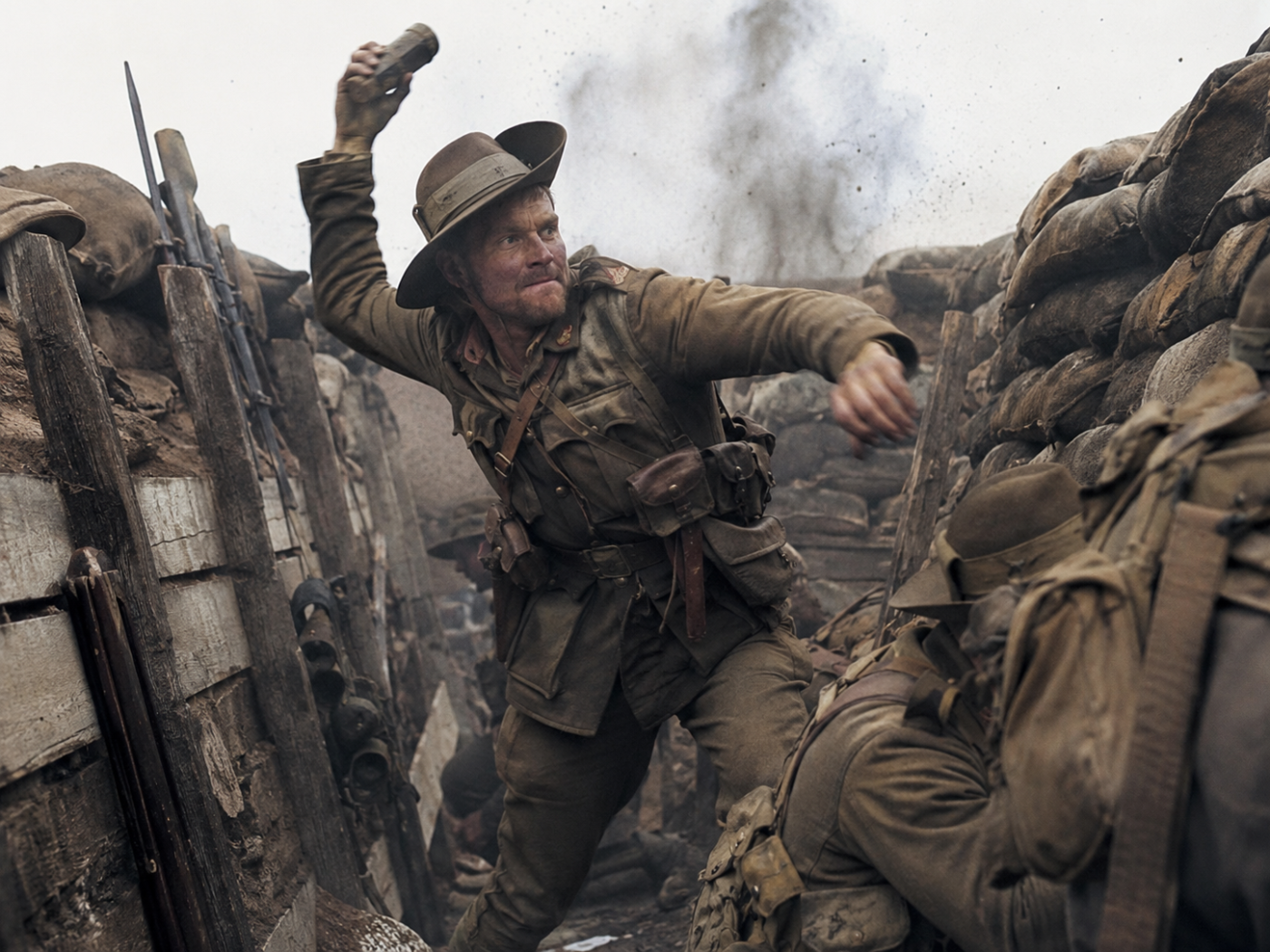
Once inside, the battle became ferocious. The narrow trenches prevented large formations from manoeuvring. Groups of men suddenly encountered each other around corners or inside dark passages. Bayonets were thrust at almost touching distance. Rifles became clubs. Grenades were thrown along trenches packed with soldiers. Men fought hand-to-hand in a confused network where it was sometimes difficult even to determine which direction the enemy would appear from next.
Despite the strength of the defences, the main Ottoman front-line position was captured within approximately twenty minutes.
Taking Lone Pine, however, proved far easier than holding it. The Ottoman commanders quickly realised the importance of the position and began launching counter-attacks. For the next four days the Australians clung to the captured trenches while repeated attempts were made to drive them out.
The fighting became dominated by grenades, then commonly called bombs. The Ottoman troops possessed effective hand grenades that could be rapidly prepared and thrown into Australian positions. Australian supplies were much more limited and included improvised explosives commonly known as jam-tin bombs, manufactured from tins packed with explosive and fragments of metal. The opposing trenches were sometimes only a few metres apart, and grenades could arrive almost continuously.
Australian soldiers developed desperate methods of surviving them. Men attempted to throw live Ottoman grenades back before they exploded. Others placed sandbags or heavy clothing over bombs in an attempt to absorb the blast. Every attempt involved an extraordinary risk. A moment's hesitation could kill or mutilate everyone nearby.
It was during this murderous grenade fighting that Lance Corporal Leonard Maurice Keysor of the 1st Battalion performed the actions that earned him the Victoria Cross. On 7 August his trench came under particularly heavy bombing. Keysor repeatedly picked up live Ottoman grenades and threw them back towards the enemy. When there was insufficient time to throw one safely, he attempted to smother the explosion with clothing or sandbags. He was wounded but refused to leave his position.
The following day he continued fighting and helped bomb Ottoman troops from a position threatening the Australian trench. Keysor was wounded again, yet once more refused evacuation. When another company lost its own bomb throwers, he volunteered to assist them. For approximately fifty hours Keysor continued fighting around Lone Pine before finally allowing himself to be evacuated. His extraordinary bravery helped prevent an important section of the captured position from being lost.
Private John Patrick Hamilton of the 3rd Battalion also displayed remarkable courage on 9 August. Just 19 years old, Hamilton moved into an exposed position from which he could observe the enemy despite intense fire. For hours he maintained his position, firing at Ottoman troops and directing Australian bomb throwers towards enemy movements. His determination helped prevent the Australians being overwhelmed during one of the most dangerous periods of the battle. Hamilton survived the First World War and would later serve again during the Second World War.
One of the most remarkable stands occurred among men of the 7th Battalion. Lieutenant Frederick Harold Tubb, Corporal Alexander Stewart Burton and Corporal William Dunstan found themselves defending a vital section of trench during a powerful Ottoman attack on 9 August. Grenades rained into their position as the defenders were gradually reduced by casualties. The three Australians refused to abandon the trench. When bombs landed among them they attempted to throw them back. The position became increasingly desperate as men around them were killed or wounded. Burton, Dunstan and Tubb remained at their posts despite the danger.
Eventually an explosion killed Burton. Dunstan was severely wounded and Tubb was also wounded, but the position was held. All three men were awarded the Victoria Cross for their actions. Burton's award was posthumous. The episode became one of the most famous moments of Lone Pine and contributed to an extraordinary distinction for the 7th Battalion, which received four Victoria Crosses from the fighting there.
The fourth was awarded to Lieutenant William John Symons. During the night of 8–9 August, Symons was ordered to lead men against a section of the captured trench system that had become dangerously exposed to Ottoman attack. The situation was considered so serious that his chances of survival were poor. Nevertheless, Symons organised his men and led them into the fighting. Through determination and close-quarter combat the Australians secured the position. Symons then remained involved in its defence as further attacks developed. His leadership under extreme conditions earned him the Victoria Cross.
Perhaps the most dramatic of the Lone Pine Victoria Cross actions belonged to Captain Alfred John Shout of the 1st Battalion. Shout was already an experienced soldier. Born in New Zealand in 1881, he had fought during the Boer War before settling in Australia. He joined the Australian Imperial Force and landed at Gallipoli on 25 April 1915. His courage during the opening stages of the campaign had already earned him the Military Cross and a Mention in Despatches.
At Lone Pine he repeatedly exposed himself during the close-quarter fighting. On the morning of 9 August, Shout and a small group attacked Ottoman soldiers occupying part of the trench system. Moving down the trench under fire, Shout personally threw bombs into enemy positions while his men followed behind him consolidating the ground they had captured. The attack succeeded.
Later that day Shout again moved forward to clear another section of trench. He continued throwing bombs at extremely close range as the Australians pushed forward. Preparing for another rush, Shout lit several bombs almost simultaneously. One exploded prematurely. The blast caused catastrophic injuries, destroying part of one hand and severely wounding his face. Despite the terrible nature of his wounds, those around him remembered that Shout remained remarkably cheerful while he was carried from the battlefield. He was evacuated aboard the hospital ship Neuralia but died from his wounds on 11 August 1915. He was buried at sea. His Victoria Cross was awarded posthumously.
By the evening of 9 August the main Ottoman counter-attacks at Lone Pine were ending. The Australians had paid an appalling price, but they still held most of the ground they had captured. More than 2,000 Australian soldiers had become casualties during the battle. Ottoman losses were also immense, with estimates approaching 7,000 killed and wounded during the fighting around the position.
The physical conditions inside the trenches were horrific. Dead Australian and Ottoman soldiers lay throughout the battlefield, sometimes several bodies deep in narrow sections where fighting had repeatedly swept backwards and forwards. Reinforcements moving forward often had little choice but to climb over the dead to reach the front. The smell of death and explosives filled the trench system. The wounded crowded communication trenches while stretcher-bearers attempted to carry casualties back towards the beaches. Men fought while exhausted, deafened by explosions and often without sleep for long periods.
Lone Pine had achieved its immediate objective. Ottoman troops and reserves had been drawn into the fighting while the larger Allied offensive developed farther north. The Australians had also captured and held an important enemy position. Strategically, however, the wider August offensive failed. The Allies were unable to gain permanent control of the crucial heights of the Sari Bair Range and the opportunity to break the deadlock on Gallipoli disappeared. Only a few months later the Anzac positions would be evacuated.
Yet Lone Pine remained one of the relatively few clear Australian battlefield successes of the Gallipoli campaign. Its lasting fame came not from the amount of territory captured, which was small, but from the extraordinary intensity of the fighting and the courage shown by the soldiers who fought there.
Seven Victoria Crosses were awarded for Lone Pine: Lance Corporal Leonard Maurice Keysor, 1st Battalion, for repeatedly handling and returning live enemy bombs while wounded during 7 and 8 August; Lieutenant William John Symons, 7th Battalion, for leading and holding an extremely dangerous position during the fighting of 8 and 9 August; Corporal Alexander Stewart Burton, 7th Battalion, for defending his trench against overwhelming attack on 9 August, killed in action and awarded posthumously; Corporal William Dunstan, 7th Battalion, for remaining at his position alongside Tubb and Burton despite wounds and intense enemy bombing; Private John Patrick Hamilton, 3rd Battalion, for remaining exposed to enemy fire for hours while observing, firing upon the enemy and assisting the Australian bomb throwers; Lieutenant Frederick Harold Tubb, 7th Battalion, for refusing to abandon his position during the desperate fighting of 9 August despite heavy casualties and being wounded; and Captain Alfred John Shout, 1st Battalion, for repeatedly leading bombing attacks along the Ottoman trenches before being mortally wounded, his award also posthumous.
To place the achievement in perspective, Australian soldiers received nine Victoria Crosses during the entire Gallipoli campaign. Seven of those nine came from the small battlefield of Lone Pine during just four days of fighting. Four were associated with the 7th Battalion alone.
Today Lone Pine is one of the best-known Australian memorial sites on Gallipoli. Lone Pine Cemetery and Memorial stand close to the ground over which the battle was fought and commemorate thousands of Australian and New Zealand servicemen connected with the Gallipoli campaign. The battlefield that once echoed with rifle shots, exploding grenades and the cries of thousands of men is now quiet.
Yet the events of 6–9 August 1915 remain central to the Anzac story. Lone Pine was a battle measured in metres rather than miles, fought within trenches where opposing soldiers sometimes stood only a few yards apart. It demonstrated both the extraordinary courage of ordinary soldiers and the terrible cost of trench warfare.
For Leonard Keysor, William Symons, Alexander Burton, William Dunstan, John Hamilton, Frederick Tubb and Alfred Shout, those few days at Lone Pine resulted in Britain's and the Commonwealth's highest award for gallantry in the face of the enemy. Seven Victoria Crosses from one small battlefield remain an extraordinary testament to the ferocity of the Battle of Lone Pine and to the Australian soldiers who captured the position and refused to give it up.