On this day in military history…
On 30 April 1945, as the Battle of Berlin reached its final and most desperate stage, the leader of Nazi Germany, Adolf Hitler, spent his last hours in the heavily fortified underground complex known as the Führerbunker beneath the Reich Chancellery in Berlin. Soviet forces were closing in rapidly, artillery shells were striking the city above, and it had become clear to those inside the bunker that the war was lost.
Inside the bunker that day were several of Hitler’s closest associates, including Joseph Goebbels, Magda Goebbels, Martin Bormann, Hitler’s newly married wife Eva Braun, as well as military aides such as Otto Günsche and Heinz Linge. Earlier that same day, Hitler had dictated his political testament, blaming the war on what he described as conspiracies and urging continued resistance, even as defeat was inevitable.
In the early afternoon, shortly after lunch, Hitler and Eva Braun withdrew into his private study. According to accounts later given by those present, the atmosphere in the bunker was tense and surreal. Some reported that Hitler appeared physically diminished, his health clearly deteriorated, yet still rigid in his beliefs. Around 3:30 pm, a gunshot was heard. After a brief wait, Linge and Günsche entered the room and found Hitler dead from a self-inflicted gunshot wound to the head, while Eva Braun had taken poison, most likely cyanide.
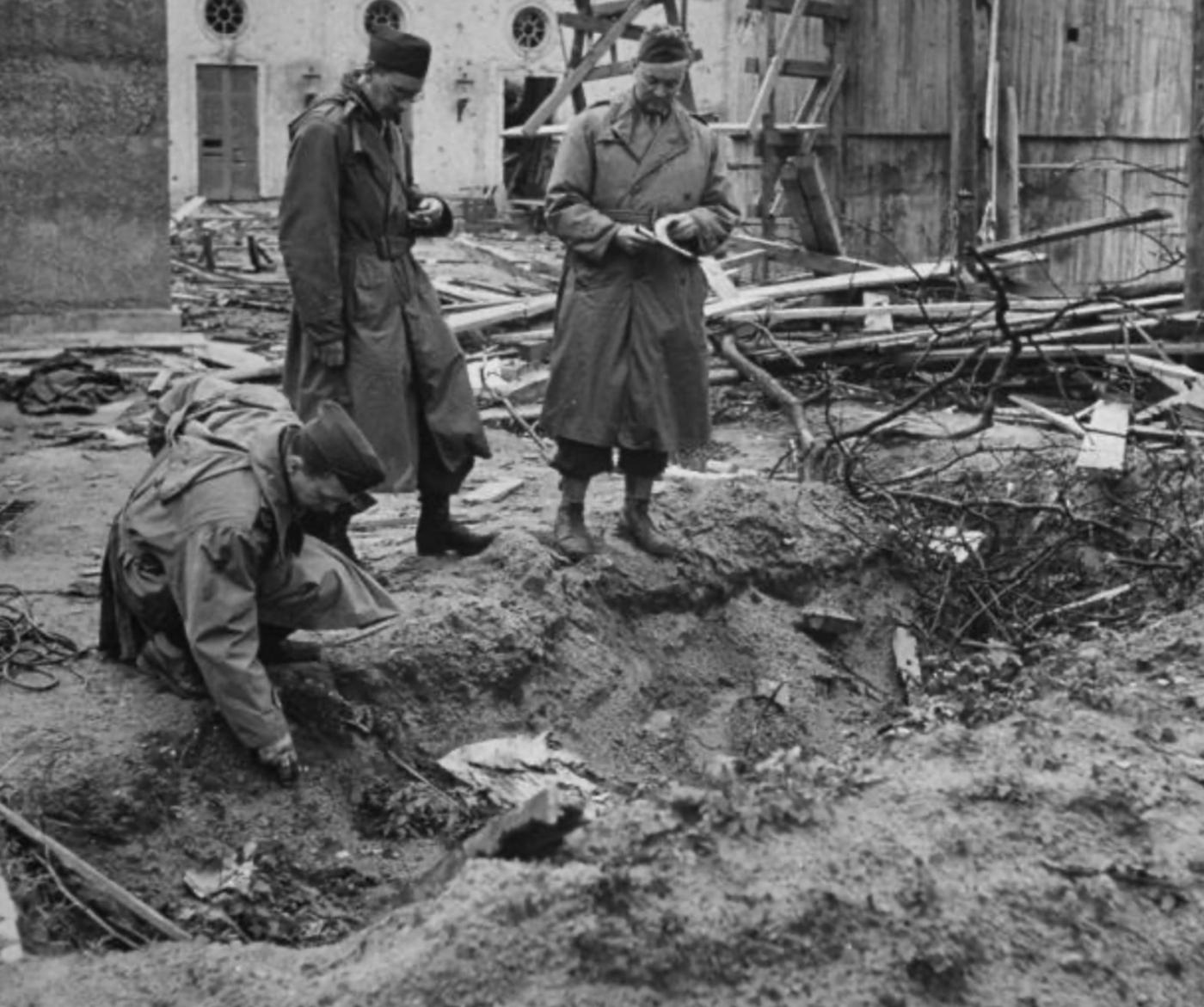
Following Hitler’s explicit instructions, his body and that of Eva Braun were carried up through the bunker’s emergency exit into the Reich Chancellery garden. There, in the midst of shellfire, they were placed in a shell crater, doused with petrol, and set alight. Those present, including Bormann and Goebbels, reportedly stood in silence or gave Nazi salutes as the bodies burned. The hurried cremation was intended to prevent Hitler’s remains from being captured and displayed by the advancing Soviet forces, a fate he had feared after seeing what happened to Benito Mussolini just days earlier.
News of Hitler’s death was not immediately announced. The chaotic conditions in Berlin and the collapse of communication lines delayed any official statement. It was not until the evening of 1 May 1945 that German radio broadcast the announcement. The message, delivered by Admiral Karl Dönitz, stated that Hitler had “fallen at his command post in the Reich Chancellery, fighting to the last breath against Bolshevism.” Notably, the announcement avoided explicitly mentioning suicide, instead portraying his death as a heroic last stand, consistent with Nazi propaganda aims.
The Soviet Union initially treated the reports with suspicion. When Soviet troops captured the bunker area, they conducted their own investigations. Remains believed to be Hitler’s were recovered and subjected to forensic analysis, including dental identification based on records from Hitler’s dentist. Despite this, the Soviets kept many details secret for years, which contributed to uncertainty and speculation in the immediate postwar period.
Over time, the generally accepted historical account became that Hitler died by suicide in the bunker on 30 April 1945, corroborated by multiple eyewitness testimonies and physical evidence. However, alongside this widely accepted narrative, an alternative theory has persisted for decades, suggesting that Hitler may have staged his death and escaped Europe.
According to this theory, Hitler did not die in Berlin but instead fled via a network of escape routes often referred to as “ratlines,” which were used by some Nazi officials to reach South America. Countries such as Argentina have frequently been cited as possible destinations. Proponents of this idea point to alleged declassified documents, witness statements, and claims of sightings of Hitler in remote regions long after the war ended.
Some investigators and authors have argued that inconsistencies in Soviet reports, combined with the secrecy surrounding the recovered remains, leave room for doubt. They highlight testimonies from individuals who claimed to have seen or interacted with a man resembling Hitler in South America during the late 1940s and 1950s. Others reference intelligence files that mention rumors of his survival, though these are often unverified or speculative in nature.
Despite these claims, the majority of historians and forensic experts maintain that there is no credible evidence supporting the escape theory. The eyewitness accounts from those present in the bunker, along with dental evidence and subsequent investigations, are widely considered conclusive. Nevertheless, the mystery surrounding the final days of the Third Reich, combined with Cold War secrecy and the dramatic nature of Hitler’s downfall, has ensured that alternative theories continue to capture public imagination.
The death of Adolf Hitler remains one of the most significant moments in modern history, marking the collapse of Nazi Germany and the approaching end of the Second World War in Europe. Whether viewed through the lens of documented history or lingering speculation, the events of 30 April 1945 continue to be studied, debated, and remembered as a turning point that reshaped the world.