Connaught Rangers
The Connaught Rangers were among the most celebrated Irish infantry regiments in the British Army, with a history stretching from the wars against Revolutionary France to the upheavals surrounding Irish independence. Closely associated with the west of Ireland, they earned a formidable reputation for courage and endurance, while their story reflected the complicated relationship between Irish identity and service under the British Crown. Although the regiment took its final form in 1881, its principal roots lay in the 88th Regiment of Foot, raised in 1793 by John de Burgh, 13th Earl of Clanricarde. Recruiting in the province of Connaught, now usually spelt Connacht, it was formed as Britain expanded its army to fight Revolutionary France. Overseas service soon followed in the Low Countries, India, Ceylon and Egypt, before participation in the unsuccessful British expedition against Buenos Aires in 1807, where fighting through defended streets ended in surrender.
The 88th established its reputation during the Peninsular War, fighting in Wellington’s army across Portugal, Spain and southern France. Its battle honours included Talavera, Bussaco, Fuentes de Oñoro, Ciudad Rodrigo, Badajoz, Salamanca and Vitoria, campaigns demanding exhausting marches, assaults on fortified positions and close combat against experienced French troops. General Sir Thomas Picton associated the regiment with the nickname “The Devil’s Own”, reflecting its ferocity in battle, although his less flattering description, the “Connaught Footpads”, referred to its reputation for plundering. Despite extensive service against Napoleon, the regiment did not fight at Waterloo: returning from North America in 1815, it reached Europe too late to participate. Later generations fought in the Crimean War at Alma, Inkerman and the siege of Sevastopol, followed by service during the Indian Rebellion and the wars in southern Africa.
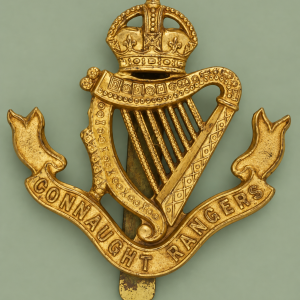
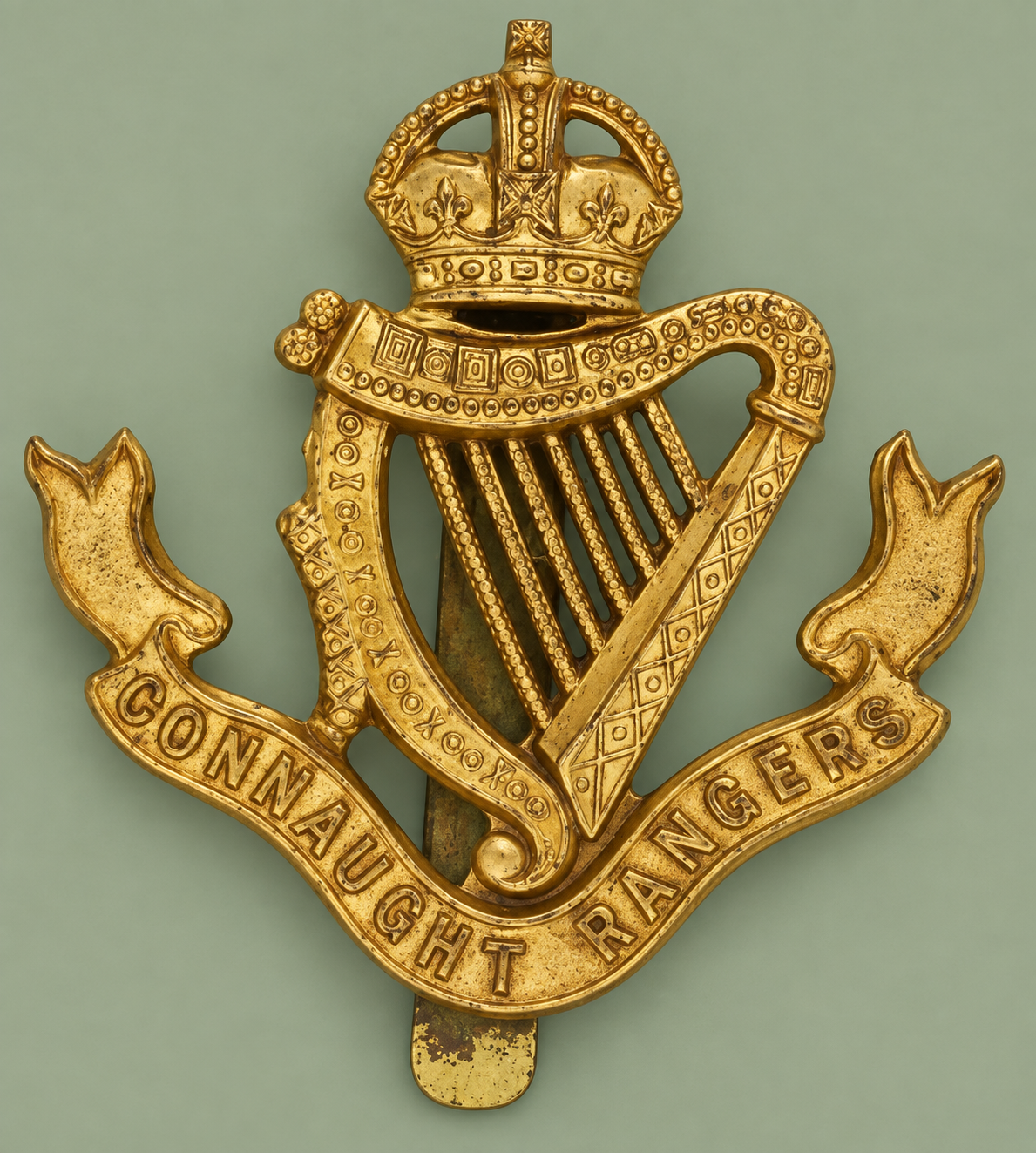
On 1 July 1881, the Childers Reforms united the 88th and 94th Regiments of Foot as the Connaught Rangers. The former 88th became the 1st Battalion and the 94th the 2nd Battalion, bringing with it an ancestry connected to the Scots Brigade that had served in the Netherlands. This gave the strongly Irish regiment a Scottish strand within its inheritance. Its depot was at Renmore Barracks in Galway, with a recruiting district covering Galway, Mayo, Roscommon, Sligo and Leitrim. These local connections helped make military service a family tradition, with successive generations joining a regiment familiar through relatives and neighbours. Its insignia combined the Irish harp with the royal crown, while the motto “Quis Separabit?” meant “Who shall separate us?” The familiar brass cap badge, bearing the harp beneath a crown and the regimental name on a curved scroll, became a treasured reminder of service.
Overseas postings continued after the amalgamation. A detachment of the 2nd Battalion served as camel-mounted infantry during the expedition attempting to relieve General Gordon at Khartoum in 1884–85, and the battalion later participated in the Dongola campaign in Sudan. The 1st Battalion served in South Africa during the Second Boer War of 1899–1902. One of the regiment’s best-known cultural associations emerged in August 1914, when men of the 2nd Battalion were reported singing “It’s a Long Way to Tipperary” at Boulogne. A newspaper account helped publicise the song, which became one of the most recognisable musical memories of the First World War.
When war began, the 2nd Battalion joined the original British Expeditionary Force in France, while the 1st arrived from India later in 1914. Heavy fighting soon inflicted devastating losses, and in December the depleted 2nd Battalion was absorbed into the 1st. The regiment eventually comprised six battalions: two regular, two reserve and two wartime service battalions. Four served overseas, while the reserve units trained and supplied replacements. Thousands of volunteers entered the ranks as the experienced soldiers of the pre-war army were lost in battle, bringing men from different backgrounds into a regiment whose identity remained firmly connected to Ireland.
Their service extended far beyond France and Belgium. The 1st Battalion fought on the Western Front before moving to Mesopotamia, modern-day Iraq, and later Palestine. The 5th endured the Gallipoli campaign in 1915, followed by service on the Salonika front and in Palestine. These theatres exposed soldiers to extremes of temperature, disease, difficult terrain and shortages as well as enemy fire. In 1918, the 5th transferred to France and participated in the closing Allied offensives, including fighting around Serain and Le Cateau in October. It survived the war and was redesignated as the regiment’s new 2nd Battalion in 1919.
The 6th Battalion served with the 16th Irish Division, fighting at Guillemont and Ginchy on the Somme in September 1916, then at Messines and during the Third Battle of Ypres in 1917. Among its soldiers was Private Thomas Hughes, awarded the Victoria Cross for bravery at Guillemont on 3 September 1916. Its eventual fate demonstrated the destructive scale of the conflict: after enormous losses during the German spring offensive of March 1918, the battalion was broken up and its surviving men transferred. The Connaught Rangers Association records that 13,431 men served in the regiment during the war and estimates that approximately 2,500 lost their lives. Behind those figures were families across Ireland and Britain, sometimes losing several men from the same household, with the regiment’s dead buried across numerous countries.
After the war came one of the most remarkable episodes in Irish military history. On 28 June 1920, soldiers of the 1st Battalion at Jullundur, now Jalandhar, in India refused military duties in protest against British actions in Ireland during the War of Independence. The protest spread to a detachment at Solon, now Solan, where an attempt to obtain rifles from the guarded armoury ended in gunfire and the deaths of Privates Patrick Smythe and Peter Sears. The mutiny was suppressed, and those involved faced courts martial and imprisonment. Private James Daly, a leading figure in the events at Solon, was executed by firing squad at Dagshai on 2 November 1920. He remains the last British Army soldier executed for mutiny. The episode exposed the strain that events in Ireland placed on men serving thousands of miles from home, and Daly’s death became an enduring part of the regiment’s memory.
The Connaught Rangers’ end followed the Anglo-Irish Treaty settlement and the decision to disband the southern Irish regiments. On 12 June 1922, their colours were laid up at Windsor Castle in the presence of King George V, and the regiment was formally disbanded on 31 July. Its disappearance formed part of the wider political settlement and Army reorganisation, rather than punishment for the mutiny. A military lineage reaching back to 1793 had ended after service across Europe, Africa, Asia and the Middle East. Its memory survives through family collections, medals, photographs, memorials and the Connaught Rangers Association, with a regimental display at King House in Boyle, County Roscommon. Remembered as “The Devil’s Own”, the regiment left a history of battlefield distinction, immense sacrifice and divided loyalties that continues to occupy a significant place in Irish and British military history.