Congo Leopard Camo
Few military uniforms are as immediately recognisable as the leopard spot camouflage worn in the country now called the Democratic Republic of Congo. With its dark rosettes scattered across brown and green cloth, it resembles an animal's coat more closely than the usual woodland patterns. Its
best-known military identity belongs to the Mobutu era, when the country was named Zaire between 1971 and 1997, and the leopard became closely associated with presidential power.The pattern emerged in Zaire during the early 1970s. Around 1973 is often given as its starting point, although a precise official adoption date is difficult to establish. Photographic research places it on senior officers by early 1974 and shows wider issue to the Kamanyola Division by the middle of the decade. These dates need not describe a single event: the first appearance of a cloth, its adoption by
officers and its distribution to whole units could occur at different times. Who actually developed it remains less certain. Early uniforms are reputed to have been manufactured in Belgium, but a securely documented individual designer has not been identified. Belgian manufacture should therefore not be confused with proof of Belgian invention. Related leopard spot patterns appeared elsewhere in Africa, including Chad and Libya, and some researchers suggest an earlier connection with neighbouring Congo-Brazzaville. That was a separate country, and the direction in
which these designs travelled remains open to debate. The choice fitted the political atmosphere of Mobutu's rule. After taking power in 1965, he promoted a programme of African authenticity intended to reshape the country's public identity. His familiar leopard-skin cap drew upon much older regional associations between the animal, chiefly authority and strength. It is tempting to describe the uniform as his personal creation, but the evidence supports an
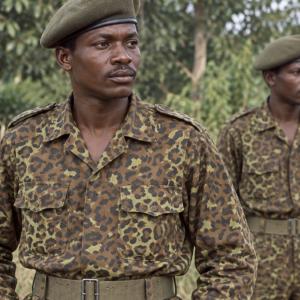
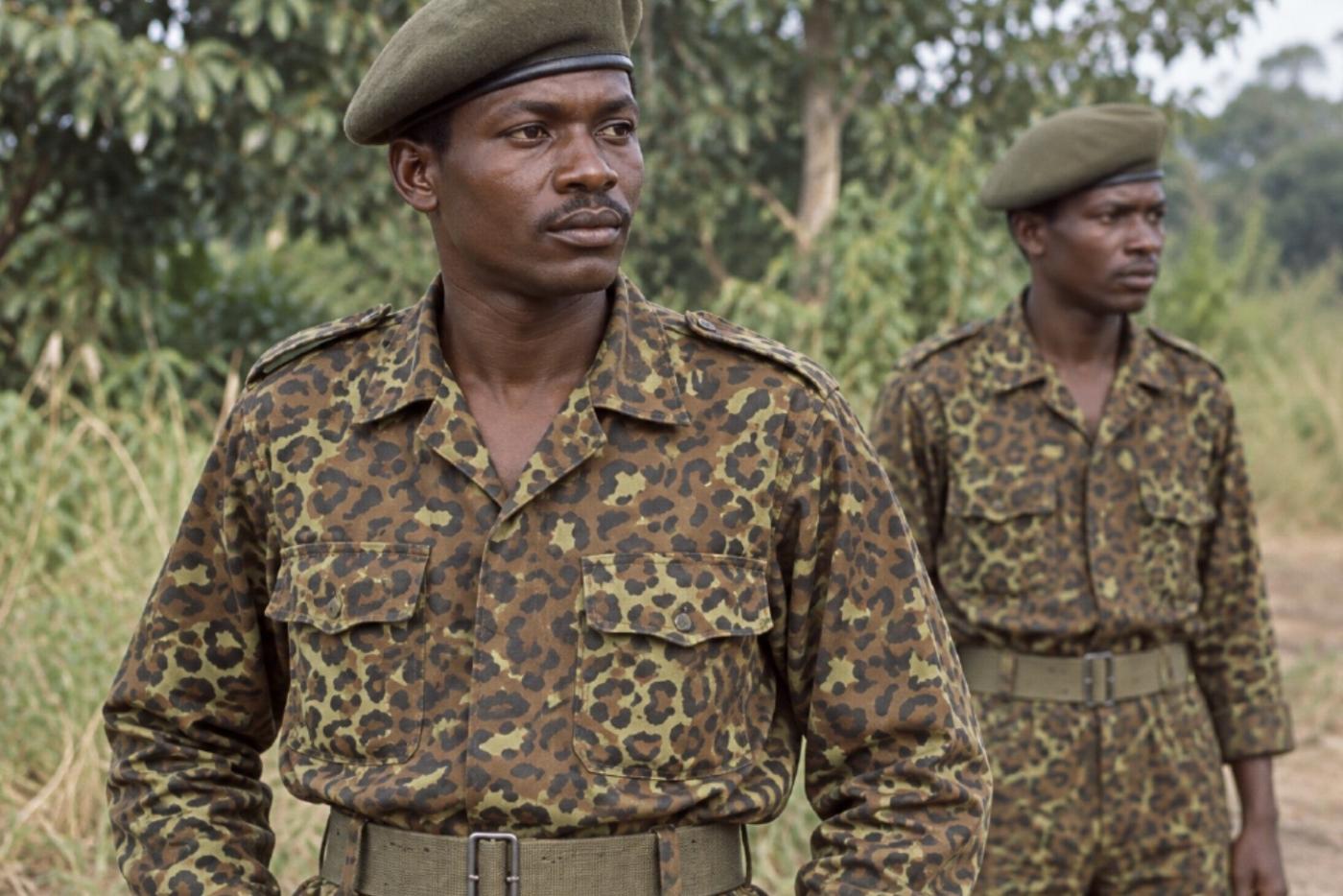
association with his image rather than a proven claim that he drew the pattern himself. The example shown here has irregular dark rings and broken spots over earthy brown and muted yellow-green areas. It is printed cloth rather than animal skin. The darker Zairean version differed from
some related African patterns, while variations in production and fading could change its appearance. As a camouflage concept, the small contrasting shapes can interrupt the surface of a uniform among vegetation and broken shadow. Its striking appearance alone, however, cannot establish how well it
concealed a soldier under field conditions. The formation most closely associated with it was the Kamanyola Division. The distinctive uniforms helped give its men a recognisable identity, and period photographs show leopard clothing worn with characteristic brimmed hats. On parade, white belts, gloves and gaiters could turn the same cloth into an especially conspicuous display. Its use was not confined to ceremonial occasions: photographs from
the Shaba fighting in 1977 show the division wearing it in the field. The pattern also became associated with commando training at Kota Koli, including foreign personnel attending courses there. Nevertheless, it never represented one universal uniform for every Zairean soldier. Belgian brushstroke and jigsaw, French-style lizard, plain green fatigues and other designs continued alongside it. Another potential source of confusion is the French expression tenue léopard,
which usually refers to striped lizard camouflage rather than these literal leopard spots. Leopard spot uniforms remained in sporadic use into the 1990s, and scattered examples survived among government troops and armed groups after Mobutu's fall in 1997. They are a reminder that military clothing can carry several meanings at once: concealment, unit identity and political symbolism. The pattern's origins are not fully documented, but its place in the visual history of Zaire is unmistakable. Few camouflage designs connect so directly with the image of a ruler and the era in
which his soldiers served.