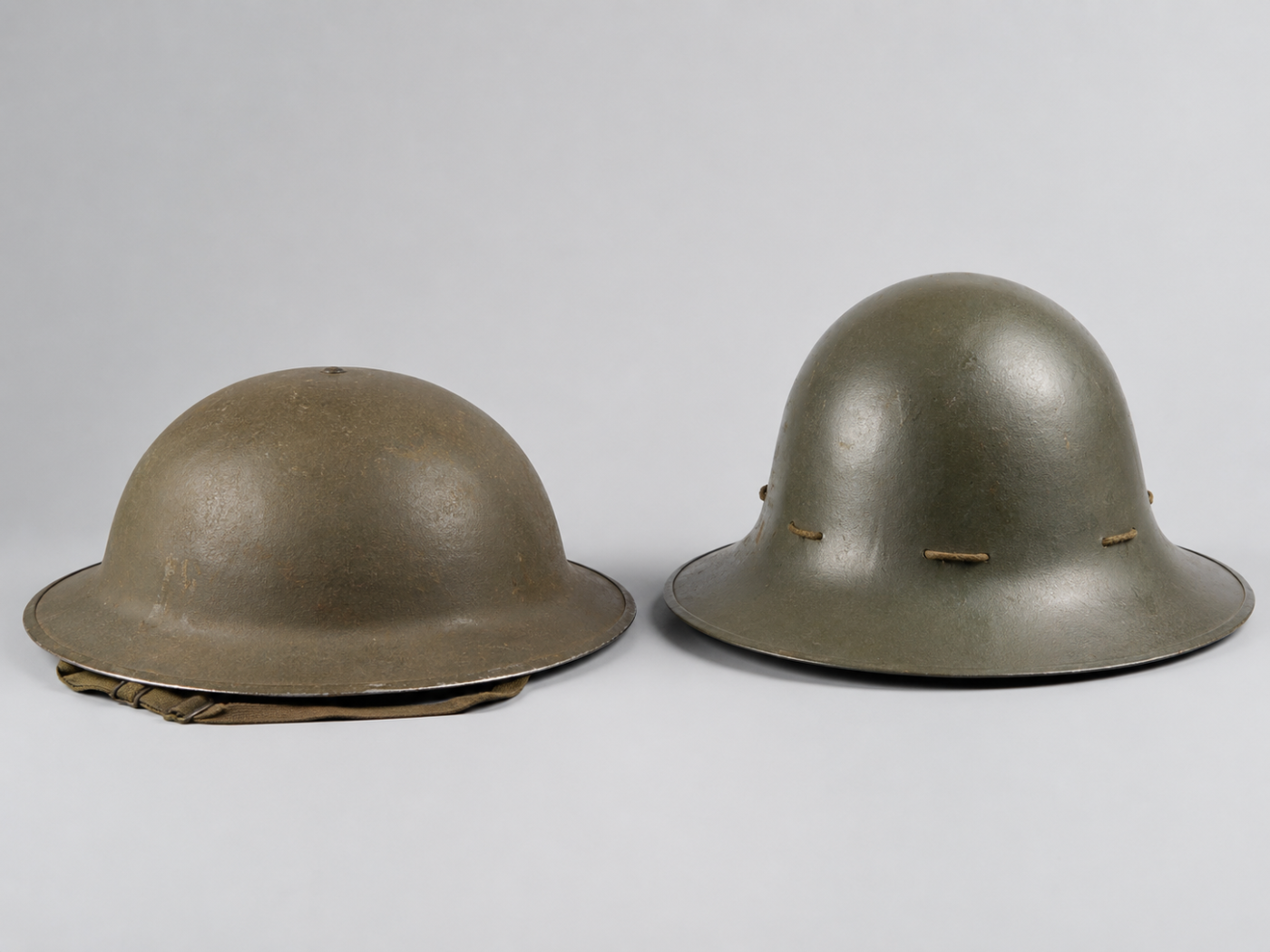
Brodie & Zuckerman Helmets
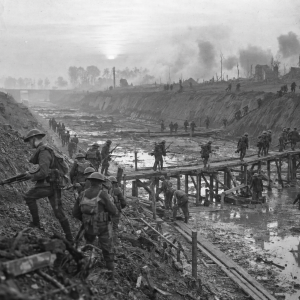
Few pieces of British military equipment are as instantly recognisable as the steel helmet known as the Brodie. Its wide brim and shallow bowl became a defining image of the First World War British soldier and remained in service, in modified forms, into the Second World War. During the Blitz it was worn not only by soldiers but also by ARP wardens, firefighters, police, rescue parties, ambulance crews and many other civil defence workers.
Although collectors often use “Brodie” for almost any British dish-shaped helmet, there were several distinct generations. The original Brodie appeared in 1915, followed by the improved Mark I in 1916. Surviving Mark I shells were later refurbished as the Mark I*, while the Mark II was introduced just before the Second World War. Alongside these were reduced-standard Home Front helmets and the separate Civilian Protective Helmet, the Zuckerman, which explains the variety seen in wartime photographs.
The need for such protection arose in 1914–15 when British troops, still wearing cloth caps, suffered severe head injuries from shell fragments and debris. France introduced steel helmets first, but Britain sought a simpler design suitable for mass production. John Leopold Brodie, a London-based inventor born Leopold Janno Braude in 1873, patented his helmet in 1915. Its key advantage was simplicity: it could be pressed from a single sheet of steel.
The wide brim acted like a steel umbrella, protecting against fragments falling from above, though it offered less protection from the sides. The earliest Type A helmets were made from mild steel, but production soon shifted to tougher manganese steel developed by Sir Robert Hadfield. This “Hadfield steel” contained about 12% manganese and was highly resistant to impact, though not intended to stop bullets—its purpose was to defeat shrapnel and debris.
The helmet’s simple form made it ideal for industrial production. Steel blanks were pressed into shape, trimmed, painted and fitted with liners and chinstraps. However, manganese steel was difficult to work, so production was spread across many firms including Joseph Sankey & Sons, Hadfields Ltd, William Beardmore & Co, and several Sheffield manufacturers. Steel suppliers such as Vickers and Thomas Firth & Sons also played key roles. These complex supply chains explain the coded markings found on surviving helmets, which are valuable for identifying origin and production batches.
In 1916 the design evolved into the Mark I, which added a rim and improved liner system. The liner was essential, creating a gap between head and steel to absorb impact. In 1917 a rubber “doughnut” ring was added for extra cushioning. Helmets were painted in dull khaki or green, often with textured finishes to reduce glare. Over seven million Brodie and Mark I helmets were produced during the First World War and used by British and Commonwealth forces, while the United States adopted a related design.
Large stocks remained after 1918 and were stored for future use. In the 1930s, as war loomed again, these were updated with improved liners to create the Mark I*. Some soldiers entered the Second World War still wearing First World War shells. The new Mark II, introduced just before the war, became the standard British helmet. It closely resembled the Mark I but included improvements such as a non-magnetic rim and modernised fittings.
Manufacture was again shared among major industrial firms such as Briggs Motor Bodies (BMB), Fisher & Ludlow (F&L) and Rubery Owen (RO&Co). Liners were often made separately, meaning shell and liner manufacturers frequently differed. Wartime production prioritised speed and supply over uniformity, resulting in mixed markings and components.
With the outbreak of war in 1939, helmet demand expanded far beyond the armed forces. ARP wardens, firefighters, rescue teams, police and factory workers all required protection. Helmets were painted and marked to identify roles: white helmets with a black “W” for wardens, and various colours and letters for other services. Local variations were common, making classification complex.
Only a few official Brodie-derived types existed—Type A, Type B, Mark I, Mark I* and Mark II—but within civil defence there were many variations. Some helmets were downgraded for non-combat use, sometimes marked with holes in the brim to indicate reduced specification. Others were made from lower-grade steel or repurposed military stock. Colour alone does not determine function, as helmets were frequently repainted during service.
The most distinct Home Front helmet was the Zuckerman, introduced in 1940. Designed by Solly Zuckerman, Derman Christopherson and Hugh Cairns, it was intended specifically for civilians facing falling debris during air raids. It was cheaper, deeper in shape and easier to produce than military helmets, with a simple liner system and widespread issue to civil defence workers and the public.
Strictly speaking, the Brodie refers only to the original 1915 design and its direct descendants. The Mark I, Mark I* and Mark II are military developments, while the Zuckerman is a separate civilian design. However, in common usage all are often grouped under the Brodie name.
The helmet was designed primarily to protect against fragmentation, not bullets. Its wide brim was effective against overhead shrapnel but left the sides more exposed, leading later to improved designs such as the Mark III “turtle” helmet introduced in 1944.
The Brodie’s success lay in its compatibility with British industry. Steel from Sheffield, pressed shells from motor body firms, liners from textile and leather manufacturers, and paint from chemical suppliers all combined into a single mass-produced item. A helmet might pass through several factories before reaching service.
For collectors, each helmet is a historical record. Rim stamps, liner markings, paint layers and even dents can reveal its journey through war and post-war use. Many were repainted or repurposed, and civil defence markings were functional rather than decorative, making authenticity dependent on careful examination.
From the trenches of the Western Front to the bombed streets of Britain, the Brodie helmet served two world wars. Its strength was not perfection but practicality: it could be made quickly, in vast numbers, and it saved countless lives from fragmentation and debris. More than a century later, it remains one of the most iconic symbols of British military history.