Black week of Bomber Losses
In October 1943, the American Eighth Air Force suffered a series of devastating losses that shook confidence in its daylight bombing campaign against Nazi Germany. Flying from airfields across East Anglia, its crews were sent against aircraft factories, shipyards, transport centres and other industries supporting the German war effort. The period remembered as “Black Week” ran from 8 to 14 October, rather than beginning on the 5th. Around 30 bombers were lost on several individual days, but by the end of the week 148 heavy bombers had failed to return, with further aircraft reaching England too badly damaged to repair.
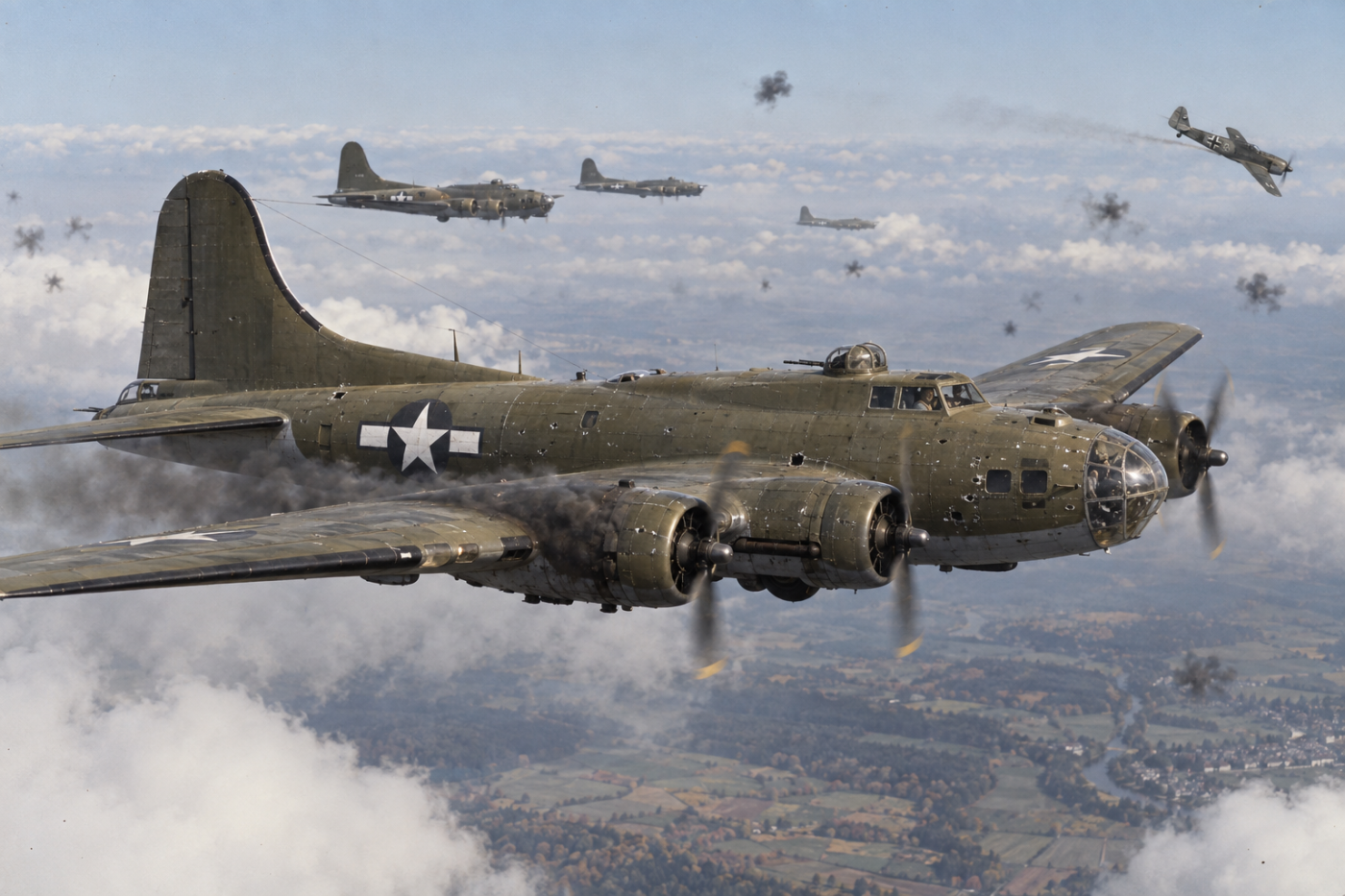
The disaster grew from a dangerous gap between American bombing theory and the realities of fighting over Germany. Before the war, planners had argued that heavily armed bombers, flying in close formations, could protect one another with overlapping machine-gun fire. By attacking in daylight, their bombardiers were expected to identify and destroy particular factories, weakening Germany’s ability to continue the war. However, the Luftwaffe had developed an effective defensive system combining radar, ground observers, fighter controllers and antiaircraft batteries. As American formations penetrated further inland, they encountered increasingly concentrated resistance.
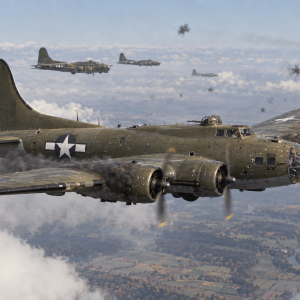
The principal aircraft were the Boeing B-17 Flying Fortress and Consolidated B-24 Liberator, both four-engined heavy bombers normally carrying ten men. These included the pilot, co-pilot, navigator and bombardier, together with the flight engineer, radio operator and gunners. The B-17 was the aircraft most closely associated with the week’s catastrophic losses, particularly over Münster and Schweinfurt, while B-24s also flew attacks and diversionary operations. Despite their defensive guns, neither type could reliably withstand determined fighter attacks without adequate escort.
Republic P-47 Thunderbolts and RAF Spitfires could accompany the bombers for only part of their journey. Although auxiliary fuel tanks were extending fighter range, continuous protection to distant targets and back was still unavailable. Once the escorts turned home, German pilots could concentrate on the bombers. The Americans’ formation tactics offered some protection, but any aircraft slowed by damage or engine trouble became especially vulnerable.
On 8 October, the offensive opened with attacks on Bremen and Vegesack. B-17s encountered fierce fighter opposition and heavy flak, while B-24s attacked the Vegesack area. Approximately 30 bombers failed to return. Many survivors came home with wounded men, damaged engines and shattered airframes, leaving ground crews struggling to prepare aircraft for the next operation.
On 9 October, another long mission sent formations towards Anklam, Marienburg, Danzig and Gdynia. The attack on the Focke-Wulf aircraft factory at Marienburg achieved considerable destruction, demonstrating what daylight bombing could accomplish under favourable conditions. Elsewhere, German fighters inflicted severe losses, particularly on bombers returning from Anklam. Another 28 heavy bombers failed to return, bringing the losses over two days to 58. Commanders nevertheless ordered another major operation for the following morning.
On 10 October, the target was Münster, an important railway centre serving the industrial Ruhr. The raid also struck the city centre and residential districts, causing heavy civilian casualties. For the American crews, it became another ordeal of repeated fighter attacks followed by flak over the target. Thirty B-17s were lost, bringing the three-day total to 88.
The 100th Bomb Group, based at Thorpe Abbotts in Norfolk, suffered particularly grievously. Of the thirteen Fortresses that continued into the Münster operation, twelve were lost. Only Royal Flush, flown by Lieutenant Robert “Rosie” Rosenthal, returned to the group’s base. Its survival, despite serious damage and wounded crewmen, became one of the best-known episodes in the history of the “Bloody Hundredth”. Behind every missing aircraft were men whose comrades could only hope they had managed to parachute to safety.
The final catastrophe came on 14 October, remembered as “Black Thursday”. The Eighth Air Force returned to the ball-bearing factories at Schweinfurt, hoping to disrupt production of components essential to aircraft, vehicles and industrial machinery. The B-17 formations again had to fly beyond effective fighter protection. German interceptors attacked repeatedly, while antiaircraft guns added to the destruction around the target. Sixty Fortresses failed to return from this single operation. The losses forced American commanders to curtail attacks beyond escort range and confront the urgent need for dependable long-range fighter cover.
The human cost needs careful explanation, because figures describing airmen as “lost” are often mistaken for deaths. A detailed study of the four major operations records eleven men initially reported killed and 1,499 missing. Subsequent investigation established that 490 of those missing had also died, giving a total of 501 airmen killed. Another 921 became prisoners of war, while smaller numbers evaded capture, were rescued or were interned in neutral countries. There were also 149 recorded wounded. These were individual airmen, rather than 501 complete crews.
Black Week exposed the limits of sending heavily armed bombers deep into enemy territory without continuous fighter support. The arrival of the long-range P-51 Mustang, alongside improvements in other escorts and changing fighter tactics, would help transform the campaign during 1944. For the men flying in October 1943, however, that protection lay in the future. Their courage had carried them through repeated orders to return to hostile skies, but courage alone could not