A-4 Skyhawk
The Douglas A-4 Skyhawk was one of the most successful and enduring light attack aircraft ever produced for the United States Navy and Marine Corps. Small, fast, remarkably agile and capable of carrying a weapons load that appeared completely out of proportion to its size, it became a familiar sight over Vietnam, served aboard American aircraft carriers for decades and was eventually operated by air forces and naval air arms around the world. Its success came largely from the philosophy of its designer, Ed Heinemann, who believed that military aircraft did not necessarily have to become larger, heavier and more complicated with every new generation.
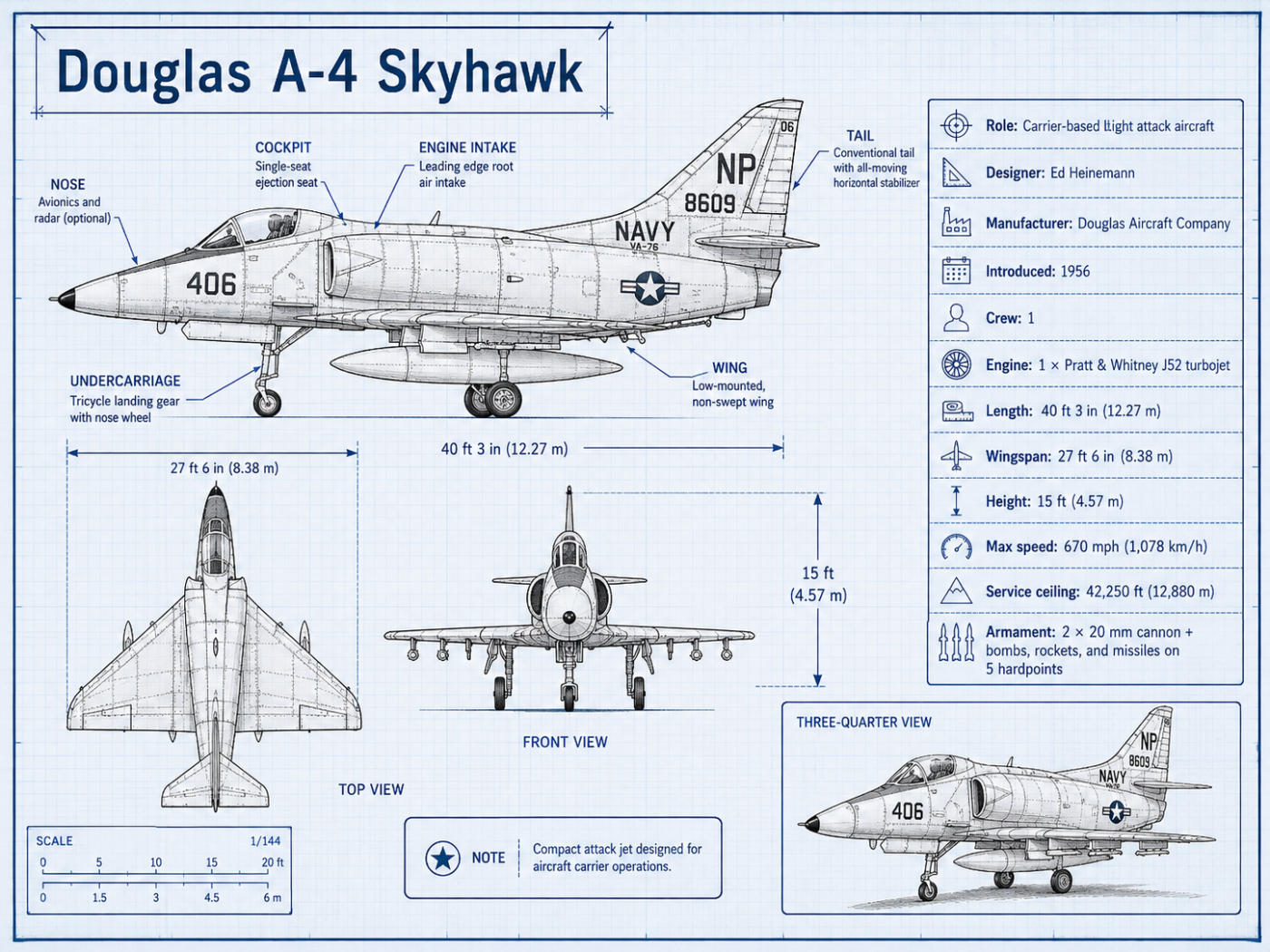
The aircraft was designed by a Douglas Aircraft Company team led by Edward Henry “Ed” Heinemann, one of America’s most respected aircraft designers. Heinemann had already been involved in a succession of successful military aircraft, including the Douglas SBD Dauntless and AD Skyraider. During the early 1950s he became increasingly concerned that new combat aircraft were becoming unnecessarily heavy and complex. His approach was therefore almost the opposite. He wanted an aircraft that was small, strong, straightforward to maintain and capable of carrying a considerable bomb load from an aircraft carrier. The resulting design was so compact that, unlike most carrier aircraft of the period, it did not require folding wings. Its wingspan was only around 27 feet 6 inches, allowing it to fit aboard carrier lifts and hangars without the additional weight and mechanical complexity of folding mechanisms.
The United States Navy awarded Douglas a contract for the prototype XA4D-1 on 12 June 1952. The first prototype, Bureau Number 137812, was constructed at Douglas Aircraft Company and made its maiden flight from Edwards Air Force Base in California on 22 June 1954, flown by test pilot Robert Rahn. The aircraft immediately demonstrated that Heinemann’s lightweight philosophy had considerable potential. The Navy had originally envisaged a considerably heavier attack aircraft, but the design came in at roughly half the proposed 30,000-pound gross-weight specification.
Initially known under the US Navy designation A4D, the aircraft became the A-4 under the unified American military aircraft designation system introduced in 1962. Early production aircraft were designated A4D-1, becoming the A-4A, followed by progressively improved A-4B, A-4C, A-4E, A-4F and other versions. Douglas Aircraft Company manufactured the aircraft, later becoming McDonnell Douglas after the 1967 merger. Production continued for approximately twenty-five years, and by the time the final aircraft was completed in 1979 a total of 2,960 had been built.
The first operational aircraft were delivered to US Navy Attack Squadron VA-72 in October 1956. Although designed primarily as a carrier-based attack aircraft, it quickly demonstrated remarkable versatility. Early versions were powered by the Wright J65 turbojet, while later and more powerful models such as the A-4E and A-4F used the Pratt & Whitney J52. The A-4E, for example, used a J52-P-6A producing approximately 8,500 pounds of thrust, with later variants receiving even more powerful engines.
Performance varied between versions, but a typical later aircraft could reach approximately 670 mph at sea level, placing it close to the speed of sound despite its relatively small engine and simple airframe. A US Navy A-4E specification gives a maximum speed of approximately 673 mph and a service ceiling of around 33,800 feet, although some versions could operate higher. Range could be extended by external fuel tanks or aerial refuelling. During development, a Navy pilot even set a world speed record over a 500-kilometre closed course at approximately 695 mph.
One of its most impressive characteristics was the amount of weaponry it could carry. The standard internal armament consisted of two 20 mm cannon mounted in the wing roots. Depending on the version, external stores were carried beneath the fuselage and wings. Earlier aircraft generally had three weapons stations, while the A-4E introduced two additional wing stations, giving a total of five and greatly increasing flexibility. A later configuration could carry as much as approximately 8,200 pounds of external ordnance, an extraordinary load for its size.
Typical combat loads included bombs, rockets, napalm and cluster munitions. It could also carry guided weapons such as the AGM-12 Bullpup, and later AIM-9 Sidewinder missiles for self-defence. Some versions were equipped to employ the AGM-65 Maverick. External fuel tanks were frequently carried because it was primarily intended for short, fast strike missions rather than long-range patrols.
The aircraft also had an important nuclear strike role. During the Cold War, the US Navy required carrier aircraft capable of delivering tactical nuclear weapons against Soviet and Warsaw Pact targets. Its speed, small size and carrier capability made it particularly suitable. It could approach at low altitude before performing loft or toss bombing, releasing a nuclear weapon while climbing steeply to escape the blast.
Conventional attack operations ultimately defined its combat reputation. Its most extensive American combat service came during the Vietnam War. US Navy units operated from carriers off the Vietnamese coast while Marine Corps aircraft frequently operated from land bases. They attacked bridges, roads, railways, military installations, supply depots and artillery positions throughout North and South Vietnam.
Its compact size made it difficult to detect, while its manoeuvrability allowed extremely low-altitude flight. However, this also exposed it to heavy anti-aircraft fire and surface-to-air missiles. Pilots often flew into some of the most heavily defended airspace in the world. Losses were significant, but the aircraft repeatedly demonstrated its ability to absorb damage and sometimes return safely despite severe battle damage.
Perhaps the most famous American associated with the aircraft was future US Senator John McCain. On 26 October 1967, he was flying an A-4E from USS Oriskany during a strike against Hanoi when his aircraft was hit by a surface-to-air missile. He ejected, was injured, and was captured, spending more than five years as a prisoner of war.
It also played a prominent role during the catastrophic fire aboard USS Forrestal on 29 July 1967. A rocket accidentally fired from an F-4 Phantom struck an A-4, igniting fuel and triggering explosions across the flight deck. The disaster killed 134 sailors and injured many more, becoming one of the worst carrier accidents since the Second World War.
Although designed for attack missions, its agility eventually gave it another role. The US Navy used it extensively as an aggressor aircraft to simulate enemy fighters during air-combat training, particularly Soviet-built MiG-17s. This role became closely associated with the TOPGUN school, where it proved a challenging opponent for much larger fighters.
Its handling qualities also led to its selection by the US Navy’s Blue Angels. Specially modified versions replaced the F-4 Phantom II in 1974. The smaller aircraft allowed extremely tight formations and remained in use with the team until 1986, making it familiar to millions of spectators.
The US Marine Corps became an equally enthusiastic operator. Later versions such as the A-4M were developed specifically for Marine requirements, featuring a more powerful engine producing approximately 11,200 pounds of thrust, improved cockpit visibility and upgraded avionics. The first A-4M flew in 1970, with 158 eventually produced.
It was also widely exported to countries including Australia, New Zealand, Israel, Argentina, Brazil, Kuwait and Singapore. Israeli aircraft saw extensive combat in the Middle East, particularly during the War of Attrition and the 1973 Yom Kippur War.
Argentina operated the aircraft during the 1982 Falklands War, where it attacked British naval forces at extremely low level. Several ships were hit, although Argentine squadrons suffered heavy losses from Sea Harriers, missiles and anti-aircraft fire. The conflict demonstrated that a design from the early 1950s could still threaten modern warships nearly thirty years later.
A useful feature was its ability to carry a “buddy” refuelling store, allowing one aircraft to refuel another in flight and giving carriers an organic tanker capability. Combined with external fuel tanks, this significantly extended operational range.
Pilots gave it affectionate nicknames such as “Scooter”, “Tinker Toy” and “Heinemann’s Hot Rod”, reflecting its small size and lively performance. Heinemann had deliberately stripped away unnecessary complexity, producing a rugged, inexpensive and easy-to-maintain aircraft capable of carrying a substantial weapons load.
Its basic dimensions highlight its compact design. An A-4E measured approximately 40 feet long with a wingspan of only 27 feet 6 inches and stood just over 15 feet high. Despite this, it could carry several tons of ordnance. It was always flown by a single pilot, although two-seat training versions were later developed.
Production ended in 1979 after 2,960 aircraft had been built. By then, aviation technology had advanced significantly, yet the design remained useful due to its low cost, reliability and manoeuvrability.
It continued in US service long after production ceased, serving as a trainer, aggressor and support aircraft. The US Navy finally retired its last examples in 2003, more than half a century after the original contract was awarded.
The aircraft remains a classic example of successful design through simplicity. Heinemann and his team created a compact carrier aircraft capable of delivering conventional and nuclear weapons, refuelling others, training pilots and performing demonstration roles. From Vietnam to the Middle East and the South Atlantic, it saw extraordinary service across multiple decades and conflicts.
Nearly 3,000 were built, and it remained effective long after its first flight in 1954. Small enough to avoid folding wings yet powerful enough to carry a heavy weapons load, it fully justified its reputation as one of the most distinctive and successful naval attack aircraft of the jet age.