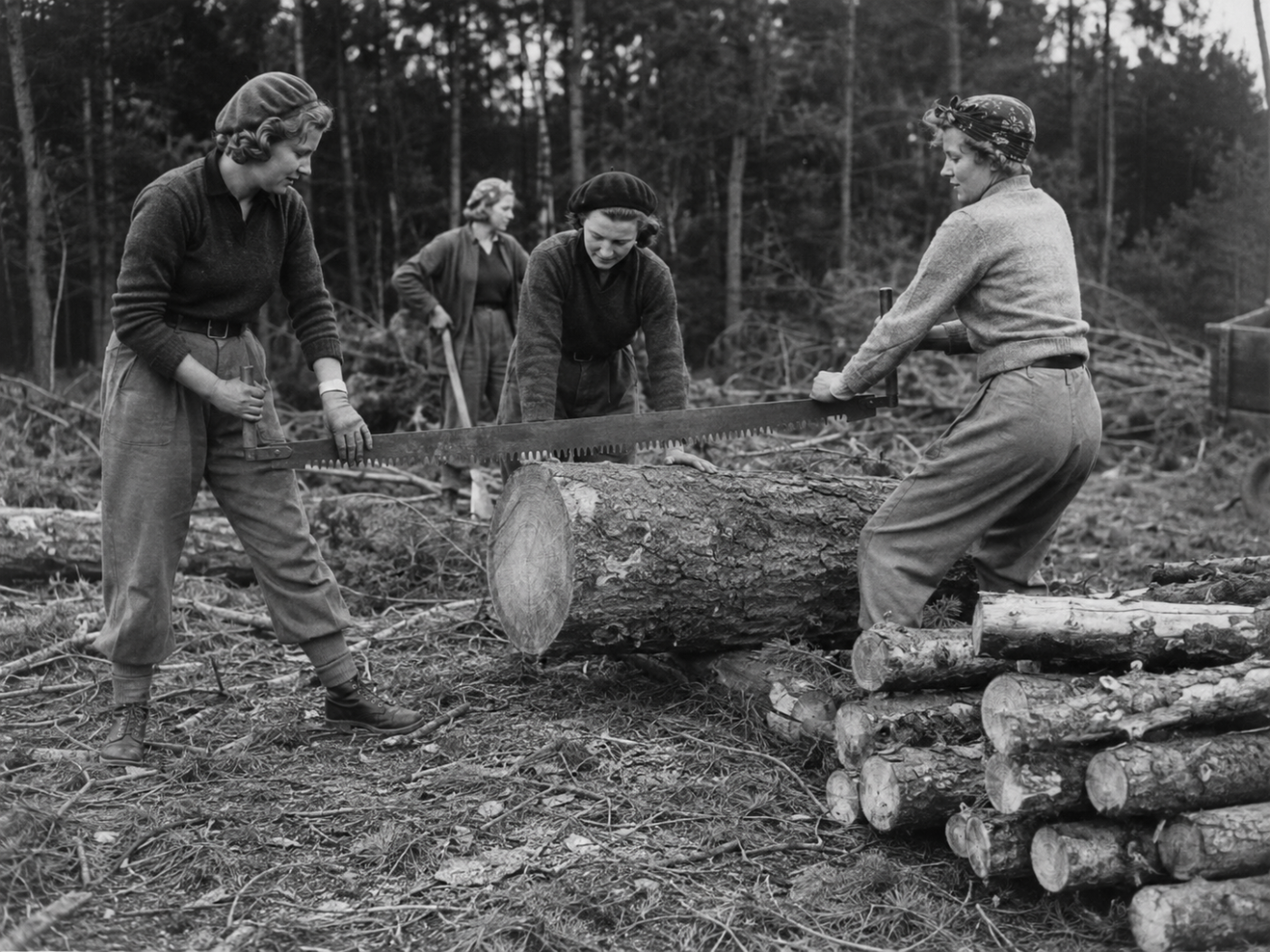
Woman’s Timber Corp
Few wartime jobs illustrate the extraordinary change in the lives of British women during the Second World War better than that of the “Lumberjills”, the young women who entered Britain’s forests with axes, crosscut saws and tractors and performed work which only a few years earlier had been regarded almost exclusively as a male occupation. Officially members of the Women’s Timber Corps, they became an essential part of Britain’s struggle to keep its mines, railways, factories and armed forces supplied during a period when timber was every bit as strategically important as coal, steel and food.
Britain entered the Second World War in a dangerously vulnerable position when it came to timber. For generations the country had relied heavily upon imported wood, particularly supplies brought across the Atlantic and from northern Europe. By the eve of war Britain was producing only a very small proportion of the timber it consumed at home. Once German U-boats began attacking merchant shipping, every ship carrying timber to Britain represented cargo space that might instead have been used for food, ammunition, fuel or weapons. Imported timber was bulky, occupied enormous amounts of shipping space and suddenly had to cross seas that had become a battlefield.
The obvious answer was to cut considerably more timber from Britain's own forests, estates and woodlands, but there was an immediate problem. Thousands of experienced foresters, lumbermen, drivers and sawmill workers had joined or been called into the armed forces. The very moment Britain desperately needed to increase domestic timber production was also the moment much of the traditional workforce disappeared.
Timber was needed almost everywhere. Britain’s coal mines consumed enormous quantities of pit props to support underground workings, and without coal the factories, railways, ships and power stations upon which the war effort depended could not function. Wood was required for railway sleepers, telegraph poles, military buildings, ammunition boxes, packing cases, ladders, road blocks and engineering works. Timber went into aircraft production and boat building, while wooden tracks and mats could be laid to help vehicles and heavy equipment move over difficult ground. Even charcoal made from timber had specialised wartime uses, including filtration equipment, and the demand ran into millions of tonnes.
Women had already demonstrated during the First World War that they could undertake forestry work, but many of the old prejudices had returned during the inter-war years. Forestry was still widely regarded as unsuitable for women because of the enormous physical effort involved. Felling a mature tree using an axe and a long crosscut saw was brutally demanding work, and once the tree was down it had to be stripped of its branches, cut into manageable lengths, measured, moved and eventually transported to a sawmill or railway siding. War gradually made such arguments irrelevant.
In April 1942 the Ministry of Supply established the Women’s Timber Corps in England, closely connected with the Women’s Land Army, and Scotland followed with its own organisation the following month. The women soon acquired a far more memorable name. They became the “Lumberjills”, the female counterpart of the lumberjack, and the name has remained associated with them ever since.
Most recruits were young. Seventeen was generally regarded as the minimum recruiting age and many of the women were in their late teens or early twenties, although accounts survive of considerably younger girls becoming involved in timber work. They arrived from almost every imaginable background. Some were country girls familiar with horses and outdoor work, but large numbers came from towns and cities and had never previously held an axe, driven a tractor or even spent much time in a forest. Secretaries, shop assistants, factory workers, hairdressers and office clerks suddenly found themselves wearing heavy boots and working miles from the nearest town.
They could not simply be handed an axe and sent into a wood. Forestry could be extremely dangerous, and training centres were established where recruits learned the basics before being posted to working forests. One of the best known was the training camp at Culford, near Bury St Edmunds in Suffolk. Other English training centres operated at Hereford, Wetherby in Yorkshire and Lydney in the Forest of Dean. In Scotland an important training establishment operated at Shandford Lodge near Brechin in Angus, while training was also carried out at Park House at Drumoak in Aberdeenshire. A typical training course lasted approximately four weeks, although the length varied according to the job for which a woman was being trained, and in that short period an inexperienced recruit could be introduced to felling, crosscutting, trimming branches, sawmilling, timber measurement and haulage.
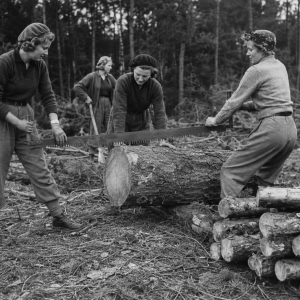
The most dramatic Lumberjill was perhaps the tree feller. Working in pairs, women learned how to determine which direction a tree should fall, cut the initial notch and then work a long two-person crosscut saw backwards and forwards through the trunk. Coordination mattered almost as much as physical strength, and experienced pairs developed a rhythm, allowing the teeth to do the cutting. Axes weighing several pounds were constantly sharpened and could be unforgiving in inexperienced hands. There were no chainsaws doing the bulk of the work and nothing resembling the protective equipment expected by modern forestry workers, so a misplaced axe, snapping branch or incorrectly felled tree could cause serious injury.
Felling was only the beginning. Once the tree crashed to the ground the branches had to be removed, a process known as snedding. The trunk was then crosscut into specified lengths depending upon its intended use. Pit props for coal mines required particular dimensions, while other trees might be destined to become poles, sleepers or sawn timber. Other Lumberjills became sawmill workers, operating machinery capable of inflicting terrible injuries in a fraction of a second. Some drove tractors and heavy timber vehicles, while others worked with horses used to drag felled trunks out of woodland where wheeled vehicles could not easily reach.
One of the less physically dramatic but extremely important jobs was that of the timber measurer. These women required a good head for mathematics. They inspected standing trees, estimated usable quantities of timber, measured felled trunks and calculated volumes. Their figures were important because timber was valuable government-controlled material and forestry workers were often paid according to the amount they produced. At training centres such as Culford, recruits could therefore find themselves sitting examinations and working through calculations as well as swinging axes, and the popular image of the Lumberjill as simply a woman cutting down trees only tells part of the story. The Corps required skilled measurers, clerks, drivers, sawyers and machine operators as well as fellers.
After training the women could be sent almost anywhere that timber was required. Lumberjills worked across England, Wales and Scotland, from Suffolk and the Forest of Dean to Yorkshire, Northumberland, the Lake District, Wales and the great forests and estates of Scotland. Rendlesham Forest in Suffolk became one documented wartime workplace, while women were photographed there operating portable saw equipment as late as July 1945. The Forest of Dean was another important centre of activity.
Scotland became particularly important because of its extensive forests and timber resources. Women were posted throughout Perthshire, Angus, Aberdeenshire, Inverness-shire, Moray and Argyll and into isolated Highland forestry camps. Some worked around Alyth near Dundee after training at Shandford Lodge, while others found themselves living in remote settlements many miles from the towns and families they had known. Conditions could be extremely primitive. Some women were placed in hostels or requisitioned houses, but others lived in wooden huts and forestry camps erected close to the trees being harvested, where heating could be poor, washing facilities basic and clothing permanently damp. A Lumberjill might begin work on a freezing winter morning with mud around her boots and finish the day covered in sawdust, resin and dirt.
The work did not stop because it was raining. Women felled timber in rain, snow, frost and summer heat, and a day could involve hours of swinging an axe, pulling a crosscut saw or lifting timber which was extremely heavy even when divided between several workers. Hands blistered and muscles hardened, and many recruits who arrived with little experience of physical labour became remarkably strong within months. The uniform helped give the Women’s Timber Corps a separate identity, with work shirts, jumpers, breeches or dungarees, stout footwear and distinctive forestry headgear, while the Timber Corps badge incorporated a fir tree beneath a crown. Wearing trousers itself represented a considerable change for some young women, and wartime necessity was quietly overturning social conventions alongside the trees.
Despite undertaking comparable work, women did not automatically receive comparable pay. Lumberjills could earn more than ordinary members of the Women’s Land Army because much forestry work was paid by results or piecework, but female forestry workers generally received less than men performing equivalent jobs. Depending upon job and output, wartime earnings might fall roughly between 35 and 50 shillings a week, with specialist measurers among those able to earn the higher rates. Yet many former members later remembered the period with extraordinary affection. For a young woman who had previously lived with her parents and rarely travelled beyond her home town, being posted hundreds of miles away could be frightening but also liberating. Friendships were formed quickly because the women depended upon one another, and they worked together, ate together and frequently lived together in isolated accommodation. After days of exhausting forestry work there were dances, local pubs, concerts and relationships with servicemen stationed nearby, and Canadian forestry troops also working in Britain, particularly in Scotland, led to friendships and romances, with some women eventually emigrating to Canada after marriage.
Their achievement becomes even more impressive when Britain's position at the beginning of the war is considered. Before hostilities Britain was dependent upon overseas sources for roughly 96 per cent of the timber it consumed. The nation could not instantly replace those imports simply by cutting its own woods, since forestry operates across decades rather than months and many plantations established after the First World War were still immature. Nevertheless, every usable British tree felled and processed reduced pressure on desperately needed merchant shipping. It is therefore difficult to assign a reliable percentage of Britain's total wartime timber requirement specifically to the Lumberjills. They were one part of a much larger home-grown timber operation which also included male British foresters, Canadian forestry units, Newfoundland and Honduran workers, prisoners of war and other labour, but the Women's Timber Corps became a major part of the workforce which allowed domestic production to be dramatically expanded at the precise moment Britain's overseas timber supply was under threat.
Their contribution to coal production alone was strategically important. A coal mine could consume enormous numbers of wooden pit props, and without them underground workings could not safely advance. No pit props meant less coal; less coal meant less electricity, reduced industrial production and fewer trains and ships operating. A tree felled by a nineteen-year-old Lumberjill in a Scottish forest could therefore eventually be supporting the roof of a coal seam hundreds of feet underground, helping to produce the fuel powering an armaments factory elsewhere in Britain, and that connection explains why forestry was genuinely war work.
The number of women who served is surprisingly difficult to state precisely. Contemporary administrative records and later historians have produced different totals, partly because of changes in organisation and differences between England, Wales and Scotland. Around 6,000 women is frequently quoted for the formal Women's Timber Corps, while broader modern forestry histories have suggested that as many as 18,000 women became trained or employed in aspects of wartime forestry. Whichever definition is used, thousands of young British women entered an industry previously dominated by men and demonstrated beyond doubt that they could perform the work.
They were also joined in Britain's forests by some remarkable groups of overseas workers. Canadian Forestry Corps personnel operated numerous camps, particularly in Scotland, and almost 900 volunteers from British Honduras crossed the Atlantic to help produce British timber, meaning forestry during the war became an international effort hidden away among Britain's trees.
Danger was constant. Trees weighing several tonnes could twist unexpectedly as they fell, heavy trunks rolled, axes slipped, and crosscut saws and sawmill machinery could remove fingers in an instant. Horses hauling timber could become difficult to control, while tractors operating on steep or muddy ground presented another hazard. There were none of the modern chainsaw trousers, high-visibility jackets, helmets, ear defenders and sophisticated protective equipment associated with professional forestry today, and the women learned primarily through instruction, discipline and experience. A mistake could be serious.
Perhaps the greatest measure of their success was that scepticism gradually disappeared. Forestry managers who initially doubted whether young women could handle the physical work discovered that properly trained women could fell, process, measure and move timber efficiently, and many Lumberjills became highly skilled forestry workers rather than temporary labourers. Some became so experienced that after the fighting in Europe ended women were sent into Germany to assist with recovering equipment from abandoned sawmills, an extraordinary conclusion for recruits who only a few years earlier might never have used an axe.
The war ended in Europe in May 1945, but timber work continued because Britain's needs did not disappear with Germany's surrender. The Women's Timber Corps survived into 1946 before finally being disbanded. There was no great victory parade for the Lumberjills. Women handed back their uniforms and returned to civilian life, many going into jobs that bore little resemblance to forestry, while others married and raised families and rarely spoke about their wartime service. Unlike members of the armed forces, they received no campaign medal for the years they had spent performing difficult and sometimes dangerous work, and for decades their contribution remained largely overshadowed by better-known stories of the Women's Land Army, the ATS, WAAF and WRNS.
Recognition came painfully slowly. A national campaign eventually led to surviving members of both the Women's Land Army and Women's Timber Corps receiving a special commemorative badge from the British Government in 2008, by which time more than six decades had passed since they had put away their axes and saws, and many thousands had already died without receiving official recognition. Memorials have also helped restore their place in history, including a striking memorial in Queen Elizabeth Forest Park near Aberfoyle depicting a Lumberjill at work.
Their story deserves to stand alongside those of the women in aircraft factories, munitions plants, farms, hospitals and military auxiliary services. The Lumberjills did not carry rifles and they did not serve on the battlefield, but the material they produced travelled throughout the British war machine, supporting coal mines, railway tracks, military buildings, telegraph poles, crates and engineering material. They also helped change Britain itself, proving that teenage girls and young women could master dangerous machinery, control horses, drive tractors, calculate timber volumes and swing an axe beside experienced male foresters, discovering independence and abilities their society had not expected.
Britain entered the war desperately dependent upon foreign timber and with much of its male forestry workforce disappearing into uniform. Hidden in forests from Suffolk to the Scottish Highlands, thousands of women helped fill that gap. In freezing rain, deep mud and summer heat they felled, stripped, measured, hauled and milled the trees Britain needed to continue fighting. They called them the Lumberjills, and for several crucial years these young women became part of the industrial lifeline that kept wartime Britain standing.