Wire of Death
German troops crossed into Belgium on 4 August 1914. The Belgian government had refused to allow the German army to march through the country towards France, and the invasion brought Belgium into the First World War. Liège, Brussels and most of the country were occupied during the following weeks. Antwerp remained an important centre of resistance until October, when the city fell after a German siege. The Belgian army withdrew behind the River Yser in the far west, leaving most Belgian civilians under German rule. The Netherlands remained neutral and mobilised its armed forces to defend its borders. When the fighting approached Antwerp, almost one million Belgians crossed into the Netherlands. Many later returned, but the frontier continued to offer the nearest route out of occupied Belgium.
Before the war, the Belgian-Dutch border had been open. Roads, fields and villages crossed it, while families lived and worked on both sides. German occupation changed its importance. Young Belgian men used the Netherlands as the first stage of a journey to Britain, France and the remaining Belgian army on the Yser. More than 30,000 Belgian war volunteers eventually followed this route. Allied intelligence organisations also operated from the Netherlands and used agents inside occupied Belgium to observe railway movements, military positions and German troop concentrations. Secret couriers carried reports north, while clandestine postal networks transported hundreds of thousands of letters between Belgian soldiers and their families. Smugglers moved food, fuel and other scarce goods, and German deserters also attempted to reach neutral territory. The German army could guard roads and railway crossings, but it did not have enough men to seal every field, forest and village path.
During the spring of 1915, the German authorities decided to close the frontier with an electrified barrier. Construction began in April and May and continued in separate sections. The system eventually stretched for roughly 300 kilometres from the area around Aachen and Vaals westwards towards the Scheldt and the coast. It did not always follow the exact international boundary. The Germans built it on Belgian territory and adjusted the route to rivers, roads, villages and the availability of electricity. Where the frontier followed an irregular course, the wire often took a shorter route. This left pockets of occupied Belgian territory between the barrier and the Netherlands. In several places it passed through communities whose inhabitants had previously crossed the border almost without noticing it. At Koewacht and Overslag, the barrier ran through the villages themselves.
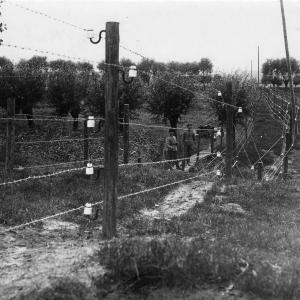
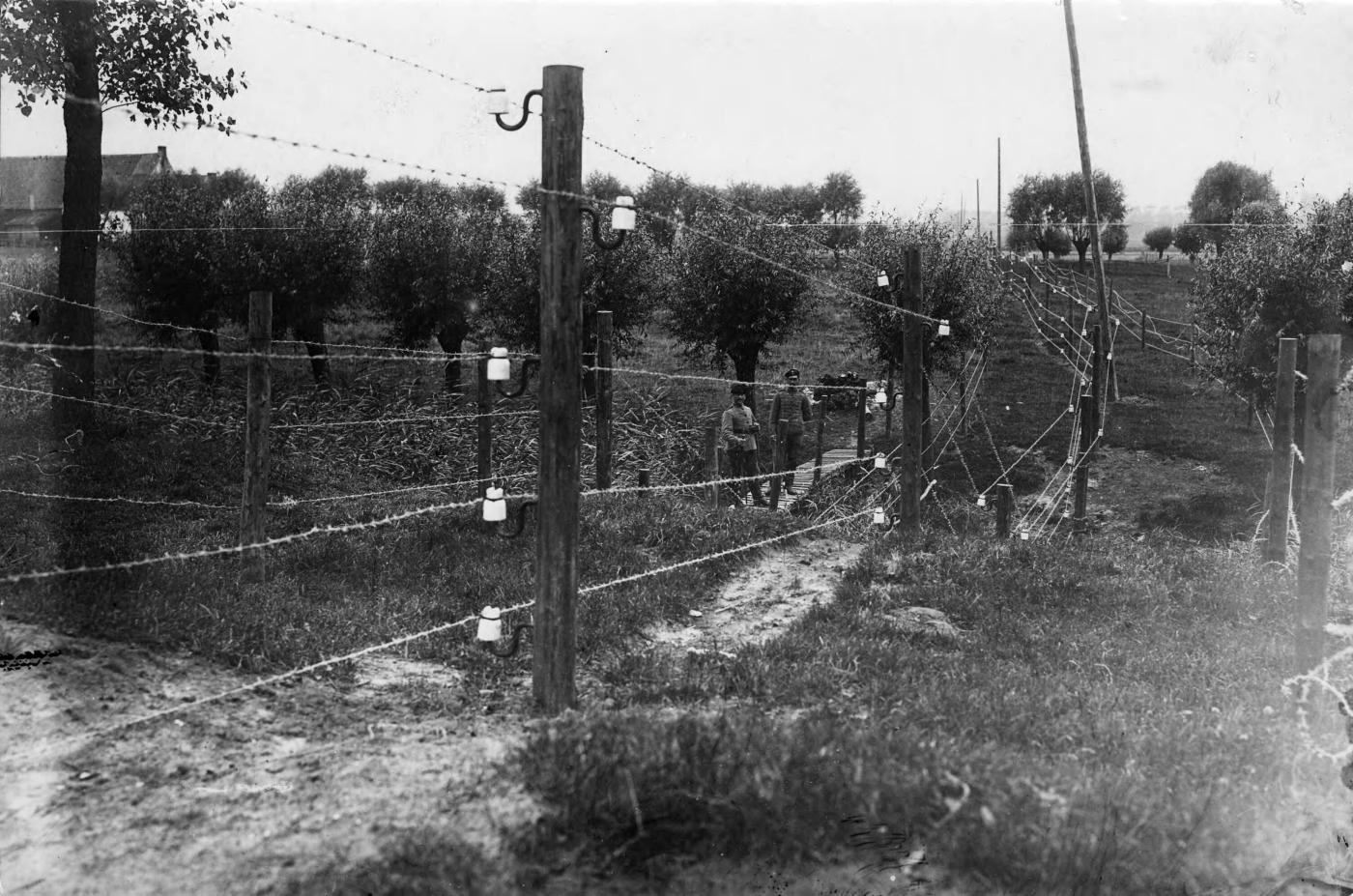
The barrier usually consisted of three parallel fences. The central fence carried a current of about 2,000 volts, while the fences on either side prevented people and animals from reaching it accidentally. The distance between the separate lines was generally between one and two metres, although the design differed from place to place. Wooden posts supported several horizontal wires attached to porcelain insulators. Some sections had four or five live wires; others had eight or more. The lowest strands were placed close to the ground to prevent anyone from crawling underneath. Factories and small generators supplied the electricity, which was distributed through wooden switching cabins placed along the route. German guards used these cabins to manage the power supply along the barrier.
The Germans cleared patrol paths beside the fences and established a restricted zone on the Belgian side. Landsturm soldiers, many of them older reservists, guarded the barrier day and night. Permanent posts watched roads, railways, canals and other likely crossing points. Signs warned of high voltage and mortal danger in Dutch, French and German. Electricity was still absent from many rural homes, and some inhabitants had little understanding of what the wires could do. The barrier looked less substantial than a brick wall or military fortification, but touching a live strand could cause death within seconds. Guards used hooks to remove animals killed by the current, while local newspapers reported people who had been found burned or trapped against the wires. The border soon became known as the Dodendraad, the Wire of Death, or more simply as De Draad: the Wire.
The wire changed daily life throughout the border region. Farmers needed German permits to reach fields near the restricted zone. Roads ended at guarded gates, and journeys that had once taken a few minutes now required official papers or long detours. Relatives who lived in neighbouring villages could no longer visit one another freely. At Achel Abbey, the barrier ran through the monastery grounds and separated the community from part of its property. Similar disruptions occurred along the entire route, where the German military had imposed a modern security system on a landscape shaped by generations of local movement.
The wire reduced border traffic, but it never stopped it. Professional guides known as passeurs studied the patrol schedules and searched for weaknesses. Bribing a German guard was often safer than approaching the live wires, although a change of patrol or the sudden appearance of an officer could turn an agreed crossing into an arrest. Other passeurs used bottomless wooden barrels, double ladders and specially constructed wooden frames. These devices were placed between or around the live strands, creating a narrow insulated passage through which a person could crawl. Some groups dug tunnels, crossed waterways or attempted to move over the fence with long ladders. Every method required time and calm. A hand placed against the wrong wire, a slipping frame or a frightened movement could kill the person crossing and anyone who tried to pull the body away.
Crossings usually took place at night. A guide first had to lead the group through the restricted area without being seen, then prepare the passage while German patrols might be only a short distance away. The people following him could include army volunteers, refugees, intelligence couriers, smugglers or escaped prisoners of war. Many had little experience of the equipment and depended entirely on the passeur. When a patrol discovered them, guards could open fire or force the group towards the barrier. German soldiers were also killed, sometimes while handling the electrical system and sometimes during confrontations with border crossers. Dutch soldiers and civilians on the neutral side faced their own dangers. The Dutch authorities guarded the frontier, arrested smugglers and interned foreign military personnel who entered the country, as required by the laws of neutrality. They could observe the German barrier from only a short distance away but had no authority to remove it because it stood inside Belgium.
The number of people killed remains uncertain. Records were incomplete, the Belgian press was censored and many deaths occurred at night in restricted areas. Some victims were electrocuted, while others were shot by guards near the barrier. Historian Alex Vanneste has listed more than 1,000 people who died at the fence. Other estimates have placed the total as high as 3,000, but the precise number remains unknown. The victims included Belgian civilians, German soldiers and deserters, Dutch inhabitants and escaped prisoners of war. Whatever the final total, the deaths were spread across hundreds of kilometres and more than three years. There was no single disaster that fixed the Wire of Death in public memory. Instead, the barrier killed through a long succession of individual accidents, failed escapes and encounters with German patrols.
Germany’s military position collapsed during the autumn of 1918. The Belgian army and its allies advanced from the Yser, while German troops withdrew eastwards. After the armistice came into effect on 11 November, the electricity was shut off. Local inhabitants began dismantling the barrier almost immediately. Wooden posts became building material or firewood, while the wire was reused around fields and pastures. Municipal authorities sold some sections, and the switching cabins disappeared. Within a short period, most physical traces of the system had been removed. The border reopened, and roads and paths that had been blocked since 1915 returned to local use.
Only small objects survived: porcelain insulators, warning signs, photographs and sections of wire kept by families or museums. Reconstructions now stand at several points along the former route, but the original barrier has almost completely vanished from the landscape. Its history shows how the First World War reached beyond the trenches of Flanders. The Netherlands remained neutral and most of the Belgian-Dutch frontier never became a battlefield, yet the border was shaped by military occupation, espionage, refugees and economic shortages. For more than three years, an ordinary-looking line of wire divided families, villages and two very different wartime worlds. On one side lay occupied Belgium. On the other stood a neutral country that appeared close enough to touch, but for many people could only be reached by passing through 2,000 volts.
Credits: Tom Dankers, Historian - Arnhems Oorlogsmuseum-40-45