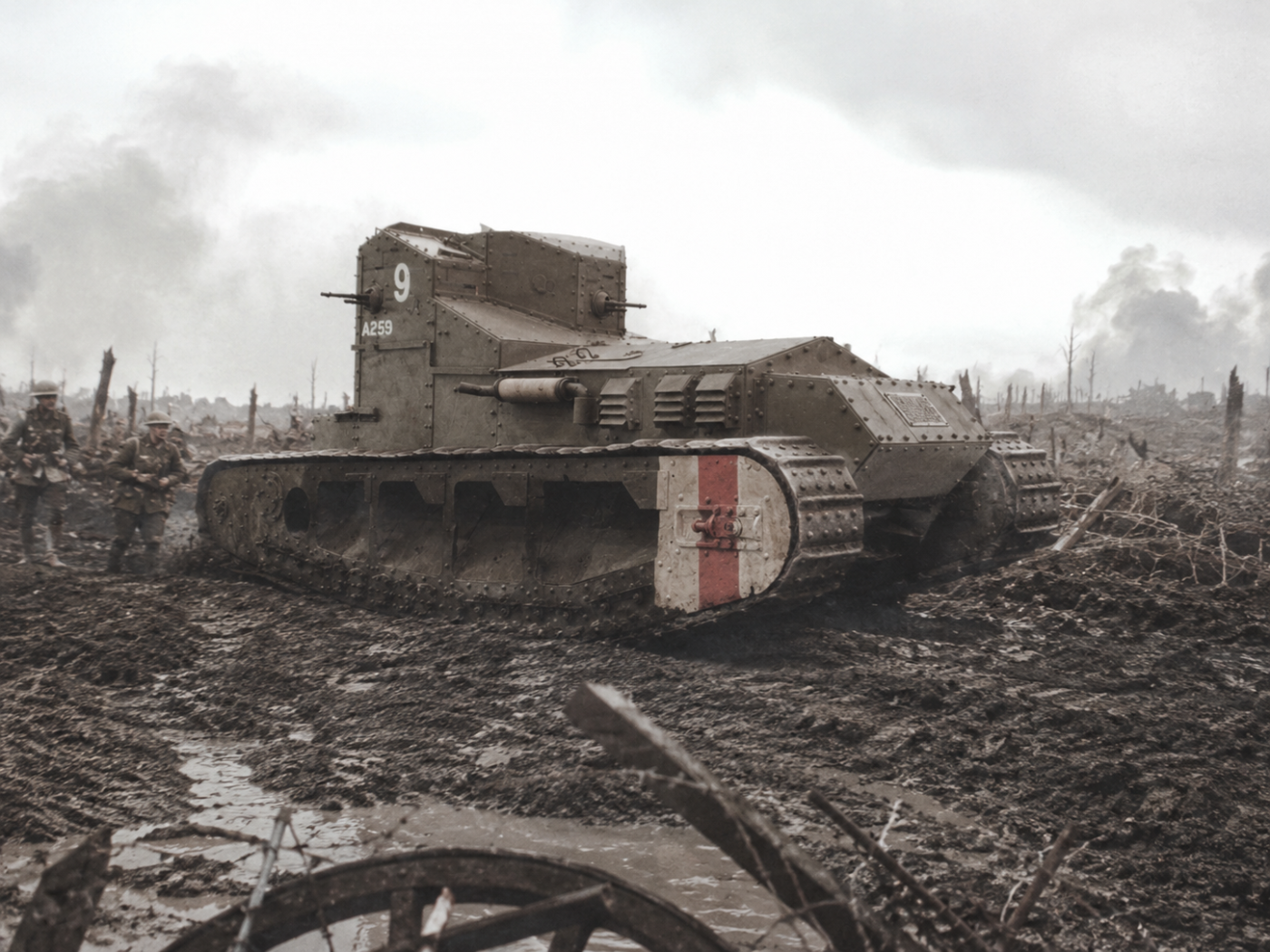
Whippet Tank
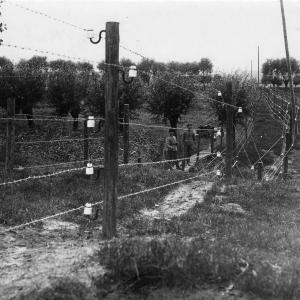
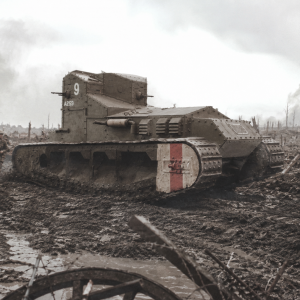
The Medium Mark A was one of the most distinctive British armoured vehicles of the First World War. Smaller, faster and more mobile than the heavy rhomboid tanks that first appeared on the Somme, it was developed to exploit breakthroughs, attack vulnerable positions behind the enemy line and restore a degree of movement to a battlefield dominated by trenches, shell holes and barbed wire.
The heavy British tanks introduced in 1916 had proved that armoured vehicles could cross trenches, crush wire and support infantry attacks, but they were slow, mechanically unreliable and unable to take advantage of a successful breakthrough. Once a section of the German line had been penetrated, there was often no armoured force fast enough to push into the rear areas before the defenders reorganised. British planners therefore began to consider a lighter and quicker machine that could operate alongside cavalry and infantry once the main defences had been breached.
The new medium tank was designed by William Tritton and his team at William Foster & Company in Lincoln. Tritton had already played a leading role in the development of Britain’s first tanks, including the early prototype known as Little Willie. Work began during 1916, and the first prototype was completed early in 1917. It was initially known as Tritton’s Chaser, a name reflecting its intended role as a fast pursuit vehicle.
Its official designation was Medium Mark A, although the nickname Whippet soon became widely used. The name was well chosen, as the vehicle was intended to act as the fast hunting dog of the British armoured force, moving through gaps created by the heavier machines and attacking enemy headquarters, artillery batteries, transport columns and infantry in the open.
Its layout was completely different from the large Mark IV and Mark V tanks. Instead of the tracks running around the entire hull, it used a more conventional arrangement with tracks on either side of a low central body. The fighting compartment was positioned at the rear, while the engines and fuel tanks occupied much of the front and centre. This gave the machine its distinctive back-heavy appearance.
It measured approximately 20 feet long, just over 8 feet wide and around 9 feet high. Its weight was about 14 tons, considerably less than the heavy British tanks, which could weigh close to 30 tons. The smaller size made it easier to transport and allowed greater speed, although it still had to cross the same devastated ground and deep trenches faced by all wartime armour.
Power was supplied by two 45-horsepower Tylor petrol engines. Each engine drove one track independently through its own gearbox and transmission. In theory, steering was achieved by adjusting the speed of the two engines, but the system was difficult to master. The driver had to coordinate separate throttles, clutches and controls, making the vehicle tiring and sometimes unpredictable to operate.
The twin-engine arrangement gave a top speed of around 8 miles per hour under favourable conditions. Although this sounds extremely slow today, it was roughly twice as fast as many contemporary heavy tanks. On shell-torn ground the actual speed was usually lower, but the Medium Mark A could still move more rapidly across firm terrain and carry out advances that would have been impossible for the earlier machines.
Its operational range was approximately 40 to 80 miles, depending on terrain, fuel consumption and mechanical condition. This greater range was important because it was expected to operate beyond the immediate front line. Once through the enemy defences, it could continue into areas where German troops were less protected and more vulnerable.
The normal crew consisted of three or four men: a commander, driver and one or two machine gunners. Conditions inside were extremely cramped. The commander might have to direct the vehicle, observe the battlefield and operate a weapon at the same time. Visibility was poor, communication difficult and the heat, fumes and noise could quickly exhaust the crew.
Armour protection varied from around 5 to 14 millimetres. The thickest plates covered the most exposed areas, while thinner armour was used elsewhere to reduce weight. This was usually sufficient to stop rifle and machine-gun bullets at ordinary combat distances, but it offered little protection against artillery shells, armour-piercing ammunition or direct hits from field guns.
The hull was built from armour plate riveted to a steel frame. Riveted construction was standard at the time, but it had a serious weakness. A heavy impact on the exterior could cause rivet heads or fragments of metal to break loose inside, injuring or killing crewmen even when the armour itself had not been penetrated.
Unlike later tanks, there was no rotating turret. The weapons were mounted in the fixed rear superstructure and fired through ball mountings or firing ports. Standard armament consisted of up to four .303-inch Hotchkiss machine guns positioned to cover the front, sides and rear.
The Hotchkiss used rigid metal ammunition strips, normally holding 30 rounds. It was air-cooled and compact, which made it suitable for use inside an armoured fighting compartment. However, the use of strips rather than belts meant frequent reloading. Handling them inside a cramped vehicle travelling over rough ground was difficult.
Although four guns could be carried, there were not enough men to operate them all at once. The weapons were arranged so that the gunners could move between firing positions according to the direction of the threat. This gave useful all-round coverage, but it did not match the efficiency of a rotating turret.
Machine-gun armament suited the intended role. The vehicle was not designed to fight enemy tanks or destroy heavily fortified positions. Its main targets were infantry, machine-gun teams, artillery crews, horse-drawn transport and troops moving in the open. Once behind the German line, it could create considerable confusion by attacking roads, headquarters and supply routes.
Approximately 200 examples were built, with production beginning in 1917. The first reached France before the end of that year, but their most important service came during 1918. By then, the British Army was using tanks in larger and better organised formations, supported by artillery, aircraft and infantry.
The type first saw major action during the German spring offensives of 1918. It was used to cover retreats, attack advancing infantry and protect exposed British positions. Its greater speed allowed it to respond more rapidly than the heavy tanks, although breakdowns and transmission failures remained a constant problem.
One of its most successful early actions took place near Cachy on 24 April 1918. British machines encountered German infantry advancing in the open and attacked at speed, using their machine guns against the exposed troops. The action demonstrated how effective fast armour could be when used against infantry without prepared anti-tank defences.
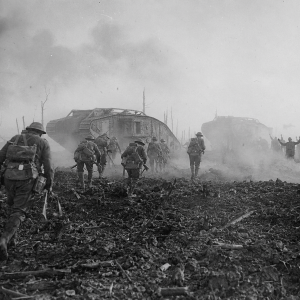
The Medium Mark A also played an important part in the Battle of Amiens on 8 August 1918, the opening day of the great Allied offensive that helped bring the war to an end. After heavy tanks and infantry broke through German positions, the faster vehicles moved into the rear areas, attacking artillery batteries, transport and retreating troops.
One machine, named Musical Box, became especially famous during the fighting. Commanded by Lieutenant Clement Arnold, it penetrated deep into German-held territory and operated for around nine hours behind the enemy line. The crew attacked infantry, transport and artillery positions before the tank was eventually disabled.
Musical Box reportedly travelled several miles beyond the main British advance and caused widespread disruption. Its crew continued fighting despite intense fire and a fuel leak. When the vehicle was finally hit, petrol caught fire and the surviving crewmen were forced to escape. The action became one of the clearest examples of the deep-raiding mission for which the design had been created.
These tanks were also expected to operate alongside cavalry. British planners still believed that mounted troops could exploit a major breakthrough, while fast armour would suppress machine guns and clear obstacles. In practice, the devastated battlefield often restricted both cavalry and tracked vehicles, but the idea pointed towards later methods of mobile warfare.
The interior was extremely uncomfortable. Crewmen worked close to the engines, fuel system, weapons and ammunition. Ventilation was poor, petrol fumes accumulated inside the hull and the noise made conversation almost impossible. Orders were often passed by shouting, gestures or physical contact.
Driving was particularly demanding. The driver looked through narrow vision slits and controlled the direction by carefully balancing the two engines. Even a small difference in engine speed could cause a sudden turn. On rough ground, the hull lurched violently and threw the crew against the metal interior.
There was no modern suspension system to absorb the shock of crossing broken terrain. The tracks ran over a series of small road wheels, and every impact was transmitted directly through the hull. Crews could suffer bruising, cuts and exhaustion simply from travelling inside for long periods.
The fuel system created another danger. Tanks and engines were positioned close to the crew compartment, and a penetrating hit could cause a serious fire. Men feared being trapped inside a burning hull, especially because the doors and hatches were small and difficult to reach in an emergency.
Despite these weaknesses, the design was generally more reliable than many heavier British tanks. Its engines and other components were based partly on commercial vehicle technology. The use of two separate power units also meant that limited movement was sometimes possible after one engine failed, although broken tracks and transmission faults remained common.
Several examples were captured by German forces. At least one was repaired and used for evaluation, allowing German engineers to study its construction and performance. Germany had produced very few tanks of its own, so captured Allied vehicles became an important source of experience.
After the Armistice, the type remained in British service for several years. Some were sent to Ireland during the War of Independence, while others were deployed during Allied intervention in the Russian Civil War. Vehicles supplied to White Russian forces were later captured and operated by the Red Army.
The Soviet Union used captured examples under the name Tyeilor, derived from the Tylor engines fitted to them. They remained in use during the early development of Soviet armoured forces and contributed to growing interest in fast tanks and mobile operations.
A small number were also exported. Japan obtained several for training and experimentation. The combination of speed and machine-gun firepower attracted countries attempting to develop their own armoured forces after the First World War.
Its greatest importance lay in the role it was created to perform. Heavy tanks were expected to smash through wire, trenches and strongpoints, while faster vehicles could move through the gap and attack communications, supplies and command positions. This was an early form of the exploitation tactics later associated with modern armoured warfare.
During the Second World War, fast tanks and mechanised formations would be used to penetrate deeply into enemy territory, cut supply routes and encircle opposing forces. The Medium Mark A was mechanically crude and difficult to control, but its battlefield purpose anticipated these later developments.
Its machine-gun-only armament also revealed an important weakness. The guns were highly effective against exposed infantry, but there was no cannon capable of dealing with enemy armour, concrete strongpoints or artillery from a safe distance. Future medium tanks would need a rotating turret and a more powerful main weapon.
The rear fighting compartment and forward engines further reduced visibility and crew efficiency. Later designs normally placed the driver in the front and used a central turret, giving the commander and gunner a much better view. Even so, its overall appearance and purpose were closer to later tanks than the huge rhomboid machines that had preceded it.
The Medium Mark A was therefore both an effective fighting vehicle and an important experiment. It provided the British Army with a faster armoured machine capable of operating beyond the immediate trench line, and its actions during 1918 demonstrated the potential value of speed, mobility and surprise.
It remained uncomfortable, lightly armed and difficult to drive, but in the hands of a determined crew it could cause disruption far beyond its modest size. The actions of Musical Box showed that a single armoured vehicle operating deep behind enemy positions could have a surprisingly powerful effect.
Today, surviving examples are extremely rare and are preserved in only a small number of museums. They remain a reminder of how quickly armoured warfare developed during the First World War. In only a few years, the tank evolved from a slow trench-crossing machine into a vehicle capable of pursuit, raiding and independent action.
This was not simply a smaller version of Britain’s heavy tanks. It represented a different idea of how armour could be used. Its speed was modest, its armour thin and its weapons limited to machine guns, but its role as a fast exploitation tank made it one of the most forward-looking armoured vehicles of the conflict.