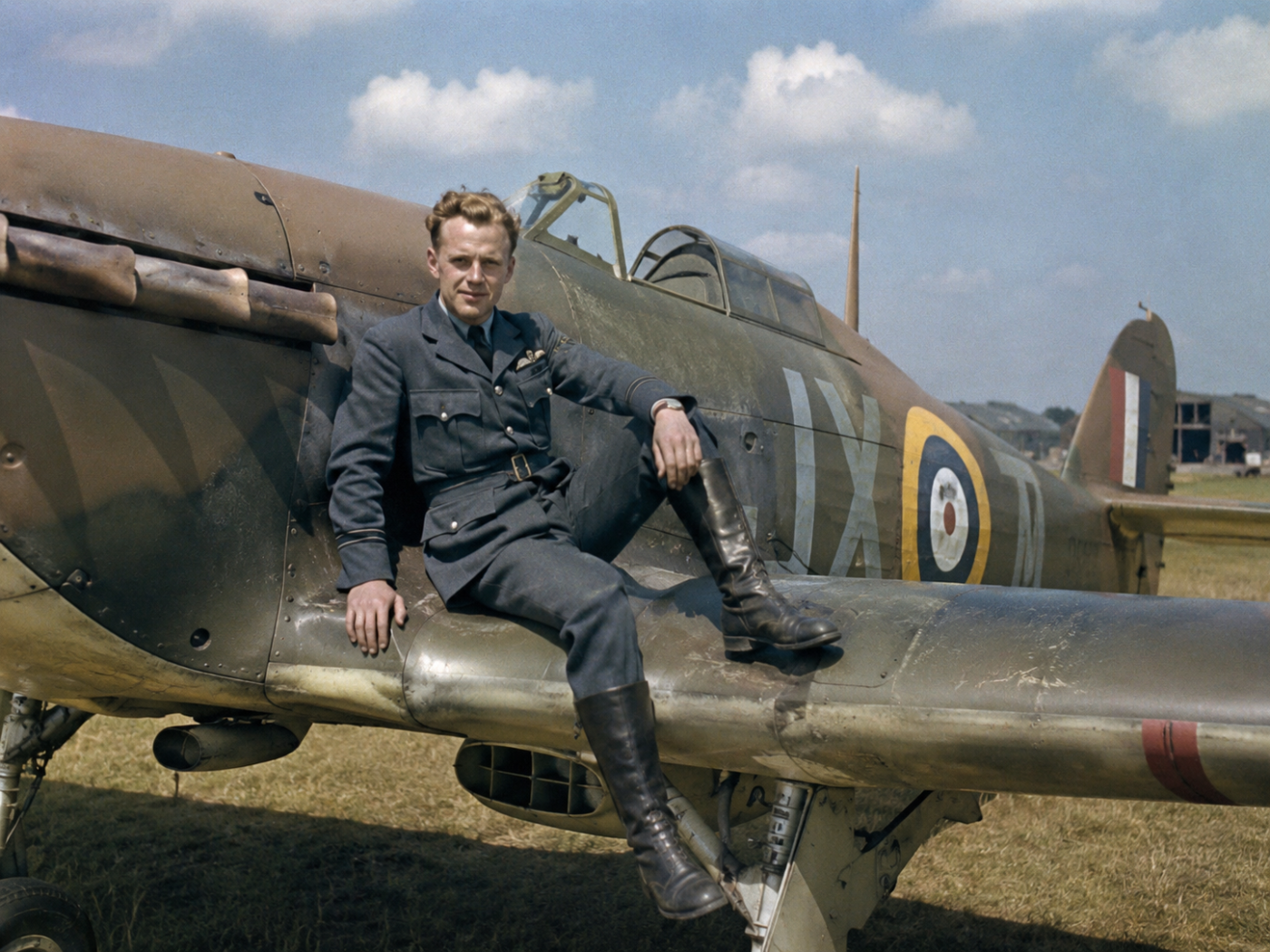
RAF Pilot Ray Holmes
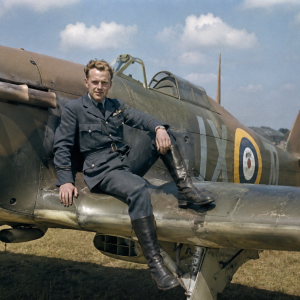
On 15 September 1940, the day that would become remembered as Battle of Britain Day, one of the most extraordinary individual actions of the entire campaign took place above central London. With his ammunition exhausted and a damaged German bomber continuing towards the heart of the capital, Sergeant Raymond “Ray” Holmes deliberately rammed the enemy aircraft with his Hawker Hurricane, cutting away its tail and bringing it down within sight of thousands of Londoners.
Raymond Towers Holmes had been born at Wallasey, Cheshire, on 20 August 1914. Before the war there was little to suggest that he would become one of the best-known fighter pilots of the Battle of Britain. He enjoyed sport and fast cars and worked as a crime reporter for the Birkenhead Advertiser. His introduction to military aviation came in 1936 when a friend suggested that he apply to the recently created Royal Air Force Volunteer Reserve.
Holmes successfully passed his medical and became only the 55th man to enlist in the new organisation. In February 1937 he travelled to Prestwick in Scotland to begin flying training. The RAF Volunteer Reserve allowed young civilian men to learn to fly part-time, creating a valuable pool of trained pilots who could be called upon should Britain go to war. When war came in September 1939, men such as Holmes suddenly found themselves preparing for frontline service.
He developed into a capable pilot and on 18 June 1940 was posted to RAF Wick in Scotland to join No. 504 (County of Nottingham) Squadron, flying the Hawker Hurricane. Within weeks the Battle of Britain was under way and the squadron moved south to RAF Hendon, placing Holmes directly in the struggle to defend London.
Sunday 15 September began quietly enough at Hendon. The pilots of No. 504 Squadron had been waiting at readiness, but with little enemy activity initially detected they were temporarily stood down. Holmes decided to return to the Sergeants’ Mess for a bath. Almost inevitably, he had hardly settled into it when the telephone rang. Radar stations on the south coast had detected a major German force forming over the Pas-de-Calais and approaching England.
Still wet, Holmes hurriedly pulled on a blue sports shirt and uniform trousers and rushed towards the airfield. A scramble order had already been given. He grabbed his life jacket and flying boots and ran to his Hurricane, serial P2725. At approximately 11.23 in the morning, less than five minutes after the alert, the Hurricanes of No. 504 Squadron were airborne.
The scale of the German attack was enormous. Adolf Hitler and the Luftwaffe leadership hoped that continued pressure against London would finally break RAF Fighter Command and establish the air superiority necessary for any invasion of Britain. During the day two major German formations were sent against the capital, consisting of large numbers of Dornier Do 17 and Heinkel He 111 bombers protected by hundreds of Messerschmitt fighters.
No. 504 Squadron was ordered to join No. 257 Squadron and the combined formation climbed towards London. At around 12.10 pm they encountered Dornier Do 17 bombers of Kampfgeschwader 76 at approximately 17,000 feet over south-east London. Their intended targets included important railway facilities and viaducts around Battersea.
For the 26-year-old Holmes it was his first major air combat. He immediately attacked a group of Dorniers separated from the main formation. During one attack oil suddenly covered his Hurricane's windscreen, temporarily obscuring his vision. The German aircraft he was attacking had reportedly been fitted with an experimental device intended to spray burning fuel towards pursuing fighters, but the equipment malfunctioned.
Once his windscreen cleared Holmes continued the fight. One Dornier, already badly damaged after attacks by RAF fighters, had fallen behind the German formation and was continuing across London. The aircraft was Dornier Do 17Z F1+FH of Kampfgeschwader 76.
The German bomber had suffered heavily. Several members of its crew had already abandoned it and its pilot, Feldwebel Robert Zehbe, came down by parachute. Zehbe was badly injured after landing and was taken into custody after being found by members of the Home Guard. He died from his injuries the following day, aged 26. Two members of the five-man crew survived the destruction of the aircraft and became prisoners of war.
Holmes positioned his Hurricane for another attack and pressed the firing button. Nothing happened. The eight Browning machine guns had exhausted their ammunition.
The damaged Dornier was still moving across central London.
Holmes now made an extraordinary decision. Rather than allow the bomber to continue, he decided to use the Hurricane itself as a weapon.
Closing rapidly from behind, he aimed his fighter towards the Dornier's rear fuselage. The Hurricane's wing struck the slender tail section of the German bomber with enormous force and sliced through it. The entire tail assembly was severed and the Dornier immediately broke apart above the centre of London.
Holmes later recalled that the German aircraft had appeared so lightly constructed that he believed his Hurricane could cut through it. His decision lasted only seconds, yet it created one of the defining images of the Battle of Britain.
The wreckage fell across London. The forward fuselage crashed close to Victoria Station while the separated tail section landed on a rooftop in Vauxhall Bridge Road. Parts of the falling aircraft were photographed and filmed, helping to make the incident famous almost immediately.
The story has often been told as Holmes deliberately preventing the Dornier from bombing Buckingham Palace. The damaged bomber certainly passed close to the Palace and bombs and incendiaries fell there as it broke apart, although later historical research has cautioned that it cannot be proved that Buckingham Palace was the aircraft's intended target. Its formation had originally been attacking railway targets around Battersea.
Two 110 lb bombs and incendiaries fell in the Palace area. One bomb penetrated the roof and entered a bathroom within the royal apartments but fortunately failed to explode. Another also failed to detonate, while incendiaries caused a fire in the grounds. King George VI and Queen Elizabeth were at Windsor at the time.
Holmes now faced his own fight for survival. The collision had seriously damaged the controls of P2725 and the Hurricane was no longer flyable. He abandoned the fighter over Pimlico and descended by parachute towards the densely built-up streets below.
In one of the more remarkable endings to an already extraordinary episode, he landed without serious injury in an open dustbin in the garden of a house in Hugh Street, Pimlico. His flying boots had disappeared during the descent. Looking up, he discovered two young women staring at the unexpected RAF pilot who had just fallen from the sky. Relieved to be alive, he reportedly climbed over the fence and kissed them both.
His Hurricane was less fortunate. P2725 plunged into Buckingham Palace Road at tremendous speed, leaving a deep crater in the roadway. Holmes made his way towards the crash site after contacting Hendon to report that he was safe. Surrounded by Londoners who had witnessed the aerial battle, he recovered a small fragment of the Hurricane's Rolls-Royce Merlin engine as a souvenir before being taken to the nearby Orange Brewery on Pimlico Road, where appreciative locals offered him a brandy.
The incident became famous because it had happened directly above the capital and had been witnessed by civilians on the ground. At a time when Britain was waiting anxiously to discover whether Fighter Command could survive, the sight of an RAF pilot deliberately using his own fighter to destroy an enemy bomber became a powerful symbol of determination.
Battle of Britain Day itself marked one of the Luftwaffe's largest attempts to overwhelm the defences of London. Hundreds of RAF fighters were committed to intercepting the German formations, and the intensity of the resistance demonstrated that Fighter Command remained far stronger than German intelligence had believed. Two days later, on 17 September, Hitler indefinitely postponed Operation Sea Lion, the proposed invasion of Britain.
Holmes' war did not end with his remarkable escape over London. He was later commissioned and in 1941 travelled to the Soviet Union with No. 151 Wing, where RAF personnel helped deliver Hurricanes and trained Soviet pilots to operate them. While serving there he also shot down a Messerschmitt Bf 109F.
Returning to Britain in December 1941, he became a flying instructor and spent much of the following years training new pilots. In February 1945 he returned to operational duties with No. 541 Squadron, flying high-altitude photographic reconnaissance missions in the Supermarine Spitfire Mk XIX deep over German territory. By the end of the war he had accumulated more than 2,000 flying hours and held the rank of Flight Lieutenant.
After leaving the RAF, Holmes returned to journalism in Liverpool, the profession he had followed before the war. More than six decades after his famous flight, his Hurricane was again brought into the public eye. In 2004 aviation archaeologists excavated the remains of P2725 from beneath Buckingham Palace Road, where much of the fighter had remained buried since September 1940.
Among the recovered objects was the Hurricane's control column. Holmes, then nearly 90 years old, was reunited with the very control column he had held during the fight over London. Remarkably, the gun button was reportedly still positioned at “FIRE”.
Ray Holmes died on 27 June 2005, aged 90. His long wartime career included service as a fighter pilot, instructor and reconnaissance pilot, but it was those few seconds above London on 15 September 1940 that ensured his place in Battle of Britain history. Out of ammunition, flying only yards from a German bomber and with almost no time to consider the consequences, a former newspaper reporter from Wallasey turned his Hurricane into his final weapon and rammed the enemy aircraft from the sky.