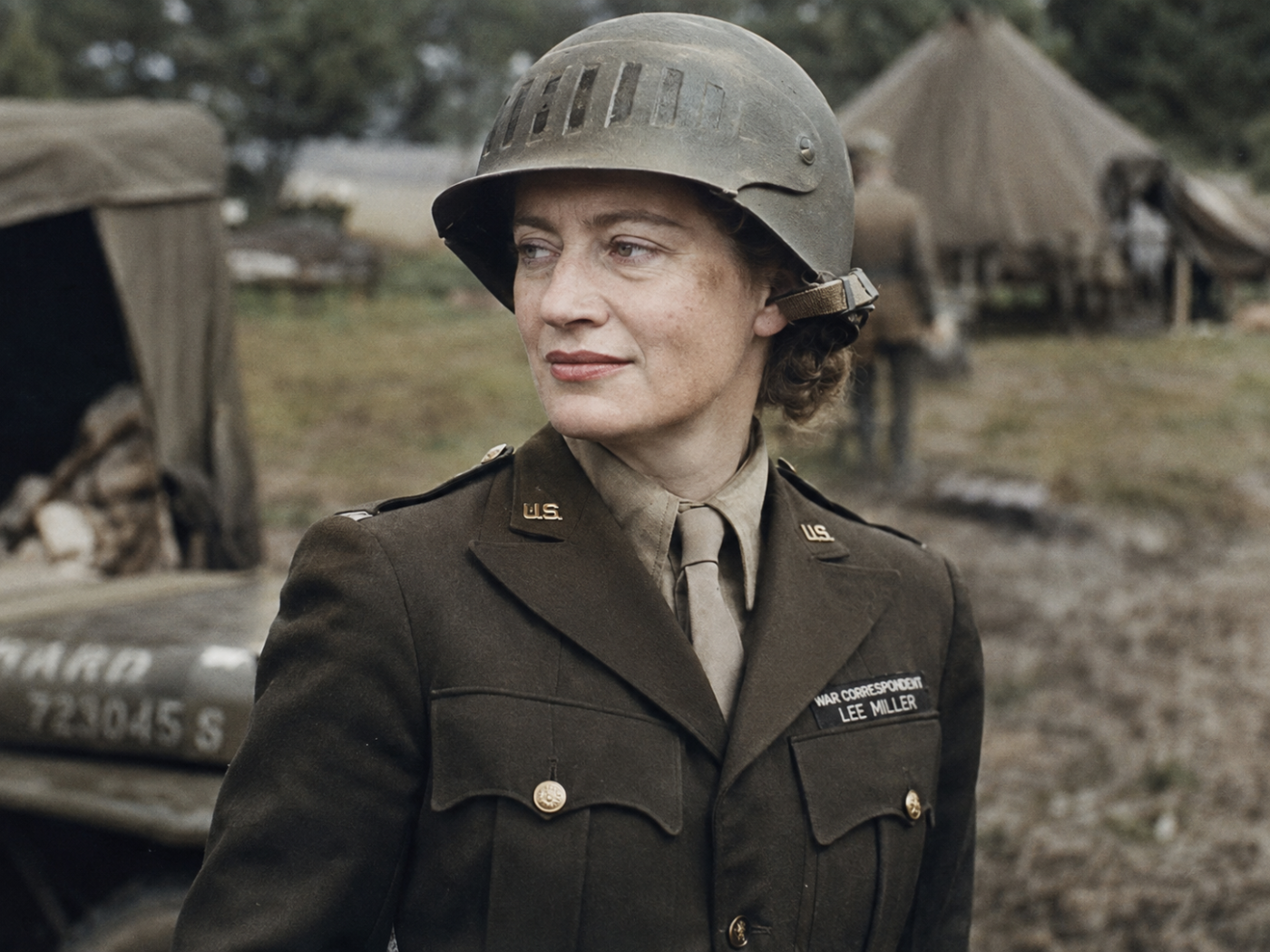
Photographer Lee Miller
Elizabeth “Lee” Miller became one of the most remarkable photographers of the Second World War, yet her route to the battlefields of Europe could hardly have been more unusual. Before she photographed ruined cities, exhausted soldiers and the victims of Nazi concentration camps, Lee had been a successful American fashion model, a Surrealist photographer in Paris and a familiar figure in the pages of Vogue. By 1945 she was travelling with the advancing Allied armies through Germany, recording scenes at Buchenwald and Dachau that would become some of the most disturbing photographic evidence of Nazi brutality. The experiences changed her profoundly, and after the war she largely turned her back on the career that had taken her into some of the darkest places in Europe.
Born on 23 April 1907 in Poughkeepsie, New York, Lee grew up around photography. Her father, Theodore, was a keen amateur photographer and from an early age she became familiar with cameras, developing and the creation of photographic images. As a young woman she travelled to Paris to study theatre design before returning to New York. Her life changed dramatically in 1927 when she entered the world of high fashion. She appeared on the cover of American Vogue and was photographed by some of the leading photographers of the period, including Edward Steichen, Arnold Genthe and George Hoyningen-Huene. She possessed the striking appearance demanded by the fashion industry, but quickly became more interested in what was happening behind the camera than in simply standing in front of it.
In 1929 she returned to Paris determined to learn photography and sought out the American Surrealist photographer Man Ray. She became his assistant, model, collaborator and partner, while also developing as a photographer in her own right. Their experimentation helped popularise the technique known as solarisation, in which areas of an image appear partially reversed in tone, producing the glowing outlines associated with Surrealist photography. Lee established her own studio in Paris and began producing fashion photographs, portraits and experimental work. By the time she returned to New York in 1932 she was no longer simply the former Vogue model; she was an accomplished professional capable of running her own successful studio.
She married the Egyptian businessman Aziz Eloui Bey in 1934 and moved to Cairo. Away from the commercial pressures of New York she photographed the Egyptian landscape and desert, producing some of her most imaginative pre-war work. During a visit to Europe in 1937 she met the British Surrealist painter and writer Roland Penrose, with whom she formed a relationship. In 1939 she left Egypt and moved to Britain to live with Penrose. Europe was approaching war, and when Britain declared war on Germany in September 1939 she chose to remain in London rather than return to the safety of the United States.
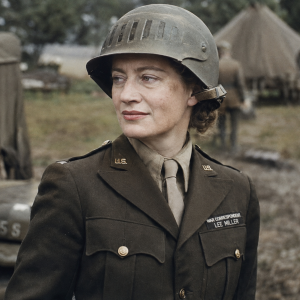
That decision eventually transformed her career. Lee began working for British Vogue, initially in the studio, but the war gradually pushed the magazine far beyond conventional fashion photography. Clothing rationing, women entering military and industrial employment and the bombing of British cities all became part of its wartime coverage. She photographed women serving with organisations including the Women’s Royal Naval Service and Auxiliary Territorial Service, while also documenting London during the Blitz. Her photographs combined the eye of a fashion photographer with an increasing interest in ordinary people living through extraordinary circumstances.
On 30 December 1942 she received accreditation as an American war correspondent, encouraged in part by her friend David E. Scherman, a photographer working for LIFE magazine. The accreditation gave her access to American military personnel and installations, although female correspondents faced restrictions that did not normally apply to their male colleagues. Women were generally expected to remain away from actual combat. Lee increasingly ignored the spirit, and occasionally the letter, of those restrictions. She wanted to photograph the war rather than merely report from behind it.
She crossed to Normandy in July 1944, approximately a month after D-Day. Her first assignment involved photographing American nurses working in a field hospital near Omaha Beach. Soon afterwards she travelled to the heavily defended French port of Saint-Malo, believing that she was being sent to cover events behind the fighting. Instead she arrived while the battle was still raging. The photographer found herself under artillery and small-arms fire and became one of the very few female correspondents to photograph combat at such close quarters. She recorded soldiers, destroyed buildings and the brutal reality of fighting at close range. Her presence breached the restrictions placed on female correspondents, and when the American authorities discovered what she had done she was temporarily placed under arrest.
Rather than discouraging her, Saint-Malo confirmed her as a genuine combat correspondent. She went on to photograph the liberation of Paris in August 1944 and followed Allied forces as they advanced through France, Belgium and Luxembourg. Her camera recorded liberation celebrations but also the uglier aftermath of occupation. She photographed suspected collaborators, including French women whose heads had been shaved as punishment for relationships or cooperation with German soldiers. These were not romanticised pictures of victory. She increasingly photographed war as she found it: damaged buildings, exhausted troops, prisoners, civilians, revenge, hunger and death.
During the winter of 1944–45 she continued following American forces through bitter fighting in Alsace and other areas close to the German frontier. Conditions were freezing and miserable, and her written reports were often as powerful as her photographs. She was not simply pressing a shutter; she sent lengthy dispatches back to Vogue describing what she had seen. As the Allied armies entered Germany in the spring of 1945, however, she encountered something beyond the normal destruction of conventional warfare.
The liberation of the concentration camps revealed the industrial scale of Nazi persecution and murder. Lee visited Buchenwald and then Dachau with the advancing American forces. At Buchenwald she photographed emaciated survivors, prisoners who had endured starvation and brutality, and the evidence of mass death left behind by the SS. At Dachau the scenes were equally horrific. The camp had been liberated by American troops on 29 April 1945, and she arrived during the immediate aftermath. Among the sights confronting photographers and soldiers were corpses, crematoria, skeletal prisoners and railway wagons containing the bodies of prisoners who had died during transport to the camp. She did not turn her camera away.
These concentration-camp photographs are among the most important images of her career precisely because they are so uncompromising. She had spent years producing beautifully controlled fashion photographs, yet at Buchenwald and Dachau she used the same understanding of composition to create images whose purpose was not beauty but evidence. They showed people in America and Britain what words alone struggled to convey. The camps were not rumours or distant propaganda stories; here were photographs taken by an American journalist standing inside them as Allied troops arrived. Her work helped establish a visual record that could not easily be dismissed or denied.
The effect on her personally was enormous. Only hours after returning from Dachau on 30 April 1945, she and David Scherman entered Adolf Hitler’s apartment in Munich. There they created one of the most famous photographs associated with her: Lee sitting naked in Hitler’s bathtub. A portrait of Hitler was positioned beside the bath, while her military boots were deliberately left on the bathmat. Those boots had carried the dirt of Dachau into the private home of the man responsible for the regime she had just witnessed. The photograph can initially appear almost humorous or provocative, but its context makes it much darker. She had gone directly from a concentration camp filled with suffering and death into Hitler’s comfortable Munich apartment. The image became an extraordinary symbolic act of contempt towards the defeated dictator. Hitler himself committed suicide in Berlin that same day.
She continued working after Germany’s defeat, travelling deeper into central and eastern Europe and photographing a continent shattered by six years of war. She documented ruined communities, displaced civilians, desperately hungry children in Vienna and conditions in Hungary and Romania. She also photographed the execution of former Hungarian prime minister László Bárdossy. The glamorous New York model of the late 1920s had by this stage witnessed bombardment, frontline fighting, dead soldiers, civilian suffering, concentration camps and executions. Few photographers of either *blocked text* experienced such a remarkable journey through the European war.
The end of the fighting did not mean she could simply return to her earlier life. The psychological consequences of what she had witnessed followed her home. She rarely spoke openly about many of her wartime experiences and suffered considerable emotional difficulties in the years afterwards. Modern accounts of her life have frequently connected her post-war depression and heavy drinking with the trauma she experienced during the conflict, although at the time the psychological effects suffered by war correspondents were poorly understood. The confident photographer who had pushed her way towards the front increasingly withdrew from professional photography.
In 1947 she married Roland Penrose and gave birth to their son, Antony. The family eventually settled at Farleys House in East Sussex, which became a gathering place for artists and writers. Friends and visitors included figures from the Surrealist and modern art worlds, and she continued to know many of the people she had encountered during her earlier artistic life, including Pablo Picasso. She still occasionally worked for Vogue and photographed artists and personalities, but photography was no longer the dominating force it had once been. Instead she developed another surprising passion: cooking. She became an imaginative and accomplished cook, entering competitions and creating unusual dishes that often reflected the same experimental instinct that had characterised her Surrealist work.
For years even her own son did not fully appreciate the scale of his mother’s photographic career. After her death at Farleys House on 21 July 1977, aged 70, Antony Penrose discovered an extraordinary collection of negatives, prints, documents and manuscripts stored away in the family home. Much of her wartime work had effectively disappeared from public attention. The discovery began the long process of cataloguing and restoring her reputation.
Her importance lies not simply in the fact that she was a woman working in an overwhelmingly male wartime profession. Her extraordinary life carried her from the fashion studios of New York to the Surrealist circles of Paris, from the London Blitz to Normandy, Saint-Malo, Paris and finally into Germany itself. She was prepared to move towards events that others were desperately trying to escape from, and at Buchenwald and Dachau she understood that what she was seeing had to be photographed. The resulting images became part of the visual evidence of the Holocaust and of the crimes committed under the Nazi regime.
There is also a remarkable contrast running throughout her story. The same woman who had once appeared on the cover of Vogue later photographed the corpses and starving survivors of Hitler’s concentration camps. The photographer trained to control lighting, clothing and composition in fashionable studios eventually used those skills while standing among the ruins of Europe. Her famous photograph in Hitler’s bathtub brought those two worlds together in a single strange image: the former fashion model and Surrealist photographer sitting in the dictator’s private bath, her boots carrying the dirt of Dachau onto his floor.
For decades Lee Miller was remembered by many primarily as a beautiful model and the companion of famous artists. The rediscovery of her archive changed that perception completely. She is now recognised in her own right as one of the most significant photographers and war correspondents of the twentieth century. Her photographs of 1944 and 1945 remain particularly powerful because she did not attempt to make war heroic. She photographed liberation alongside revenge, victory alongside devastation and, ultimately, the terrible evidence of what had taken place behind the fences of Buchenwald and Dachau. In doing so, she helped ensure that some of the darkest scenes she witnessed in the final months of the Second World War could never simply disappear from history.