Operation Pierce Arrow
Operation Pierce Arrow was the first major American air attack against North Vietnam and became one of the decisive moments that transformed the United States’ involvement in Southeast Asia from a largely advisory role into an increasingly direct military confrontation. Carried out on 5 August 1964, the operation saw United States Navy aircraft launched from the carriers USS Ticonderoga and USS Constellation strike North Vietnamese naval bases, patrol boats and petroleum facilities along the coast. Although relatively small compared with the enormous bombing campaigns that would follow, Pierce Arrow marked a significant escalation in the Vietnam War and demonstrated that the United States was now prepared to attack targets inside North Vietnam itself.
The operation was ordered by President Lyndon B. Johnson following the controversial Gulf of Tonkin incidents of 2 and 4 August 1964. At the time, the American destroyer USS Maddox was conducting intelligence-gathering patrols in the Gulf of Tonkin close to the North Vietnamese coast. On 2 August Maddox encountered three North Vietnamese torpedo boats which approached the destroyer at high speed. Maddox opened fire with its 5-inch guns while aircraft from USS Ticonderoga were called in for support. American aircraft attacked the torpedo boats, leaving one reportedly disabled and damaging the others. Maddox suffered only minor damage and there were no American casualties.
Two days later, during the night of 4 August, Maddox and the destroyer USS Turner Joy reported that they were again under attack by North Vietnamese vessels. Radar contacts, sonar readings, reports of torpedoes and confused communications convinced commanders at the time that another attack might be taking place. The ships manoeuvred violently and fired into the darkness at suspected targets. Even during the incident, however, doubts began to emerge about whether enemy vessels were actually present. The supposed second attack became one of the most controversial episodes of the Vietnam War, with subsequent examination of American records, communications and intelligence indicating that no North Vietnamese attack took place on the night of 4 August. Confused radar returns, rough weather, sonar effects and nervous interpretations of events appear to have contributed to reports of enemy torpedo boats. Captain John Herrick of Maddox himself expressed doubts shortly afterwards and recommended a full evaluation before action was taken.
In Washington, however, the reports arrived during an atmosphere of growing tension over communist activity in Southeast Asia. President Johnson and his senior advisers believed that North Vietnam had deliberately challenged American naval forces and decided that a military response was required. Johnson wanted the response to be powerful enough to demonstrate American determination without immediately committing the country to a full-scale war. The retaliation was given the operational name Pierce Arrow and aircraft from USS Ticonderoga and USS Constellation were ordered to attack North Vietnamese patrol-boat bases and associated facilities.
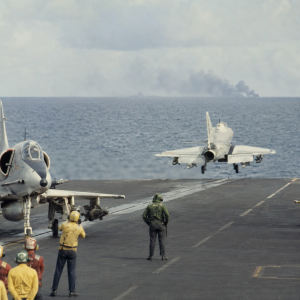
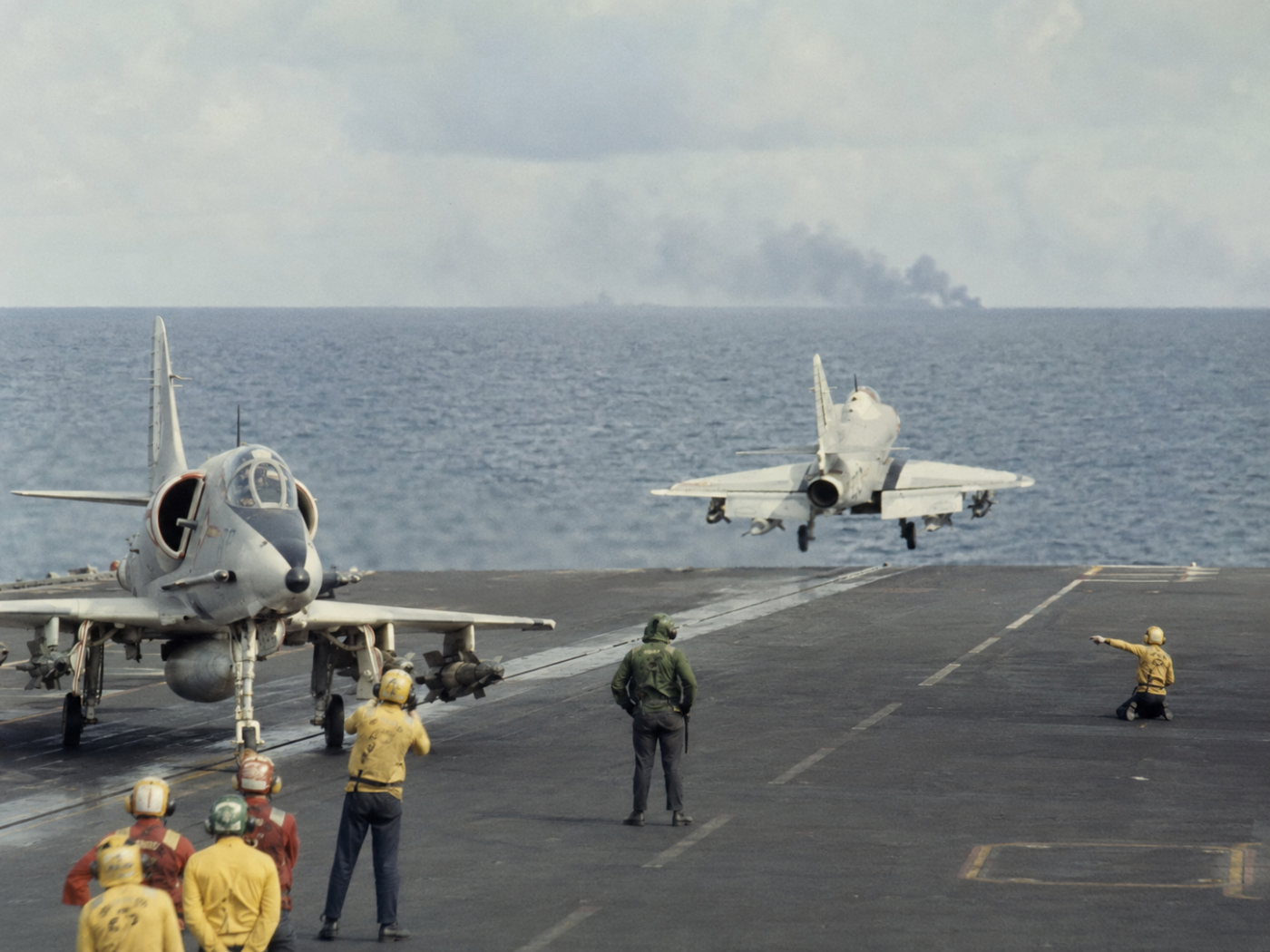
The principal targets included Hon Gai, Loc Chao, Quang Khe and Phuc Loi, together with a major petroleum storage facility at Vinh. These locations supported the North Vietnamese naval forces operating along the coastline and were considered directly connected with the torpedo boats involved in the earlier confrontation. During 5 August the two American carriers launched a total of 64 attack sorties against the designated targets. The strike force included Douglas A-4 Skyhawks, Douglas A-1 Skyraiders and other carrier aircraft supported by fighters and reconnaissance aircraft. Pilots flew from the carriers across the Gulf of Tonkin towards the North Vietnamese coastline, where they encountered anti-aircraft fire from defensive positions surrounding the naval installations.
The attacks concentrated heavily upon North Vietnamese patrol craft. Aircraft strafed and bombed vessels anchored or operating near their bases while other aircraft attacked docks, support facilities and fuel installations. American assessments following the raid claimed that approximately 25 North Vietnamese vessels had been destroyed or damaged, although as with many wartime assessments the exact figure remains difficult to establish. One of the most important targets was the petroleum storage depot at Vinh. The facility contained a considerable proportion of North Vietnam's available petroleum storage capacity. American aircraft attacked the tanks with bombs and rockets, producing large fires and columns of smoke visible from considerable distances. The United States Department of Defense subsequently claimed that around 90 per cent of the facility had been destroyed and that the depot represented roughly ten per cent of North Vietnam's petroleum storage capacity at the time.
The operation was not without American losses. Two aircraft were shot down by North Vietnamese anti-aircraft fire. Lieutenant junior grade Richard C. Sather was flying an A-1H Skyraider from USS Constellation when his aircraft was hit during the attacks. Sather was killed, becoming one of the first United States naval aviators to lose his life during combat operations against North Vietnam. The second loss would have an even more remarkable place in the history of the Vietnam War. Lieutenant junior grade Everett Alvarez Jr. was flying an A-4 Skyhawk when his aircraft was struck by anti-aircraft fire near Hon Gai. Alvarez managed to eject and came down in the water, but he was quickly captured by North Vietnamese forces.
Alvarez became the first American aviator captured and held as a prisoner of war in North Vietnam. He would remain in captivity for more than eight years, enduring harsh conditions, interrogation and mistreatment before eventually being released in February 1973. His imprisonment would span almost the entire period of major American combat involvement in Vietnam and make him one of the longest-held American prisoners of the war.
For President Johnson, Pierce Arrow was intended to send a clear political as well as military message. In a televised address to the American people, Johnson announced that American forces had responded to attacks against United States naval vessels. He emphasised that the United States sought no wider war, but warned that deliberate attacks upon American forces would receive a response. At that moment the administration continued to present the operation as limited retaliation, yet events surrounding Pierce Arrow would have consequences far beyond the destruction of several patrol boats and fuel tanks.
On 7 August 1964, only two days after the strikes, the United States Congress passed what became known as the Gulf of Tonkin Resolution. The resolution authorised President Johnson to take what were described as all necessary measures to repel armed attacks against United States forces and prevent further aggression in Southeast Asia. Although it was not formally a declaration of war, it gave the president extremely broad authority to expand American military operations. The resolution passed overwhelmingly. At the time, relatively few members of Congress knew how uncertain the evidence surrounding the reported second attack of 4 August actually was. In the House of Representatives the resolution passed unanimously, while only Senators Wayne Morse of Oregon and Ernest Gruening of Alaska voted against it.
Morse in particular warned that Congress was effectively surrendering its constitutional authority over decisions of war and peace. His objections attracted comparatively little support in 1964, but as the Vietnam War expanded and American casualties increased, his warnings would later appear remarkably significant. Pierce Arrow also demonstrated how rapidly an isolated naval encounter could escalate into strategic military action. Within only a few days the sequence had moved from an encounter between a destroyer and several small torpedo boats to American carrier aircraft bombing targets on North Vietnamese territory and Congress granting the president sweeping military powers.
Nevertheless, Pierce Arrow did not immediately begin a continuous bombing campaign against North Vietnam. After the strikes the situation temporarily settled and American carrier operations resumed a more normal pattern. Washington was still attempting to balance military pressure with political caution, particularly because 1964 was a presidential election year and Johnson did not want to appear eager to begin a major Asian war. That restraint would not last, and during the following months the security situation in South Vietnam continued to deteriorate. Communist Viet Cong forces increased attacks upon South Vietnamese and American positions while political instability continued within the South Vietnamese government. American military commanders increasingly argued that attacking communist forces inside South Vietnam alone would never be sufficient while North Vietnam remained able to support the insurgency.
Further American retaliatory attacks followed. In February 1965, after Viet Cong attacks against American installations including the assault on Camp Holloway near Pleiku, the United States launched Operation Flaming Dart against targets in North Vietnam. Shortly afterwards Operation Rolling Thunder began, initiating a sustained bombing campaign that would continue, with interruptions, until 1968. In that sense Pierce Arrow can be regarded as a rehearsal for what was coming. Carrier aircraft operating from the Gulf of Tonkin would become a familiar feature of the Vietnam War. American aircraft carriers maintained what became known as Yankee Station in the Gulf, from where thousands of combat sorties would eventually be launched against targets throughout North Vietnam.
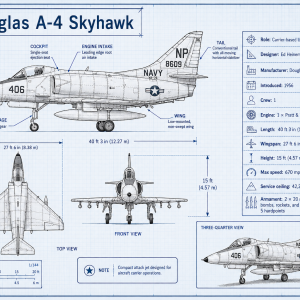
The aircraft used during Pierce Arrow also represented the changing face of American naval aviation. The A-4 Skyhawk, a compact jet attack aircraft capable of carrying a substantial bomb load, would become one of the most recognisable naval aircraft of the Vietnam conflict. The slower piston-engined A-1 Skyraider, despite being designed during the Second World War, proved extremely effective because of its long endurance and ability to carry heavy weapon loads. For North Vietnam, Pierce Arrow provided an early indication of the overwhelming technological and firepower advantage that the United States could bring to the conflict. Yet it also demonstrated something that would become increasingly apparent as the war continued: destroying individual military installations would not necessarily force Hanoi to abandon its political objectives.
North Vietnamese air defences would expand enormously after 1964. Anti-aircraft guns were supplemented by radar-controlled weapons, MiG fighters and Soviet-supplied surface-to-air missiles. What had begun with American aircraft attacking relatively lightly defended coastal targets would eventually develop into one of the most heavily defended air campaigns encountered by American aviators. The political significance of Pierce Arrow ultimately exceeded its immediate military results. A handful of coastal installations and patrol boats could be repaired or replaced, but the operation established a precedent. American aircraft had openly bombed North Vietnamese territory on the orders of the president and Congress shortly afterwards granted him broad authority to continue military action.
It also became inseparably connected with the controversy surrounding the Gulf of Tonkin incident. Later evidence demonstrated that the supposed second attack of 4 August almost certainly never occurred. Intelligence available at the time was confused, contradictory and in some cases wrongly interpreted. The controversy became even more serious as historians examined whether officials had presented information selectively while seeking congressional support for stronger action.
Operation Pierce Arrow therefore occupies a unique place in the history of the Vietnam War. Militarily it lasted only a matter of hours and involved 64 attack sorties from two aircraft carriers. Compared with the enormous bombing operations that would later involve hundreds of thousands of sorties, it appeared relatively small, but historically its importance was enormous. On 5 August 1964 American aircraft openly attacked North Vietnam in direct retaliation for events in the Gulf of Tonkin. One American pilot, Richard Sather, was killed. Another, Everett Alvarez Jr., began an imprisonment that would last until 1973. North Vietnamese patrol boats and facilities were destroyed, the Vinh petroleum depot was heavily damaged, and within forty-eight hours Congress had given President Johnson the authority that would help enable a dramatic expansion of the war.
What had begun as a tense naval encounter in the Gulf of Tonkin had become something far larger. Within months American bombing of North Vietnam would become routine, and within a year hundreds of thousands of United States troops would be committed to Southeast Asia. Operation Pierce Arrow was therefore far more than a retaliatory air raid. It was one of the critical steps through which America moved towards full-scale involvement in the Vietnam War, a conflict that would ultimately last for years, cost millions of Vietnamese lives and more than 58,000 American dead, and leave political and military consequences that continued long after the last United States combat troops had left Vietnam.