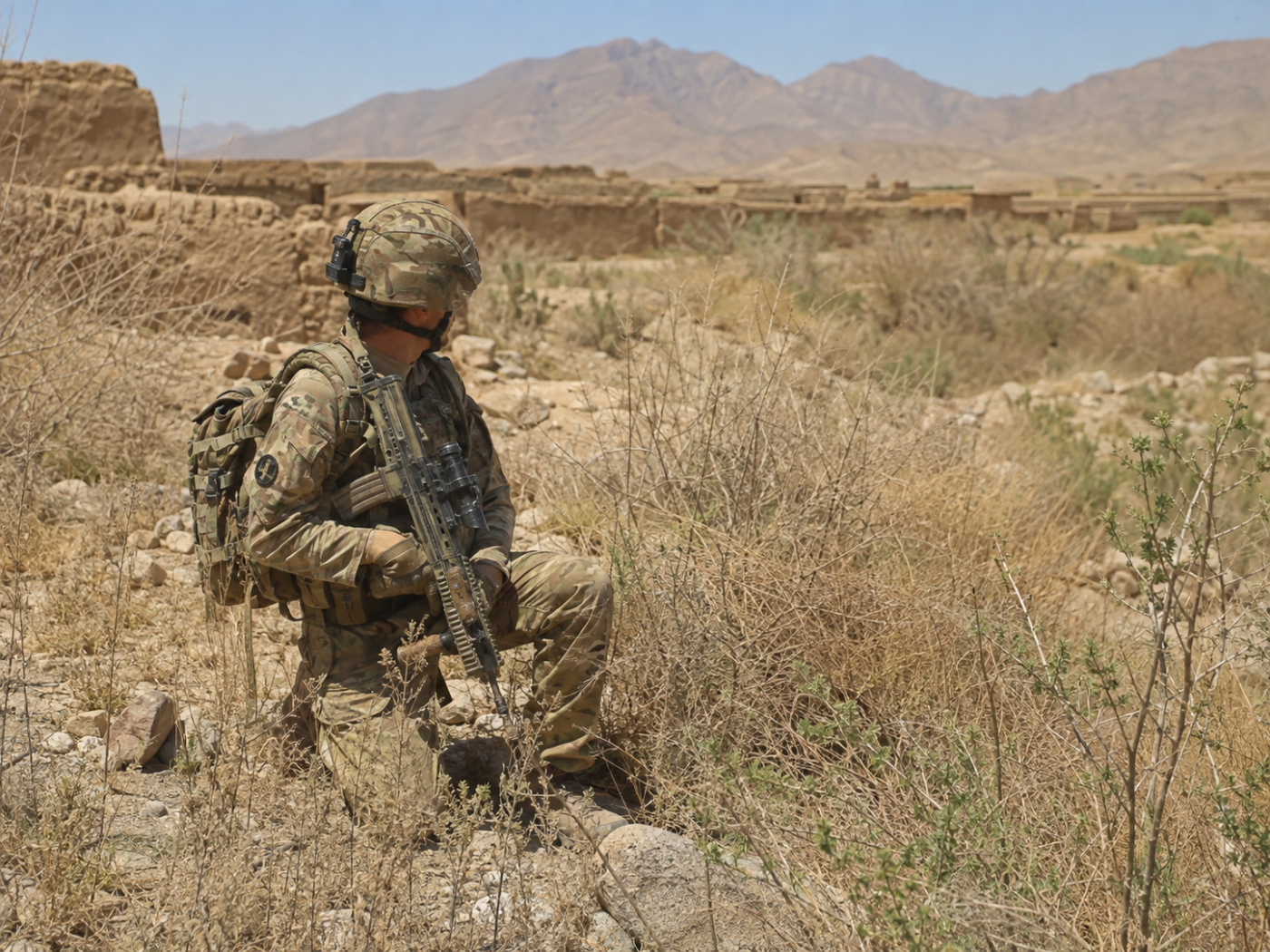
MTP Camouflage
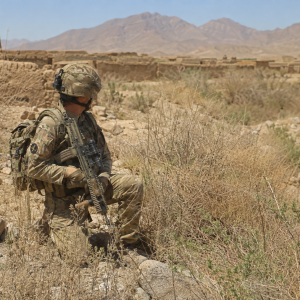
For more than forty years the distinctive shapes of British Disruptive Pattern Material, better known as DPM, had been one of the most recognisable features of the British soldier. Woodland DPM served in Europe, Northern Ireland and numerous overseas deployments, while a lighter desert version was produced for operations in the Middle East. Both patterns performed well in the environments for which they had been designed, but the war in Afghanistan exposed a serious weakness: British troops could pass through several completely different types of terrain during a single patrol.
In Helmand Province a patrol might leave a dusty forward operating base, cross pale open desert, enter a village of mud-brick compounds and then move into the lush vegetation of the Helmand River’s so-called Green Zone. Desert DPM could work reasonably well against dry ground and stone, but stood out among crops, trees and darker vegetation. Woodland DPM was more suitable for green areas, yet became conspicuous in open desert. Changing uniforms during an operation was clearly impossible, while body armour, ammunition pouches and other equipment could create an additional mixture of contrasting patterns.
The need for one camouflage design capable of working across this changing landscape became increasingly urgent as fighting in Helmand intensified. Rather than simply selecting another existing uniform, the Ministry of Defence began a scientific investigation into how soldiers were actually seen against the Afghan landscape.
The project was carried out principally by scientists from the Defence Science and Technology Laboratory, usually known as Dstl, working with Defence Equipment and Support’s clothing specialists and the Infantry Trials and Development Unit. Colonel Stephen James led the Defence Equipment and Support clothing team responsible for delivering the new pattern, while Dstl specialists including George Philpott and Christopher Jones were publicly associated with the scientific research and testing work.
Research began in 2009 as an Urgent Operational Requirement. The initial work was completed remarkably quickly, with the principal research programme compressed into approximately six months and funded at a cost of around £250,000. This speed reflected the immediate need to provide British troops in Afghanistan with better concealment rather than waiting for the completion of a much longer normal procurement programme.
The scientists did not rely simply on soldiers looking at several pieces of cloth and choosing the one they preferred. Cameras were sent to Helmand so that personnel could take carefully controlled photographs of the backgrounds through which troops operated. These included cultivated fields, dry scrub, stone, desert, mud compounds and the varied vegetation of the Green Zone.
The photographs allowed researchers to measure the colours, tones and brightness found in the Afghan landscape. This information was entered into computer models representing green, desert and mixed environments. Researchers then produced and compared camouflage samples based on the collected colour data.
Camouflage is not merely a question of matching one colour. A successful design must break up the outline of the human body, prevent the eye from quickly identifying familiar shapes and remain effective as the wearer moves between light and shadow. Dstl therefore examined texture, contrast, pattern size, reflected light and the length of time it took an observer to detect a soldier against a particular background.
A series of potential uniforms was tested against the two existing British patterns, woodland DPM and desert DPM. Commercially available designs were also examined, most importantly MultiCam, developed in the United States by Crye Precision.
Crye’s design had been created around the idea that one camouflage could provide useful concealment across numerous environments rather than becoming highly effective in one landscape but poor in another. Instead of relying on sharply separated blocks of colour, MultiCam used greens, browns, tans and lighter areas with softer transitions and changes in tone. This helped the cloth take on some of the visual character of its surroundings under different lighting conditions.
Ten camouflage suits were put through five main tests. Trials included laboratory assessments, controlled field evaluations, scientific and aerial photography and the judgement of soldiers who would eventually have to wear the clothing on operations. Samples were tested in Britain, Cyprus, Kenya and Afghanistan, providing backgrounds ranging from European vegetation to dry, dusty and semi-arid terrain. The Infantry Trials Unit was directly involved in testing the designs under realistic conditions.
The trials produced a clear result. Crye Precision’s MultiCam performed best on average across the full range of environments. However, Britain did not simply adopt unaltered American MultiCam as its new standard uniform.
The final British Multi-Terrain Pattern combined the successful colour technology and general multi-environment approach associated with Crye Precision with disruptive shapes influenced by traditional British woodland DPM. The resulting design retained a recognisably British appearance while using a palette that could operate far more effectively across green vegetation, dry earth, stone, crops and built-up areas.
Keeping some of the familiar DPM-style shapes was not simply a matter of tradition. During development, junior ranks reportedly said that maintaining a recognisable British identity was important. Pattern consistency could also help troops identify other British soldiers more easily in confused battlefield conditions. The finished design therefore became a genuine hybrid: American multi-environment camouflage technology combined with visual features taken from Britain’s established DPM heritage.
This distinction is why MTP and MultiCam can appear almost identical from a distance yet show noticeable differences when placed together. Their colour ranges are closely related, but the arrangements and shapes printed across the material differ. MTP generally contains more of the sweeping, brush-like forms associated with British DPM, while original MultiCam has its own mixture of softer patches, gradients and smaller contrasting elements.
The Ministry of Defence publicly revealed the new uniform in December 2009. Soldiers of 4 Mechanised Brigade were among the first to receive it before deploying on Operation Herrick in early 2010. British personnel began wearing MTP in Afghanistan from around March and April that year, including soldiers from the Royal Dragoon Guards. It represented the first major change to the British Armed Forces’ standard camouflage pattern since the introduction of DPM during the late 1960s.
Initial examples were produced in the familiar Combat Soldier 95 style because there was no time to wait for an entirely new clothing system. This meant that early MTP garments could resemble the older DPM uniform in their pocket arrangement and general construction, despite carrying the new camouflage.
MTP was subsequently combined with the new Personal Clothing System, usually called PCS. The PCS uniform introduced practical changes based on operational experience. These included redesigned pockets that could be reached more easily while body armour was being worn, angled chest pockets, improved fastening arrangements and changes intended to increase comfort and freedom of movement. This is why MTP refers primarily to the camouflage pattern, while PCS describes the design and construction of the clothing itself.
The transition was gradual. At first MTP was prioritised for those deploying to Afghanistan, while woodland and desert DPM remained common elsewhere. From 2011 the new clothing began to appear more widely, and by 2012 it was being issued throughout the Royal Navy, British Army and Royal Air Force. MTP eventually replaced both major versions of DPM as the standard operational camouflage of the British Armed Forces.
The clothing range grew far beyond the basic jacket and trousers. MTP was applied to smocks, warm-weather clothing, under-body-armour combat shirts, waterproof garments, helmet covers, body-armour components, daysacks, rucksacks and load-carrying equipment. Different materials were selected according to the intended use, with lighter garments for hot climates and heavier or layered equipment for cold and wet conditions.
Some warm-weather MTP combat jackets, trousers and under-body-armour shirts have also been treated with the insecticide permethrin. The treatment is intended to provide additional protection against mosquitoes, ticks and other insects that can carry disease during tropical or subtropical operations.
British military clothing is normally supplied through contracts rather than being manufactured permanently by one single government-owned factory. One important contractor has been Cooneen Defence, based at Fivemiletown in County Tyrone, Northern Ireland. Cooneen has supplied permethrin-treated MTP combat jackets, trousers and under-body-armour shirts. Production and component sourcing can take place through wider international supply chains, and individual contracts, factories and countries of manufacture may change over time.