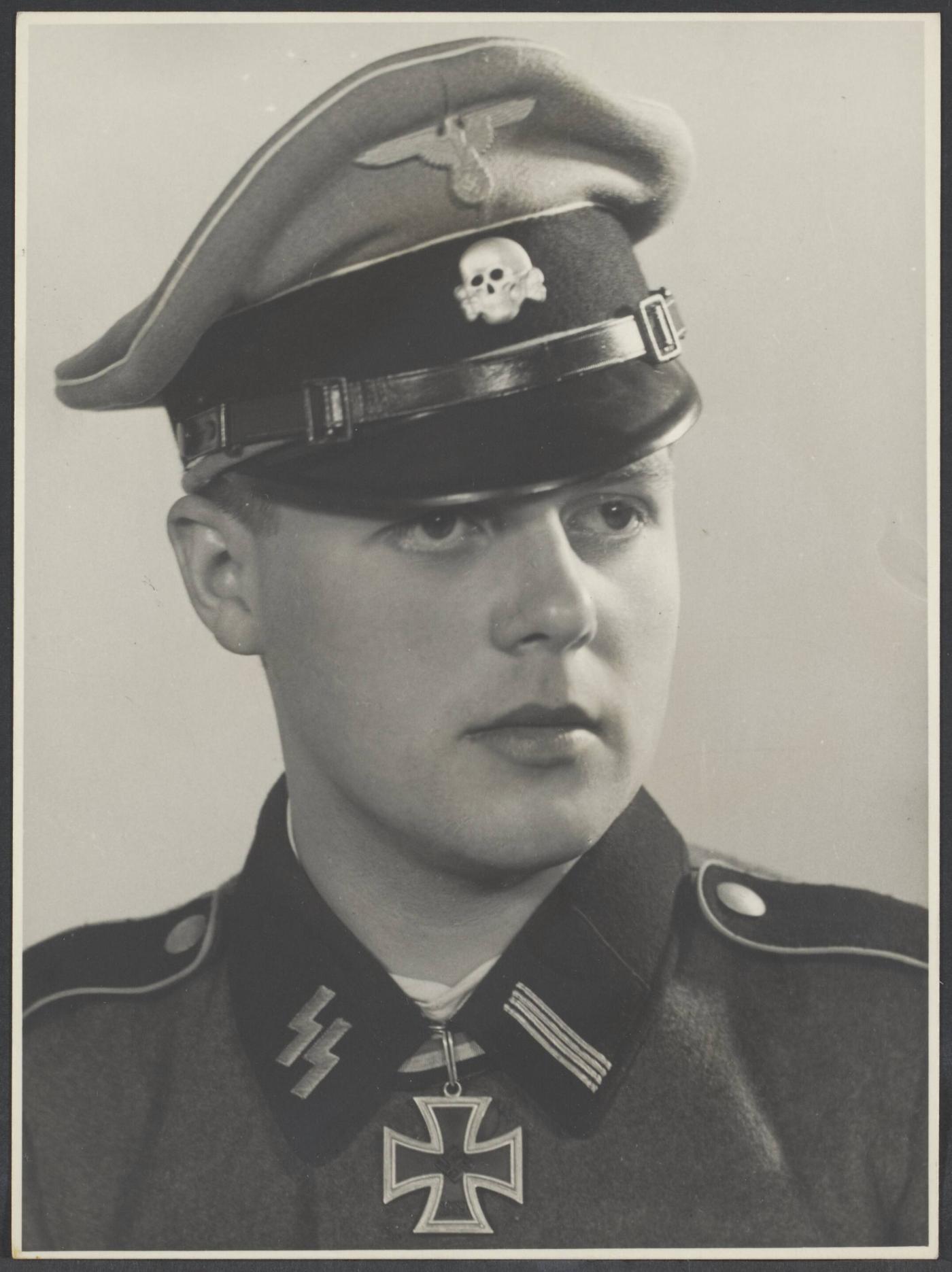
Gerardus Mooyman
German forces crossed the Dutch border during the early hours of 10 May 1940. Five days later, after the bombing of Rotterdam and the threat that other cities might receive the same treatment, the Dutch armed forces surrendered. The Netherlands was placed under German occupation, with Arthur Seyss-Inquart as Reich Commissioner. The SS soon began looking for Dutch recruits. Nazi racial ideas classified the Dutch as a Germanic people who could eventually be absorbed into a German-dominated Europe. Dutch and Flemish volunteers were first recruited for units such as the SS Regiment “Westland” and the SS-Freiwilligen-Standarte “Nordwest”. Recruitment increased after Germany attacked the Soviet Union in June 1941. The war in the east was advertised as a European campaign against communism, and the Germans established the Vrijwilligerslegioen Nederland for Dutch volunteers. More than 20,000 Dutchmen eventually served in the Waffen-SS. Most were sent to the Eastern Front.
Among the young men attracted to German service was Gerardus Leonardus Mooyman. He was born in Apeldoorn on 23 September 1923 and grew up in a Catholic lower-middle-class family. His father had struggled as a small businessman during the economic depression and joined the Nationaal-Socialistische Beweging, the Dutch Nazi movement. At home, Germany was spoken of with admiration. Hitler appeared to have ended unemployment, restored order and turned a defeated country into the strongest power in Europe. Mooyman later recalled that he grew up hearing constant praise for National Socialism. He was sixteen when Germany invaded the Netherlands. The rapid defeat of the Dutch army, followed by the fall of Belgium and France, strengthened the impression that German victory was unavoidable. In 1941, at the age of seventeen, he volunteered for German service.
In April 1941, Mooyman joined the SS-Freiwilligen-Standarte “Nordwest”. He later transferred to the SS-Freiwilligen-Legion “Niederlande”. The Germans allowed it to display Dutch names and symbols, but the Legion was commanded and equipped as part of the Waffen-SS. Its recruits swore loyalty to Adolf Hitler and received military and ideological training under German supervision. At the end of 1941, the formation was sent east. It reached the northern sector of the Eastern Front in early 1942 and was deployed around the Volkhov River and Leningrad. The Germans had surrounded Leningrad in September 1941, but they had failed to capture the city. Fighting continued through forests, marshes and frozen river valleys. Winter brought extreme cold, while spring and autumn turned roads and fields into mud. The Dutch volunteers faced Soviet artillery, infantry attacks, disease and shortages that had been largely absent from the triumphant recruiting posters shown at home.
Mooyman served in the Legion’s anti-tank company. By early 1943 he was part of the crew of a 7.5-centimetre Pak 97/38 gun. The weapon combined a captured French gun barrel with a German carriage and could be used against Soviet armour at relatively short distances. Its crew had to wait until a tank entered the effective firing range, open fire and reload before the tank or supporting artillery located their position. The gun offered little protection. A direct hit, machine-gun fire or shell fragments could kill the crew within seconds. Mooyman proved to be an effective gunner. During the fighting south of Lake Ladoga he was credited with destroying several Soviet tanks and received both classes of the Iron Cross.
The action that made him famous took place on 13 February 1943. Soviet forces were trying to widen the corridor that had recently been opened through the German siege lines towards Leningrad. Tanks attacked the positions occupied by the Dutch Legion near Lake Ladoga. According to German reports, Mooyman’s crew destroyed seven tanks during the first attack. His gun commander was killed, leaving the nineteen-year-old Mooyman in charge of the weapon. When another Soviet armoured force approached later that day, the crew continued firing and was credited with another six tanks. The total of thirteen came from German wartime accounts and was repeated throughout the later publicity campaign. Whatever the precise number, the fighting had been serious and Mooyman’s gun remained in action while the position was under attack. German records later credited him with twenty-three destroyed tanks during his service at the front.
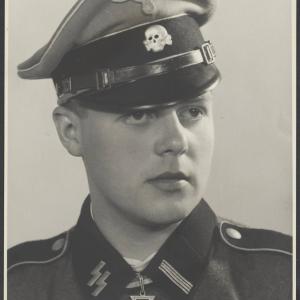
On 20 February 1943, Mooyman received the Knight’s Cross of the Iron Cross. He was the first Dutchman and the first foreign volunteer in the Waffen-SS to receive the decoration. The Knight’s Cross was one of Germany’s highest awards for military service and was normally associated with experienced officers, pilots or commanders. Mooyman was still a nineteen-year-old SS-Sturmmann, a junior enlisted rank. Photographs taken after the award showed him in a clean uniform, wearing the large cross around his neck and standing beside an anti-tank gun. The pictures travelled more widely than the details of the battle itself. Newspapers described him as calm, brave and loyal. German and Dutch National Socialist publications compared him with naval heroes such as Michiel de Ruyter and Maarten Tromp. The young volunteer from Apeldoorn was presented as proof that Dutchmen could earn honour and status in Hitler’s European army.
Mooyman returned to the occupied Netherlands as an SS celebrity. He attended official receptions, met leading members of the NSB and appeared at gatherings of National Socialist youth organisations. Newspapers published interviews and photographs, while his name and image were used in recruiting material. A street in Schagen was even named after him. The campaign presented his success as proof that a young Dutch volunteer could earn honour and recognition on the Eastern Front. Mooyman was particularly useful for this purpose. He was young, recognisably Dutch and had entered the SS without rank or previous military experience. His Knight’s Cross turned him into an example for other potential recruits, suggesting that they too could gain status through service in the Waffen-SS.
The publicity did not end his military career. In August 1943, Mooyman was selected for further training and later attended the SS officer school at Bad Tölz. The Dutch Legion was reorganised as the SS Volunteer Panzergrenadier Brigade “Nederland”, which was sent back to the northern Eastern Front. By then, Germany had lost the initiative. Soviet armies were advancing westwards, and the German formations around Leningrad were forced to retreat through Estonia and Latvia. Mooyman returned to the fighting in 1944 and was promoted to SS-Untersturmführer, the equivalent of a junior lieutenant, in June. The conditions bore little resemblance to those of 1941. Units were short of trained men, fuel and equipment, while Soviet forces had gained overwhelming strength in artillery and tanks. The “Nederland” formation withdrew towards Germany and was repeatedly reduced and rebuilt. During the final months of the war, its remaining troops fought in Pomerania and near the Oder before breaking into smaller groups during the Soviet advance on Berlin.
Mooyman was captured by American troops in Germany on 4 May 1945. Several days later, he escaped from captivity and went into hiding in Germany. In March 1946, he returned to the Netherlands, where he was arrested. During a later transfer from Scheveningen to Delft, he escaped for a second time and fled back to Germany. He eventually returned to the Netherlands and was arrested near the Dutch-German border at Millingen on 28 August 1947. Mooyman appeared before a Dutch court in October and was sentenced to six years in prison. The trial marked a complete reversal of his public position. Four years earlier, newspapers in the occupied Netherlands had praised him as a national hero. He now stood trial as a Dutch citizen who had volunteered for German military service, worn the uniform of the Waffen-SS and sworn loyalty to Hitler. He did not serve his full sentence and was released at the end of August 1949.
After his release, Mooyman settled in the north of the Netherlands and worked as an independent businessman. He married, had a family and generally remained outside public life. His name continued to appear in books and collections of wartime photographs, usually beneath the familiar image of the young SS soldier wearing the Knight’s Cross. In 1967 he gave an interview in which he spoke openly about his upbringing and his decision to join. He described his wartime experiences as a personal tragedy and accepted that he had fought for a criminal cause. He also acknowledged that, as a military collaborator, he bore some responsibility for the crimes committed by the Nazi regime. His later regret did not change the fact that he had volunteered or that the SS had used him as a propaganda figure, but it showed how far he had moved from the beliefs of his youth. Gerardus Mooyman died in a traffic accident near Anloo on 21 June 1987. He was sixty-three years old.
Credit: Tom Dankers, Historian - Arnhems Oorlogsmuseum 40-45