On this day in military history…
The Wola Massacre of August 1944 remains one of the most appalling episodes of the Second World War and one of the greatest mass killings of civilians carried out in German-occupied Europe. Beginning on 5 August 1944 in the Wola district of Warsaw, German SS, police and auxiliary formations systematically murdered tens of thousands of Polish civilians in an attempt to terrorise Warsaw into submission and crush the Warsaw Uprising. Men, women, children, hospital patients, doctors and nurses were killed in streets, courtyards, factories, houses and hospitals, often in organised mass executions that continued for several days.
The massacre cannot be understood without the events that began four days earlier. At 5pm on 1 August 1944, the Polish Home Army, the Armia Krajowa, launched the Warsaw Uprising against the German occupation. Poland had endured nearly five years of brutal German rule, and as Soviet forces approached Warsaw from the east, the Polish underground leadership hoped to liberate the capital before the Red Army entered it. The aim was not simply military. The Polish resistance hoped that by taking control of Warsaw itself it could demonstrate that the legitimate Polish underground state remained capable of governing its own capital rather than allowing Joseph Stalin to impose a Soviet-controlled administration upon Poland.
The uprising was intended to last only a few days, but Warsaw rapidly became the scene of fierce urban warfare. Approximately 45,000 Home Army members initially participated, although only a fraction possessed firearms. They fought German forces equipped with tanks, artillery, aircraft and heavy weapons. The initial Polish attacks succeeded in capturing considerable areas of the city, but several strategically important German positions remained in enemy hands and German reinforcements soon began arriving.
Adolf Hitler reacted to news of the uprising with fury. Heinrich Himmler and the German leadership determined that Warsaw was to be made an example. Orders were issued for the rebellion to be crushed with extreme brutality and for the civilian population to be treated without mercy. The intention went far beyond defeating armed resistance fighters. The destruction of Warsaw and the killing of its inhabitants were seen as a means of eliminating both the uprising and the Polish capital as a centre of national resistance.
Wola lay to the west of central Warsaw and became one of the principal routes along which German reinforcements would have to advance towards the city centre. Polish resistance positions in the district therefore represented a serious obstacle. On 5 August the Germans began a major assault through Wola. The day would later become known in Poland as Black Saturday.
The German forces involved included conventional troops, SS formations, police units and auxiliary forces. Among the most notorious was the SS special formation commanded by Oskar Dirlewanger. Dirlewanger's unit had an exceptionally brutal reputation and contained convicted criminals and other men recruited for anti-partisan warfare. Also involved in the suppression of Warsaw were formations associated with Bronislav Kaminski's collaborationist forces, together with other German-controlled eastern units. Overall command of the forces attacking through Wola was associated with SS-Gruppenführer Heinz Reinefarth, while SS-Obergruppenführer Erich von dem Bach-Zelewski was subsequently placed in overall command of German operations against the uprising.
As German troops advanced on 5 August they began clearing streets and buildings not simply of resistance fighters but of civilians. Entire families were ordered from their homes. Residents were driven into courtyards, gardens, factory grounds and open areas where machine guns had been positioned. Groups containing hundreds or sometimes thousands of people were shot. The executions were conducted repeatedly across the district.
Some civilians initially believed that they were merely being evacuated. German soldiers would order residents to leave their apartments and join groups being marched through the streets. Instead of being taken to safety, many were directed into nearby courtyards or industrial compounds and murdered. Bodies accumulated so quickly that execution sites became filled with the dead.
One of the characteristics that made the Wola killings particularly horrifying was their indiscriminate nature. German forces made little meaningful distinction between suspected resistance fighters and civilians. Children were killed alongside their parents. Elderly people who could barely walk were murdered. Women carrying infants were included in execution groups. People sheltering in basements from artillery fire were discovered and brought outside to be shot.
Hospitals, which under the accepted laws and customs of war should have offered some protection to the wounded and medical personnel, were also attacked. Patients were removed from beds, and in some locations both patients and members of the medical staff were murdered. The sick, wounded and disabled were unable to escape even when advance warning of German troops reached a neighbourhood. Accounts from Wola describe hospitals becoming places of terror as German and auxiliary troops entered buildings containing civilians and wounded insurgents.
One of the best-known locations associated with the massacre was the area around Wolska Street, where numerous mass executions occurred. Factories provided convenient enclosed areas in which large numbers of civilians could be assembled and killed. The Ursus factory and other industrial sites became killing grounds. Residents were also murdered at houses, workshops and street intersections throughout Wola.
The killing took place on such a scale that German authorities faced the practical problem of disposing of thousands of bodies. Special groups of Polish civilians were forced to remove and burn corpses. These men were sometimes referred to as Verbrennungskommando, or burning commandos. They were ordered to drag bodies into large piles, frequently using timber, furniture or flammable material taken from nearby buildings, and then set them alight. The purpose was partly practical but also served to destroy evidence of the killings.
For members of these forced labour details, survival was uncertain. They had witnessed the massacre and knew that they too could eventually be murdered. Some managed to escape or survive the fighting and later provided valuable testimony about what they had seen. Their accounts helped reconstruct the enormous scale of the killings when investigations were carried out after the war.
The atmosphere in Wola during those days was almost beyond description. Buildings burned, artillery shells exploded across the district and Polish resistance fighters attempted to slow the German advance while only streets away mass executions were taking place. Civilians hiding in cellars could hear gunfire from nearby courtyards without knowing whether the people being killed were resistance fighters or their neighbours. German soldiers searched buildings methodically, forcing residents outside and setting fire to houses.
The massacre reached its greatest intensity between 5 and 7 August. The United States Holocaust Memorial Museum estimates that approximately 40,000 men, women and children were murdered in Wola during these days, while Polish commemorative estimates have sometimes placed the total at around 50,000 or higher. Precise figures will probably never be established because entire families disappeared, records were destroyed and thousands of bodies were burned. What is beyond dispute is that Wola witnessed killing on an extraordinary scale.
The Germans nevertheless discovered that murdering civilians did not automatically defeat the Polish resistance. Home Army units continued fighting fiercely. On 5 August Polish forces also achieved one of the uprising's most remarkable successes when troops from the Zośka Battalion liberated the Gęsiówka concentration camp, freeing hundreds of Jewish prisoners. The contrast between the liberation of prisoners in one part of Warsaw and mass murder in another demonstrated the extraordinary brutality and confusion of the battle.
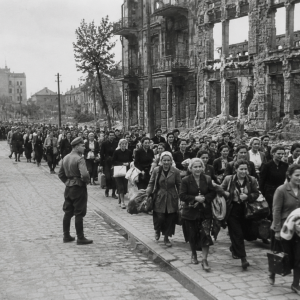
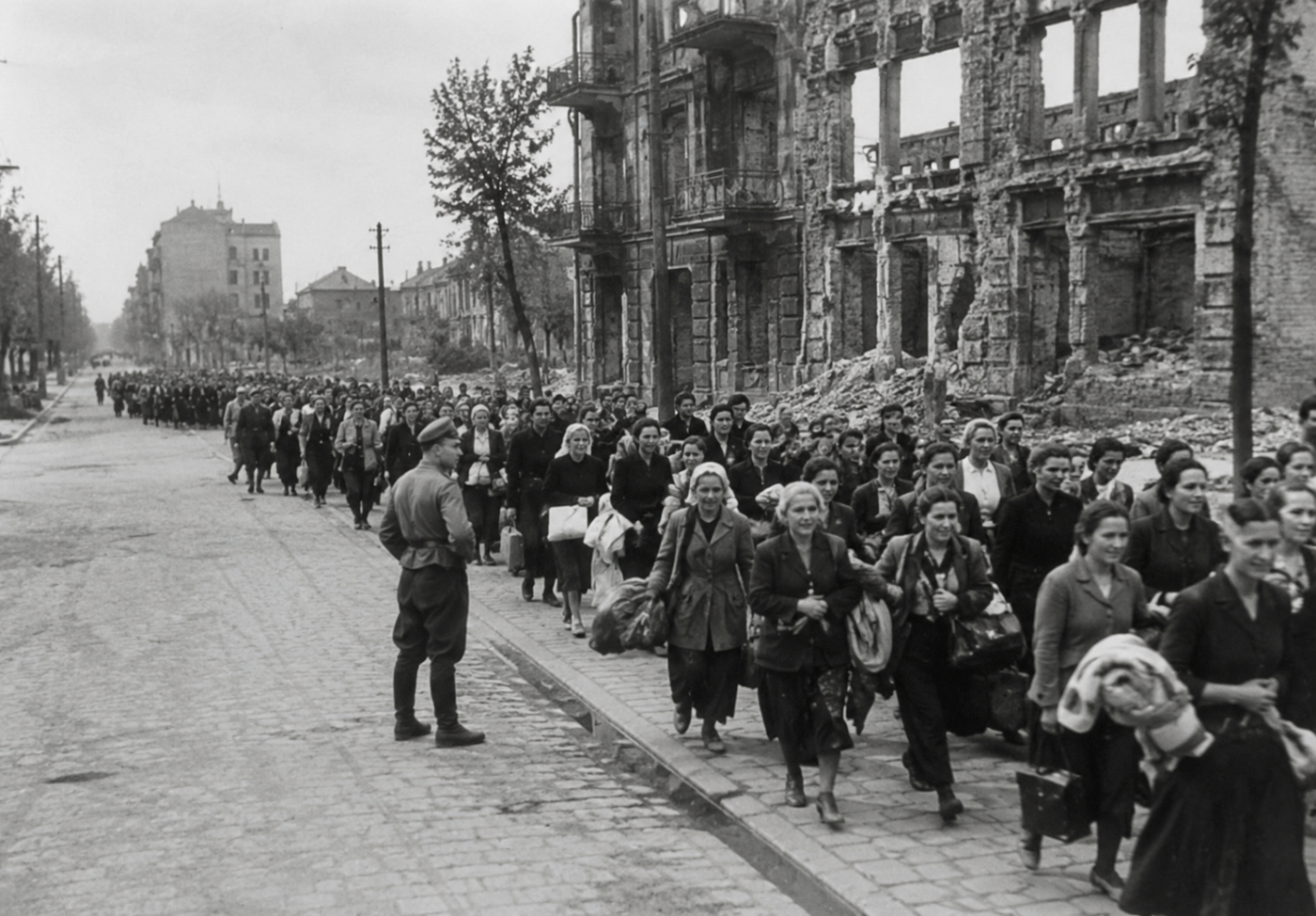
As German commanders gradually recognised that the indiscriminate killing of the entire population was complicating military operations and creating enormous numbers of bodies, the policy began to change. Civilians increasingly became subject to mass expulsion rather than immediate execution, although killings continued. Captured civilians were driven from Warsaw and sent through collection and transit facilities, most notably Dulag 121 at Pruszków outside the city.
Conditions during these evacuations were harsh. Families were separated, possessions were lost and thousands of people were selected for forced labour in Germany. Others were transported to concentration camps. The removal of Warsaw's population became an organised part of the German suppression of the uprising.
The uprising itself continued long after the worst killings in Wola had taken place. Polish fighters defended Warsaw for 63 days, enduring artillery bombardment, Luftwaffe attacks, tanks, flamethrowers and shortages of ammunition, food, medicine and water. Despite Allied attempts to deliver supplies by air, the resistance became increasingly isolated.
The political situation made their position even more desperate. Soviet armies had reached the eastern side of the Vistula, but large-scale assistance that might have saved the uprising did not arrive during its decisive stages. Stalin had little sympathy for the Home Army, which remained loyal to the Polish government in exile in London and represented a potential obstacle to Soviet political control of post-war Poland.
By the end of September the resistance was exhausted. Negotiations followed and the uprising formally ended in early October 1944. Approximately 16,000 to 18,000 Polish resistance fighters were killed during the uprising, while civilian losses across Warsaw are generally estimated at between 150,000 and 180,000. Wola accounted for a devastating proportion of those deaths.
After the surrender, Warsaw's suffering did not end. The Germans expelled much of the remaining civilian population and deliberately destroyed large areas of the city. Buildings were systematically burned or demolished, cultural institutions were wrecked and neighbourhoods were reduced to ruins. By the time Soviet and Polish communist forces entered Warsaw in January 1945, much of the capital had been devastated.
Many of those responsible for the Wola Massacre escaped adequate punishment. Oskar Dirlewanger died in 1945 under circumstances that remain disputed, probably after being captured in French custody. Heinz Reinefarth survived the war and was never successfully prosecuted for his role in the Warsaw atrocities. He later became a politician in West Germany and served as mayor of Westerland on the island of Sylt, something that caused lasting anger in Poland. Despite investigations and attempts to bring him to trial, he died in 1979 without having faced justice for the massacre.
The fate of the victims presented another terrible difficulty. Because so many bodies had been burned, identifying individual victims was often impossible. Human remains and ashes recovered from execution sites were collected after the war and buried in Warsaw. The Warsaw Insurgents Cemetery in Wola became one of the principal places of remembrance, containing the remains and ashes of tens of thousands of people killed during the uprising and German reprisals.
Today numerous plaques and memorials mark the sites where civilians were murdered. Walking through modern Wola, it is possible to encounter memorials on streets where apartment blocks, businesses and ordinary city life have returned. Many mark locations at which entire groups of residents were executed during the first days of August 1944.
Every year on 5 August Warsaw remembers the victims of Wola. Ceremonies and remembrance marches pass execution sites, names of victims are read aloud and candles are placed beside memorial plaques. For many Polish families the event remains personal history rather than simply another episode of the Second World War.
The Wola Massacre also illustrates the wider nature of Nazi occupation policy in Poland. Warsaw was not merely being treated as a battlefield. German authorities considered the city's population itself an enemy and attempted to destroy the willingness of Poles to resist through mass terror. The killing of tens of thousands of unarmed civilians was therefore not an accidental consequence of urban combat but a deliberate campaign of terror accompanying the suppression of the uprising.
The events of 5 August 1944 are particularly important because they demonstrate what happened when military operations became combined with deliberate extermination. German forces advancing towards resistance positions could have concentrated upon defeating armed fighters. Instead, entire streets and neighbourhoods were subjected to executions that included infants, schoolchildren, hospital patients and elderly civilians who posed no military threat.
For those who survived, memories of Wola lasted for the rest of their lives. Some survived beneath piles of bodies after execution squads moved away. Others escaped burning buildings or were overlooked by soldiers searching cellars. Their testimony after the war provided historians with descriptions of execution sites that otherwise might have vanished along with the thousands of people killed there.
The massacre remains inseparable from the story of the Warsaw Uprising itself. The uprising represented an extraordinary attempt by an occupied population to liberate its own capital after five years of German occupation. The response in Wola showed the lengths to which Nazi Germany was prepared to go in attempting to destroy that resistance.