On this day in military history…
The First World War began in the summer of 1914, but the road to conflict had been building for many years. What started as a political crisis in the Balkans quickly drew in Europe’s great powers through a dangerous combination of military alliances, imperial rivalry, nationalism, arms races and rigid war plans. Within little more than a month, the assassination of one man in Sarajevo had helped trigger a war that would eventually involve much of the world and cost millions of lives.
The immediate spark came on 28 June 1914 in Sarajevo, the capital of Bosnia and Herzegovina. Archduke Franz Ferdinand, heir to the throne of Austria-Hungary, was visiting the city with his wife Sophie, Duchess of Hohenberg. Bosnia had been formally annexed by Austria-Hungary in 1908, a move bitterly resented by many Serbian nationalists who believed the territory should form part of a wider South Slav state.
A group of young Bosnian Serb nationalists had plotted to assassinate the Archduke during his visit. Several of the conspirators were linked to the revolutionary movement Young Bosnia, while weapons and assistance had come through individuals connected with Serbian nationalist networks. One of the assassins, Nedeljko Čabrinović, threw a bomb at Franz Ferdinand’s car, but it bounced away and exploded beneath another vehicle, injuring several people.
The Archduke decided to continue with the visit. Later that morning, after attending a reception, he chose to visit those wounded in the earlier attack. Confusion over the route caused his driver to take a wrong turn. When the car stopped and attempted to reverse, 19-year-old Gavrilo Princip happened to be standing nearby. Princip stepped forward and fired two shots at close range, fatally wounding Franz Ferdinand and Sophie.
Their deaths shocked Europe, but an immediate continental war was not inevitable. The assassination became the trigger because it struck at the centre of a European system already filled with distrust and competing ambitions.
Austria-Hungary regarded Serbia as a serious threat to the survival of its multinational empire. Serbian nationalism was particularly worrying because millions of Slavs lived within Austrian and Hungarian controlled territories. Leaders in Vienna feared that a powerful Serbia could encourage rebellion and eventually break the empire apart.
Germany strongly supported Austria-Hungary. In early July, German leaders gave Vienna what became known as the “blank cheque”, effectively promising support even if action against Serbia resulted in a wider European war. This assurance encouraged the Austrian government to take a much harder position.
On 23 July 1914, Austria-Hungary delivered an ultimatum to Serbia containing a series of extremely severe demands. Serbia was given just 48 hours to respond. Among the demands were measures designed to suppress anti-Austrian propaganda and nationalist organisations, but one particularly controversial condition called for Austro-Hungarian officials to participate in investigations inside Serbia.
The Serbian government accepted most of the demands but rejected those it believed infringed its sovereignty. Its response was considered remarkably conciliatory by several European governments, but Austria-Hungary was not satisfied.
On 28 July 1914, exactly one month after the assassination in Sarajevo, Austria-Hungary declared war on Serbia.
The first shots of the conflict were soon exchanged along the Danube and near Belgrade. Austro-Hungarian forces bombarded the Serbian capital, and the regional crisis began rapidly expanding beyond the Balkans.
Russia regarded itself as a protector of Serbia and other Slavic peoples in southeastern Europe. It also feared that allowing Austria-Hungary to destroy or dominate Serbia would greatly increase Austrian and German influence in the Balkans. Russia therefore began military preparations and ordered mobilisation.
This was an extremely dangerous development because mobilisation in 1914 was not simply a political gesture. European armies depended upon huge, carefully prepared railway timetables to move millions of soldiers, horses, guns and supplies. Once mobilisation began, governments believed that delaying or stopping the process could leave them dangerously exposed to attack.
Germany now faced the possibility of war against both Russia in the east and France in the west. France and Russia had been allies since the 1890s, meaning German military planners had long expected any major European conflict to become a two-front war.
Germany’s answer was based largely on the Schlieffen Plan, named after former Chief of the German General Staff Alfred von Schlieffen. The plan had been modified over the years, particularly by Helmuth von Moltke the Younger, but its central idea remained the same: Germany would attempt to defeat France quickly in the west before turning its forces eastwards against the more slowly mobilising Russian Empire.
Rather than attacking directly through the heavily fortified Franco-German frontier, German forces planned to sweep through neutral Belgium and enter northern France from the north.
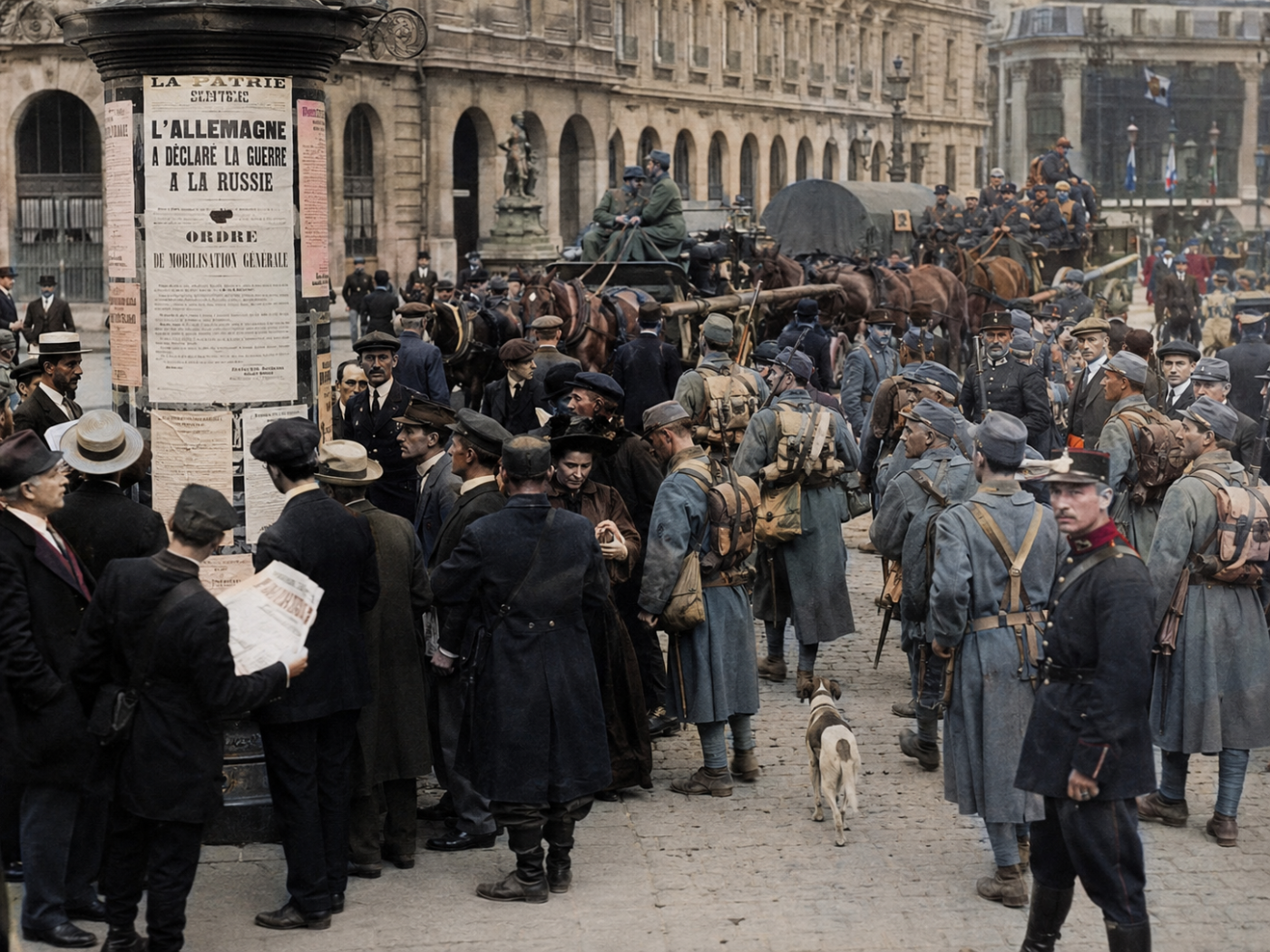
On 1 August 1914, Germany declared war on Russia.
France began full mobilisation the same day. Although both sides were preparing for conflict, neither Germany nor France wanted to appear responsible for making the first aggressive move.
On 3 August Germany declared war on France.
German forces then crossed into Luxembourg and demanded passage through Belgium. Belgium had been recognised as an independent and neutral state under international agreements dating from the nineteenth century. The Belgian government rejected Germany’s demand that its army should be allowed to pass freely through the country.
On 4 August German troops invaded Belgium.
The invasion had enormous consequences. Britain had not initially been certain that it would enter a continental war. Although Britain had developed increasingly close military and diplomatic ties with France and Russia through the Triple Entente, these arrangements were not exactly the same as a formal military alliance automatically requiring Britain to declare war.
However, Germany’s invasion of Belgium dramatically changed the situation.
Britain was one of the powers that had guaranteed Belgian neutrality under the Treaty of London of 1839. More importantly, British leaders feared the strategic consequences of Germany defeating France and controlling the Belgian and French coastline opposite Britain.
Britain issued an ultimatum demanding that Germany respect Belgian neutrality. When no satisfactory response was received, Britain declared war on Germany at 11 p.m. on 4 August 1914.
According to a famous account, British Foreign Secretary Sir Edward Grey looked towards the lamps being lit in London and remarked that “the lamps are going out all over Europe”. Whether or not the remark was spoken exactly as later remembered, it became one of the most enduring descriptions of the moment Europe entered war.
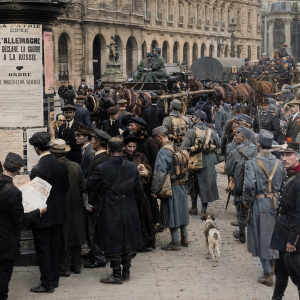
The conflict was initially greeted by considerable public enthusiasm in some European cities. Crowds gathered in Berlin, Paris, Vienna, London and St Petersburg, often cheering declarations of war and departing soldiers. Patriotic newspapers predicted victory and many believed the fighting would be over quickly.
The popular image that everyone expected the war to be finished “by Christmas” is somewhat simplified, but it is true that few people in August 1914 understood how long and destructive the conflict would become.
European armies were enormous compared with those of earlier centuries. Compulsory military service on the continent had created millions of trained reservists who could be mobilised rapidly. Germany, France, Russia and Austria-Hungary could place vast armies in the field within weeks.
Britain was different. Its regular army was relatively small because Britain traditionally relied heavily on the Royal Navy to protect the country and its worldwide empire. The professional British Expeditionary Force sent to France in August 1914 initially numbered only around 100,000 men, although it was highly trained and experienced.
The Royal Navy was one of Britain’s greatest advantages. During the years before the war, Britain and Germany had engaged in an expensive naval arms race. Germany had constructed an increasingly powerful High Seas Fleet under Admiral Alfred von Tirpitz, while Britain responded by expanding its own fleet and introducing revolutionary new battleships such as HMS Dreadnought.
When war came, Britain possessed the world’s most powerful navy. Its control of the seas would eventually allow the British Empire to transport millions of soldiers and enormous quantities of supplies while imposing a blockade on Germany and its allies.
The system of alliances is often described as the main reason the war spread so rapidly, although the situation was more complicated than two automatic blocks being dragged unwillingly into war.
Before 1914, Europe had become divided broadly between two diplomatic groupings. Germany, Austria-Hungary and Italy formed the Triple Alliance, although Italy did not initially enter the war because it argued that the alliance was defensive and Austria-Hungary had acted offensively against Serbia.
Facing them was the Triple Entente linking Britain, France and Russia. Again, this was not a single automatic military alliance in the strictest sense, but years of cooperation had brought the three powers increasingly close together.
Imperial rivalry had also contributed to tensions. Britain, France, Germany, Russia and other European states competed for territory, trade and influence across Africa, Asia and the Middle East. Germany, which had only been unified as a nation in 1871, wanted what many German leaders considered its rightful position as a world power.
France still remembered its defeat in the Franco-Prussian War of 1870–71, during which it had lost Alsace and Lorraine to the newly created German Empire. Although recovering these territories was not the only reason France entered the war, their loss remained a powerful element of French national feeling.
The Balkans were even more unstable. The declining Ottoman Empire had lost much of its territory in southeastern Europe, leaving newly independent states competing for land and influence. Two Balkan Wars in 1912 and 1913 had already demonstrated how easily regional disputes could become serious international crises.
Serbia had emerged from these wars stronger and more confident, alarming Austria-Hungary. Russia supported Serbia partly because of shared Slavic and Orthodox connections, but also because Russian leaders wanted greater influence in the Balkans and access towards the Mediterranean.
The military arms race further increased the danger. Governments had spent enormous amounts of money expanding armies, building battleships, developing artillery and constructing railway systems capable of moving troops rapidly towards national borders.
Modern military technology had advanced at a terrifying pace. Machine guns could fire hundreds of rounds per minute. Heavy artillery could destroy fortifications from many miles away. Magazine-fed rifles allowed infantrymen to maintain accurate rapid fire. Barbed wire could slow attacking troops while defenders fired from protected positions.
Yet many military doctrines still emphasised aggressive attacks and offensive spirit.
This combination would prove devastating.
Germany’s opening offensive in the west moved through Belgium according to the timetable of its war plan. Belgian resistance was much stronger than Germany expected. Fortresses around Liège delayed the advance, although enormous German siege guns eventually smashed many of the defensive positions.
Reports of German actions against Belgian civilians rapidly spread around the world. Some stories were exaggerated by Allied propaganda, but there were also genuine mass shootings, executions and destruction carried out by German troops who feared civilian resistance and irregular warfare.
The invasion created hundreds of thousands of Belgian refugees and became an important propaganda issue in Britain, where recruitment posters and newspapers repeatedly referred to the defence of “brave little Belgium”.
Meanwhile, the British Expeditionary Force crossed the English Channel and concentrated in northern France.
Its first major engagement came at Mons on 23 August 1914. British soldiers, many of them highly experienced regulars, used rapid rifle fire to inflict heavy casualties on advancing German troops. Some German soldiers reportedly believed they had been facing machine guns because of the speed and accuracy of the British fire.
Despite this resistance, the overwhelming strength of the German advance forced the British and French armies into a long retreat towards Paris.
For a time it appeared that Germany might achieve the rapid victory it had planned.
The situation changed dramatically during the First Battle of the Marne in early September 1914. French and British forces counter-attacked against the German right wing, which had become overstretched and exposed during its advance.
The German armies were forced to retreat to positions north of the River Aisne.
The failure to defeat France quickly was one of the most important moments of the entire war. Germany was now trapped in the two-front conflict its planners had tried desperately to avoid.
Both sides attempted to outflank each other further north in a series of movements later known as the Race to the Sea. By the autumn of 1914, a continuous defensive line stretched from the Belgian coast through northern France towards the Swiss frontier.
Soldiers began digging trenches to protect themselves from artillery, rifles and machine-gun fire.
What had begun as a war of rapid movement was turning into the static trench warfare that would become the defining image of the Western Front.
The war was also expanding far beyond France and Belgium.
Russia invaded East Prussia but suffered a devastating defeat at the Battle of Tannenberg in late August 1914, where German forces surrounded and destroyed much of the Russian Second Army. Austria-Hungary meanwhile struggled badly against Serbia and Russia during the opening months of the conflict.
The Ottoman Empire entered the war later in 1914 on the side of Germany and Austria-Hungary, greatly expanding the fighting into the Middle East, the Caucasus and the eastern Mediterranean.
Japan entered the war on the Allied side and attacked German possessions in China and the Pacific.
Britain’s worldwide empire meant soldiers would eventually arrive from Canada, Australia, New Zealand, India, South Africa, Newfoundland and many other territories. France similarly drew heavily upon troops from its colonial empire in Africa and Asia.
The First World War therefore became truly global.
Fighting took place in Europe, Africa, the Middle East, the Atlantic, the Pacific and parts of Asia. Naval blockades affected international trade, while submarines attacked merchant shipping across vast areas of ocean.
Britain initially depended on its small professional army, but a huge recruiting campaign soon began. Lord Kitchener, appointed Secretary of State for War, recognised that the conflict would require a far larger army than most British politicians had expected.
His image appeared on one of the most famous recruitment posters of the war, pointing directly towards the viewer with the message that Britain needed volunteers.
Millions eventually served.
Entire groups of friends, colleagues and neighbours joined together in units that became known as Pals battalions. This created powerful bonds between the men, but it also meant that when a battalion suffered heavy casualties, a single town or community could lose many of its young men in one battle.
The First World War would eventually introduce or greatly expand forms of warfare that seemed unimaginable to many people in 1914.
Poison gas would be used on a massive scale.
Aircraft would develop from fragile reconnaissance machines into fighters and bombers.
Submarines would threaten international shipping.
Tanks would appear on the battlefield.
Artillery barrages involving thousands of guns would transform entire landscapes into mud and craters.
Yet none of this was obvious during those dramatic weeks of July and August 1914.
The leaders who made the crucial decisions were reacting to immediate threats, alliance commitments, mobilisation timetables and their own assumptions about what their rivals intended. Many believed that failing to act quickly would leave their countries in an even more dangerous position.
This helped create one of the great tragedies of 1914.
Each government believed mobilisation by its opponents increased the need for its own mobilisation. Each military plan placed enormous importance on speed. Diplomats therefore had fewer and fewer opportunities to stop the crisis as armies began moving towards their borders.
Within 37 days of the assassination in Sarajevo, the major powers of Europe were at war.
The conflict they had entered would continue for more than four years.
By the time the fighting ended with the Armistice on 11 November 1918, the German, Austro-Hungarian, Russian and Ottoman empires had collapsed. Millions of soldiers and civilians were dead, vast areas of Europe had been devastated, and political boundaries across Europe and the Middle East had been transformed.
The peace settlement that followed would create new states but also new grievances and disputes. The Treaty of Versailles imposed severe conditions upon Germany, while revolution in Russia produced the Soviet Union. Political instability, economic hardship and resentment during the following decades would eventually contribute to the outbreak of another even greater conflict in 1939.
The beginning of the First World War therefore remains one of the most important turning points in modern history.
The assassination of Archduke Franz Ferdinand did not by itself cause the war. It acted as the spark that ignited a Europe already divided by rivalry, nationalism, military competition and fear.
During the summer of 1914, a regional dispute between Austria-Hungary and Serbia became a European war because each new decision triggered another. Mobilisation produced counter-mobilisation, alliances encouraged intervention and military timetables placed governments under extraordinary pressure to act quickly.
By the evening of 4 August 1914, Britain, France and Russia were facing Germany and Austria-Hungary in a conflict few people could yet imagine.
The armies marched away beneath flags and cheering crowds, many soldiers believing they would return home within months.
Instead, Europe was entering four years of trenches, artillery, mud, sacrifice and destruction that would change the world forever.