On this day in military history…
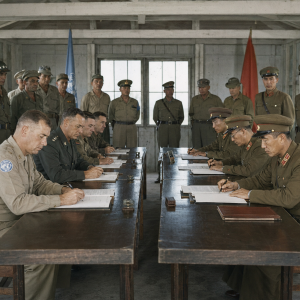
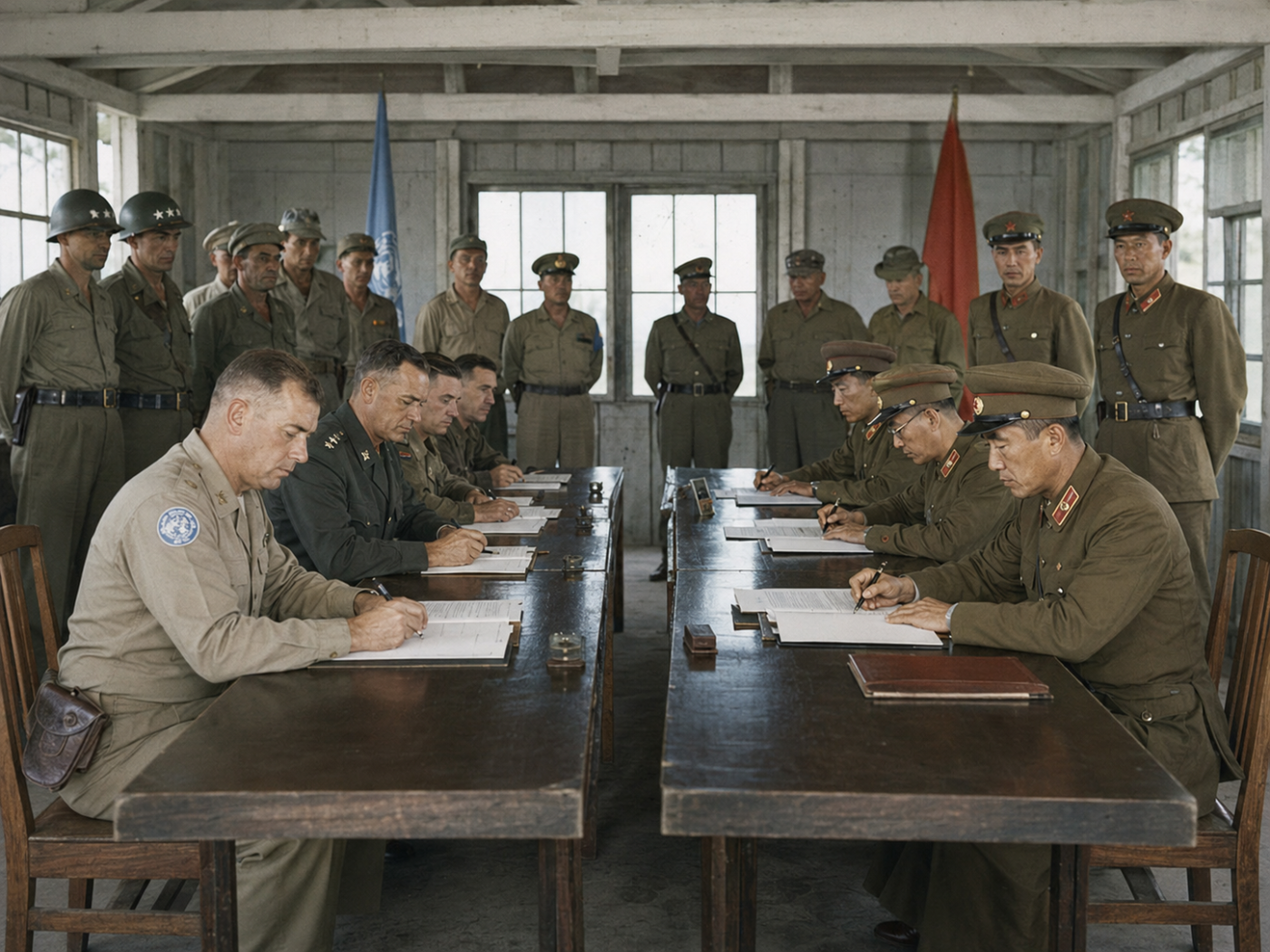
On 27 July 1953, after more than three years of brutal fighting, the guns finally fell largely silent across the Korean Peninsula as representatives of the United Nations Command, North Korea and Communist China signed the Korean Armistice Agreement. The agreement did not create a permanent peace treaty and technically did not end the Korean War, but it brought organised large-scale combat to a halt and established the military arrangements that still divide North and South Korea today.
The Korean War had begun on 25 June 1950 when North Korean forces crossed the 38th Parallel and invaded South Korea. The attack quickly overwhelmed much of the South Korean Army, forcing South Korean and United Nations forces into a shrinking defensive perimeter around the port of Pusan, now known as Busan. Under the authority of the United Nations, a multinational force led by the United States entered the conflict in support of South Korea.
The course of the war changed dramatically in September 1950 when General Douglas MacArthur launched the amphibious landing at Inchon. United Nations forces broke out of the Pusan Perimeter, recaptured Seoul and drove the North Korean Army back towards the Chinese border. For a time it appeared that the war might end with the reunification of Korea under the government in Seoul.
The intervention of Communist China transformed the conflict once again. Hundreds of thousands of Chinese troops entered the fighting, forcing United Nations forces southwards during a series of fierce winter battles. Seoul changed hands several times before the front eventually stabilised close to the original dividing line around the 38th Parallel.
By 1951 the war had become increasingly static. Instead of the sweeping advances and retreats that had characterised the first year, both sides fought over heavily fortified hills, ridges and defensive positions. Battles such as Heartbreak Ridge, Bloody Ridge and Pork Chop Hill became symbols of a war in which soldiers could suffer enormous casualties for relatively small pieces of ground.
British and Commonwealth forces played an important part in the conflict. Troops from Britain, Canada, Australia and New Zealand served alongside forces from the United States, South Korea and other United Nations countries. British soldiers fought in some of the war's hardest engagements, including the Battle of the Imjin River in April 1951, where the Gloucestershire Regiment became famous for its determined resistance against overwhelming Chinese forces.
Armistice negotiations began in July 1951, first at Kaesong and later at Panmunjom. The talks would continue for more than two years while the fighting carried on only a short distance away. The negotiations became some of the longest and most frustrating ceasefire talks in modern military history.
One of the greatest obstacles was the question of prisoners of war. The Communist side wanted prisoners to be automatically returned to their countries, while the United Nations Command argued that prisoners should not be forced to return against their will. Thousands of North Korean and Chinese prisoners held by the United Nations said they did not want to return to Communist-controlled territory.
The issue became politically explosive and repeatedly delayed an agreement. Eventually a system was established allowing prisoners who did not immediately wish to return home to be placed under the supervision of a Neutral Nations Repatriation Commission while their future was determined.
Another major part of the agreement concerned the position of the opposing armies. Rather than simply restoring the old border along the 38th Parallel, the armistice established a Military Demarcation Line based largely on the positions occupied by the opposing forces when the ceasefire came into effect.
Both sides were required to withdraw approximately two kilometres from this line, creating a strip of land about four kilometres wide running across the Korean Peninsula. This became the Korean Demilitarized Zone, normally known as the DMZ.
Despite its name, the DMZ became one of the most heavily defended borders in the world. Large numbers of troops, artillery positions, bunkers, observation posts, minefields and defensive obstacles were established immediately outside the restricted zone. For decades, North and South Korean soldiers have faced each other across this narrow buffer separating the two countries.
The DMZ stretches for roughly 250 kilometres across the Korean Peninsula, from the west coast near the Yellow Sea to the east coast near the Sea of Japan. Its route does not follow the 38th Parallel exactly because it reflects the military front line at the end of the fighting in 1953.
Within the DMZ lies the Joint Security Area at Panmunjom, one of the most recognisable locations associated with the Korean conflict. Here, buildings were constructed directly around the Military Demarcation Line, allowing representatives from both sides to meet while technically remaining within their respective areas.
The signing ceremony itself took place on 27 July 1953 at Panmunjom. Lieutenant General William K. Harrison Jr signed for the United Nations Command, while General Nam Il signed for the Korean People's Army and the Chinese People's Volunteers. The documents were later signed by senior commanders, including General Mark W. Clark for the United Nations Command.
South Korea itself was not a signatory to the armistice. South Korean President Syngman Rhee strongly opposed any agreement that left Korea divided and wanted the war to continue until the peninsula was unified. His government refused to sign the document, although South Korean forces ultimately observed the ceasefire arrangements.
The armistice required the fighting to stop within twelve hours of signing. Soldiers who had spent months living under artillery fire and the constant threat of attack suddenly found themselves facing an uneasy silence.
The agreement also established the Military Armistice Commission, which was intended to supervise the ceasefire, investigate alleged violations and maintain communication between the opposing sides. Neutral nations were also given roles in monitoring certain aspects of the agreement.
The prisoner exchanges that followed were among the largest humanitarian operations of the conflict. Sick and wounded prisoners had already been exchanged during Operation Little Switch earlier in 1953. After the armistice, Operation Big Switch began, involving the return of tens of thousands of prisoners held by both sides.
The human cost of the Korean War had been enormous. Millions of soldiers and civilians were killed, wounded or displaced, and much of the Korean Peninsula had been devastated. Cities, villages, roads, railways and industrial areas had been destroyed during three years of fighting and bombing.
Families were separated when the peninsula was divided, with many people never again seeing relatives who had ended up on the opposite side of the border. The armistice stopped the major fighting but did nothing to reunite these families or resolve the political division that had caused the conflict.
The DMZ gradually became a permanent feature of the Korean Peninsula. Although originally intended as part of a temporary military arrangement until a peaceful political settlement could be reached, no comprehensive peace treaty followed.
The area has remained the scene of numerous confrontations and incidents. Armed infiltrations, firefights, defections and political crises have occurred along and around the border. One of the most notorious incidents took place in the Joint Security Area in 1976 when two United States Army officers were killed by North Korean soldiers during a dispute over the trimming of a tree.
The DMZ itself has also developed an unusual environmental significance. Because civilian access has been severely restricted for decades, parts of the area have remained largely untouched by modern development. Wildlife has flourished in some sections, creating an accidental nature reserve within one of the most politically tense regions in the world.
The political situation created by the armistice remains unique. North and South Korea developed into two completely different states, each supported by different international alliances. South Korea eventually became a major economic and democratic power, while North Korea developed into one of the world's most isolated states.
The United States has continued to maintain military forces in South Korea as part of its defence commitment, while the Korean Peninsula remains one of the most militarised regions on earth.
Occasional meetings between North and South Korean leaders and negotiations involving the United States and other countries have raised hopes of a permanent peace agreement, but the 1953 armistice remains the foundation of the military ceasefire.
The absence of a formal peace treaty means that, in a strict political sense, the Korean War has never been completely concluded. The armistice stopped the shooting on the battlefield but left the underlying dispute unresolved.
For the soldiers who had fought across Korea's mountains, frozen valleys and shattered towns, however, 27 July 1953 marked the moment when one of the Cold War's bloodiest conflicts finally paused.
The Korean War Armistice remains one of the most important agreements of the post-war era. It ended more than three years of intense fighting, established the Military Demarcation Line and created the Demilitarized Zone that continues to divide the Korean Peninsula.
More than seven decades later, soldiers still stand guard on both sides of the DMZ, and the line established in 1953 remains a powerful reminder that the Korean War ended not with a final peace, but with a ceasefire that was intended to be temporary and instead became one of the longest-lasting military stand-offs in modern history.