Ww11 German Wooden Shu- Mine
The Schü-mine 42 was one of the simplest yet most feared German anti-personnel mines of the Second World War. Introduced into Wehrmacht service in 1942, its full German name was Schützenmine 42, meaning roughly “rifleman’s mine, model 1942”. Although it is sometimes incorrectly called the “shoe mine”, the abbreviation Schü came from Schützen rather than the German word for shoe. Small, cheap and easily concealed, the mine became particularly notorious because most of its body was made from wood, giving Allied engineers far less metal to detect than in conventional mines.
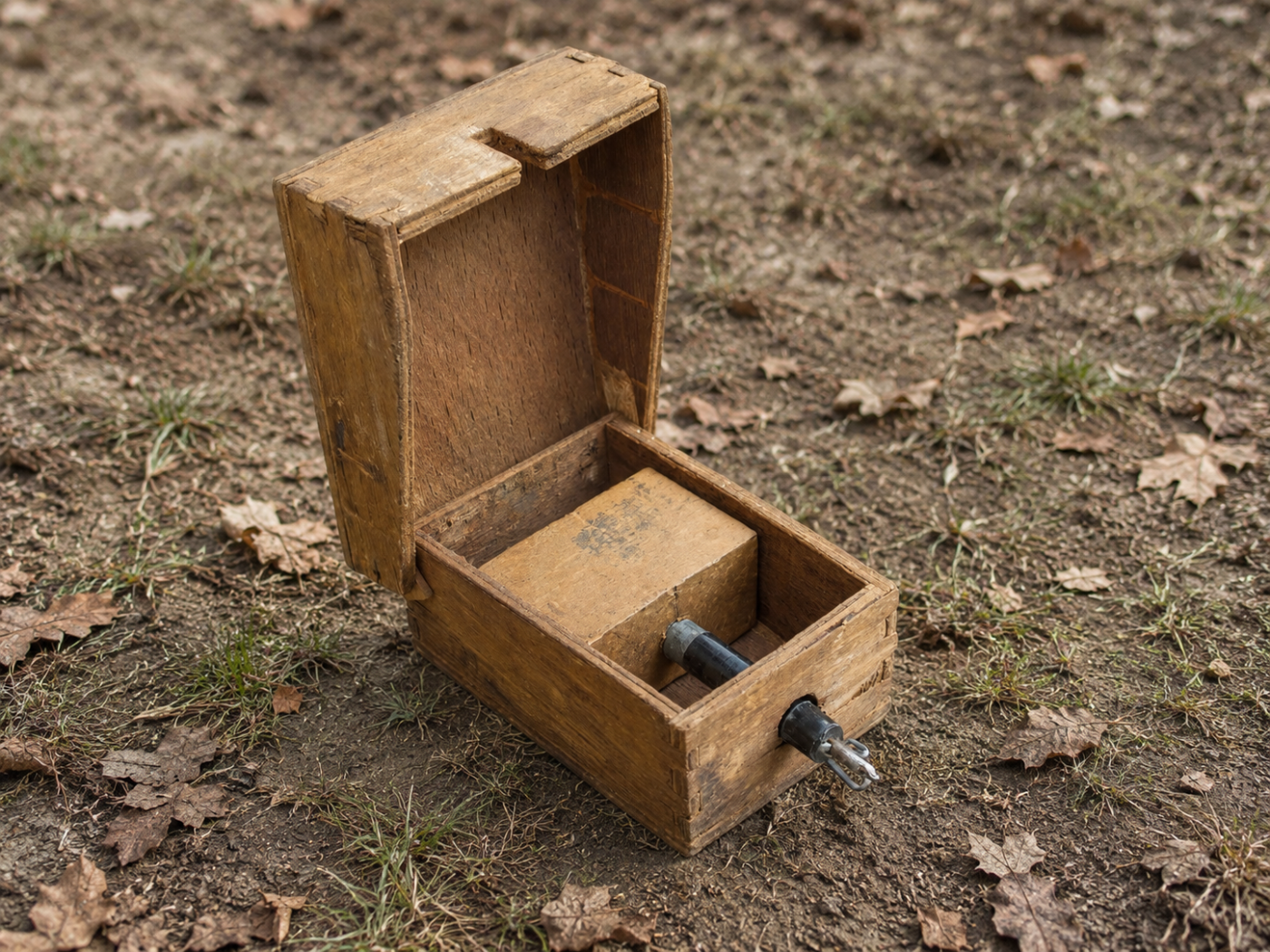
Unlike many weapons associated with famous designers, no single individual is reliably credited with inventing the Schü-mine 42. It emerged from Germany’s wartime military ordnance and engineering system at a time when the country was trying to conserve steel, aluminium and other strategically important materials. Its design was intentionally basic so that large quantities could be produced quickly using woodworking facilities and comparatively unskilled labour. Contemporary descriptions refer to a casing made from impregnated plywood, while some versions or related production used hardened compressed fibrous material. The simple wooden construction reduced the amount of metal required and helped make the mine extremely inexpensive to manufacture.
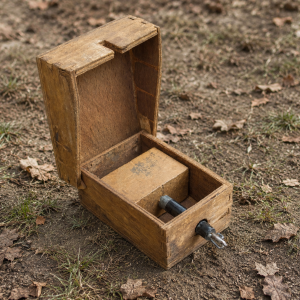
The standard Schü-mine 42 was little more than a small hinged wooden box, approximately 12–13 centimetres long, around 9–10 centimetres wide and roughly 5 centimetres high. Its complete weight was about half a kilogram. Inside was a 200-gram German Sprengkörper 28 demolition charge, normally containing TNT, together with a small detonating and firing mechanism. The wooden lid acted as the pressure surface. When a soldier stepped on the concealed mine, the downward movement operated the firing mechanism and detonated the charge beneath the foot. Contemporary sources give a relatively low operating pressure of only a few kilograms, meaning that the weight of a man stepping normally on the lid was more than sufficient to activate it.
Its destructive power did not come from a large fragmentation casing like Germany’s famous S-mine. Instead, the Schü-mine was a blast weapon intended to explode directly beneath a victim. Two hundred grams of TNT at such close range could cause catastrophic injuries to the foot and lower leg, frequently producing shattered bones, massive tissue damage and traumatic amputation. A soldier who survived could require lengthy evacuation and medical treatment, meaning that a small and inexpensive mine could remove not only the casualty but also stretcher-bearers and medical resources from the battlefield. Stones, soil and other surrounding material could also be violently thrown out by the explosion, increasing the danger to anyone nearby.
What made the Schü-mine particularly troublesome was its very small metal content. Early wartime mine detectors worked primarily by locating metal, but the Schü-mine’s wooden body produced almost no signal. Metal was still present in parts of the firing mechanism, so the mine was not literally invisible to every detector, but contemporary Allied reports emphasised that the detector head often had to pass very close before giving a reaction. In ground already littered with shell fragments, cartridge cases and other battlefield debris, locating one could become extremely difficult. Engineers were often forced to rely upon painstaking visual searches and careful probing rather than simply sweeping an area with a detector.
This difficulty became especially serious during the fighting in Normandy in 1944, where German forces made extensive use of mines to defend roads, hedgerows, tracks and prepared positions. British forces even employed mine-detection dogs in some areas to help locate mines that electronic equipment struggled to find. The danger continued long after a position had been abandoned because the small wooden boxes could be hidden beneath a thin covering of soil, vegetation or battlefield debris and were extremely difficult to see.
The mine’s simplicity was also part of a wider German wartime effort to reduce dependence upon scarce metals. As the war continued, Germany experimented with and produced mines using wood, pressed wood fibre, glass, concrete and other substitute materials. The Schü-mine 42 demonstrated that an effective anti-personnel weapon did not need an elaborate steel casing: a wooden container, a standard explosive charge and a simple firing system could create a weapon that was cheap to distribute in enormous minefields and disproportionately dangerous to the soldiers ordered to clear them.
There was also a grim psychological effect. A conventional metal mine could at least offer the possibility of being discovered electronically, but the Schü-mine forced infantrymen and engineers to distrust apparently harmless patches of earth. Every verge, gateway, hedgerow opening or disturbed piece of ground could conceal a box barely larger than a paperback book. That uncertainty slowed advances and made mine clearance exhausting and dangerous.
The Schü-mine 42 remained in German service from 1942 until the end of the war in 1945. Its concept proved influential enough that similar wooden pressure mines appeared after the Second World War, including designs derived from or closely resembling the German original. Today it remains a stark example of how simplicity, cheap materials and deliberate reduction of detectable metal could produce one of the most troublesome anti-personnel mines encountered by Allied troops in Europe.