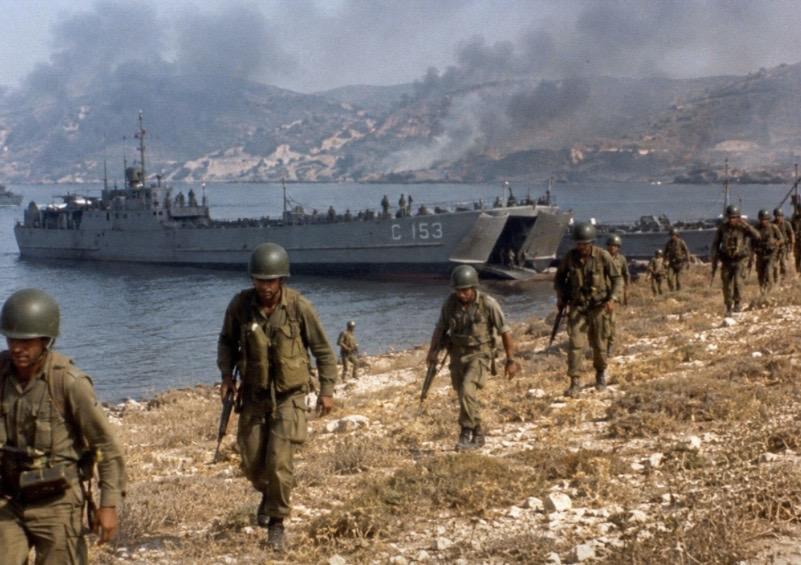
Turkey invades Cyprus
The Turkish invasion of Cyprus began on 20 July 1974 and became one of the most important and controversial military operations in the modern history of the eastern Mediterranean. Launched five days after a Greek-backed coup overthrew the Cypriot government, the operation divided the island, displaced hundreds of thousands of people and brought Greece and Turkey, both members of NATO, dangerously close to war. More than half a century later, Cyprus remains divided by the ceasefire line created during the fighting.
Cyprus had gained independence from Britain in 1960 after years of unrest and armed resistance to colonial rule. The new Republic of Cyprus was intended to be shared between the island’s Greek Cypriot majority and Turkish Cypriot minority. Archbishop Makarios III became president, while the Turkish Cypriot leader Fazıl Küçük served as vice-president. Britain retained the Sovereign Base Areas of Akrotiri and Dhekelia, and Britain, Greece and Turkey became guarantor powers under the Treaty of Guarantee.
The constitutional system was complicated and depended upon cooperation between the two communities. Government posts, parliamentary seats and public offices were divided according to agreed ethnic proportions, while the Turkish Cypriot vice-president possessed significant powers, including a veto over certain decisions. In practice, mistrust between the communities made the arrangement extremely difficult to operate.
Many Greek Cypriots supported enosis, the political ambition of uniting Cyprus with Greece. Many Turkish Cypriots opposed enosis and increasingly favoured taksim, the partition of Cyprus between Greek and Turkish-controlled areas. Violence between the communities intensified after constitutional disputes erupted in 1963. Turkish Cypriots withdrew or were forced from many government institutions, while thousands moved into defended enclaves. United Nations peacekeepers arrived in 1964 and established a ceasefire line through Nicosia that became known as the Green Line.
Although Archbishop Makarios had once been associated with enosis, he gradually accepted that an independent Cyprus offered the best chance of preserving the island’s security. This brought him into conflict with the military dictatorship governing Greece and with EOKA B, an underground Greek Cypriot organisation led by former EOKA commander George Grivas. EOKA B regarded Makarios as an obstacle to union with Greece and carried out attacks intended to destabilise his government.
On 15 July 1974, the Cypriot National Guard, controlled by Greek officers and encouraged by the military junta in Athens, launched a coup against Makarios. Tanks and troops attacked the Presidential Palace in Nicosia, which was heavily damaged. Makarios escaped through the building and was initially reported dead, but he reached the British base at Akrotiri and was flown from Cyprus.
The coup leaders installed Nikos Sampson, a journalist, former EOKA gunman and strong supporter of enosis, as president. Turkey regarded the coup as an attempt to annex Cyprus to Greece and as a direct threat to the Turkish Cypriot community. Makarios later appeared before the United Nations and described the coup as an invasion of Cyprus by the Greek military regime.
Turkey’s prime minister, Bülent Ecevit, began preparations for military action. The Turkish government argued that the Treaty of Guarantee allowed a guarantor power to intervene to restore the constitutional order if joint action by Britain, Greece and Turkey proved impossible. Ecevit travelled to London seeking British participation or cooperation, but the British government declined to join a military operation. Britain was concerned that intervention could produce a direct war between Greece and Turkey and place the British bases on Cyprus in danger.
Turkey nevertheless decided to act alone. The military plan, commonly known as Operation Atilla, involved an amphibious landing near Kyrenia on the island’s northern coast, supported by paratroopers and helicopter-borne forces landing around Nicosia and the Turkish Cypriot enclaves.
In the early hours of 20 July 1974, Turkish aircraft appeared over Cyprus. Air strikes were launched against military positions, communications centres, anti-aircraft batteries and installations around Kyrenia and Nicosia. Turkish paratroopers descended north of Nicosia, while helicopters carried troops into areas held by Turkish Cypriot fighters.
At sea, Turkish landing craft approached the coast near Pentemili, west of Kyrenia. The first troops began landing shortly after dawn, initially establishing a relatively narrow and vulnerable beachhead. Turkish forces encountered resistance from the Cypriot National Guard, which attempted to contain the landing area before reinforcements and tanks could be brought ashore.
The defenders were at a serious disadvantage. Cyprus had only a small National Guard equipped mainly with ageing weapons, including Soviet-built T-34 tanks, artillery and limited anti-aircraft equipment. Many of its senior Greek officers had been distracted by the coup and the effort to suppress supporters of Makarios. Some units were poorly positioned, communications were confused and mobilisation was incomplete when the invasion began.
Greek Cypriot forces nevertheless launched several determined attacks against the beachhead and Turkish Cypriot positions. Fighting took place around Kyrenia, the approaches to Nicosia, the airport and numerous villages. Turkish Cypriot enclaves elsewhere on the island were also attacked, as Greek Cypriot commanders attempted to prevent their fighters from supporting the invading forces.
The Turkish beachhead remained precarious during the first stages of the operation. Difficulties in coordination, navigation and communications caused confusion, while Turkish forces suffered from friendly-fire incidents. In one of the most serious episodes, Turkish aircraft mistakenly attacked Turkish naval vessels after misidentifying them as Greek ships. The destroyer Kocatepe was sunk, and other vessels were damaged, causing considerable loss of life.
Despite these problems, Turkish troops succeeded in reinforcing the landing area. Tanks, artillery and additional infantry were brought ashore, while airborne forces attempted to link with Turkish Cypriot positions around Nicosia. After heavy fighting, Turkish forces captured Kyrenia and established a corridor connecting the northern coast with the Turkish Cypriot quarter of Nicosia.
The United Nations Security Council called for an immediate ceasefire, an end to foreign military intervention and negotiations between Britain, Greece and Turkey. The fighting continued until a ceasefire came into effect on 22 July, although clashes and movements of troops persisted in several areas.
The first Turkish operation had secured only a limited area, but it created a continuous bridgehead running from the Kyrenia coast towards Nicosia. The invasion also caused political upheaval in both Cyprus and Greece. Nikos Sampson resigned on 23 July and was replaced by Glafcos Clerides, the president of the Cypriot House of Representatives. The military dictatorship in Athens collapsed soon afterwards, and civilian government was restored in Greece under Constantine Karamanlis.
Representatives of Greece, Turkey and Britain met in Geneva in an attempt to negotiate a settlement. The first Geneva agreement recognised the existence of Turkish-controlled areas and called for further talks concerning the island’s future. However, the negotiations quickly became deadlocked. Turkey demanded the establishment of a geographically defined Turkish Cypriot autonomous region, while the Greek Cypriot side argued that it needed more time to consider proposals that would fundamentally alter the country.
On 14 August, Turkey launched the second phase of its offensive. Turkish forces broke out from the Kyrenia–Nicosia corridor and advanced rapidly east and west. Supported by tanks, artillery and aircraft, they captured Morphou in the west and advanced towards Famagusta in the east. The National Guard, weakened by casualties, confusion and the political collapse in Greece, was unable to establish a continuous defensive line.
Famagusta became one of the most famous symbols of the conflict. As Turkish forces approached, much of the population fled. The modern tourist district of Varosha, once one of the Mediterranean’s most fashionable resorts, was sealed off by the Turkish military. Hotels, shops and homes were abandoned, creating a fenced and largely empty district that remained closed for decades.
The second offensive ended with a ceasefire on 16 August. Turkish forces controlled approximately 36 per cent of the island, including much of the fertile Mesaoria plain, the northern coastline, Kyrenia and the northern part of Nicosia. The ceasefire positions eventually became the basis of the United Nations-controlled buffer zone that continues to divide Cyprus.
The human consequences were immense. Estimates vary, but thousands of soldiers and civilians were killed, wounded or reported missing. Approximately 160,000 to 200,000 Greek Cypriots fled or were driven from homes in the north, while tens of thousands of Turkish Cypriots later moved from the south into the Turkish-controlled area. Prisoners were taken by both sides, and there were killings, disappearances, looting and attacks against civilians during the upheaval. The fate of missing people remained a source of anguish for families for decades.
Britain became heavily involved in the humanitarian response. British troops protected the Sovereign Base Areas, assisted refugees and helped evacuate foreign nationals. The British bases provided shelter to thousands of displaced Cypriots, but Britain did not use its forces to stop the Turkish advance. This decision has remained controversial, particularly because Britain was one of the three guarantor powers and maintained substantial military forces on and around the island.
Turkey continues to describe the operation as a peace intervention that protected Turkish Cypriots and prevented Cyprus from being absorbed into Greece. Turkish Cypriots often view 20 July as the moment they were rescued from the threat of enosis and renewed intercommunal violence. Greek Cypriots and the Republic of Cyprus regard it as an invasion and continuing occupation that expelled much of the population from the north and violated the sovereignty and territorial integrity of the republic.
In 1975, the Turkish-controlled region declared itself the Turkish Federated State of Cyprus. In 1983 it declared independence as the Turkish Republic of Northern Cyprus. The new state has been recognised only by Turkey. The United Nations and the wider international community continue to recognise the Republic of Cyprus as the legitimate government of the entire island, although it exercises effective authority only in the south.
Nicosia remains divided, making it the last divided capital in Europe. The United Nations buffer zone stretches for roughly 180 kilometres across Cyprus, varying from only a few metres wide in parts of Nicosia to several kilometres across in rural areas. Abandoned houses, military positions and deserted villages remain within the zone, guarded by United Nations peacekeepers.
Numerous negotiations have attempted to reunify Cyprus as a federation shared by the two communities. Border crossing points have opened, allowing Greek and Turkish Cypriots to travel across the dividing line, but disputes over territory, property, security guarantees, political power and the presence of Turkish troops have repeatedly prevented a permanent settlement.
The events beginning on 20 July 1974 reshaped Cyprus within a matter of weeks. What started as a confrontation over a Greek-backed coup developed into a major air, sea and land operation, the collapse of two governments and the physical division of an entire country. For Turkish Cypriots, the date is officially commemorated as a peace and freedom operation. For Greek Cypriots, it is remembered with sirens, memorial services and ceremonies marking invasion, loss and displacement. The opposing interpretations demonstrate why the events of 1974 remain so politically sensitive.
The invasion’s legacy can still be seen in the divided streets of Nicosia, the military watchtowers along the Green Line, the abandoned district of Varosha and the homes left behind by refugees from both communities. More than fifty years after Turkish forces landed near Kyrenia, the ceasefire remains in place, but no final peace agreement has been reached. The conflict of July and August 1974 therefore remains not merely an event from the island’s past, but an unresolved chapter in the history of Cyprus and the eastern Mediterranean.