Russian TT-33 Tokarev Pistol
During the Second World War, the Tokarev TT-33 became one of the most recognisable weapons carried by officers and soldiers of the Soviet Red Army. Slim, powerful and comparatively simple to manufacture, it represented the Soviet Union’s determination to replace older Imperial-era weapons with modern firearms designed for mass production. The TT-33 was the first successful Soviet-designed semi-automatic service pistol to be produced and issued in enormous numbers.
The story of the weapon began with the ageing Nagant M1895 revolver. This seven-shot revolver had served the forces of Imperial Russia and was inherited by the Red Army following the Russian Revolution. It was strong, dependable and capable of functioning in extremely difficult conditions, but by the 1920s its slow loading system, heavy trigger and relatively modest ammunition capacity made it increasingly outdated. The Soviet government therefore began searching for a modern self-loading pistol that could replace it as the standard sidearm of officers, vehicle crews, political personnel and specialist troops.
The man responsible for the successful design was Fedor Vasilyevich Tokarev, one of the Soviet Union’s most experienced firearms engineers. Born in 1871, Tokarev had served in the Imperial Russian Army and gained considerable knowledge of weapons manufacture before the Revolution. He later worked at the Tula Arms Plant, where he became involved in the development of rifles, machine guns and pistols. His experience allowed him to combine proven foreign design principles with features suited to Soviet manufacturing methods and military requirements.
During the late 1920s, the Red Army organised trials involving several domestic and foreign self-loading pistols. Tokarev produced a design chambered for the powerful 7.62×25mm cartridge, which had been developed from the 7.63mm Mauser round already familiar to Soviet forces. His pistol performed well during testing and was accepted in 1930 as the TT-30. The initials stood for Tula-Tokarev, identifying both the factory associated with its production and its designer.
The TT-30 was manufactured in limited quantities and issued for further military evaluation. Although it was considered promising, Soviet authorities wanted a weapon that would be easier and cheaper to manufacture in large numbers. Tokarev therefore revised the design, simplifying several components and altering the construction of the frame and barrel assembly. The improved version was accepted in 1933 and became known as the TT-33.
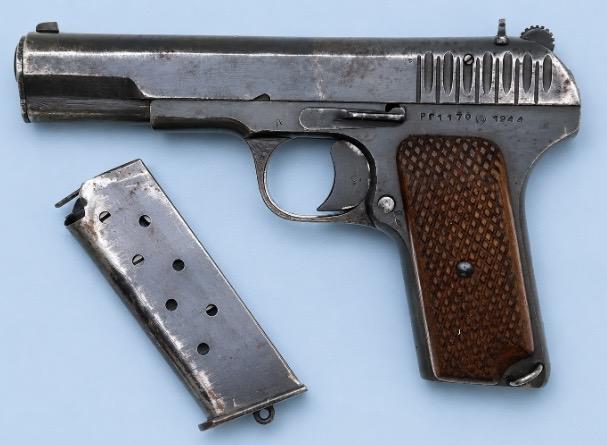
Externally, the pistol had a clean and purposeful appearance. It measured approximately 195 millimetres in length, with a barrel around 116 millimetres long, and weighed about 850 to 870 grams when unloaded. Ammunition was carried in a detachable eight-round box magazine inserted into the grip. Its narrow frame and relatively flat profile made it easier to carry in a leather holster than many bulkier contemporary military pistols.
The internal mechanism was influenced by the work of American designer John Moses Browning, particularly the locked-breech, short-recoil system used in the Colt M1911. When the pistol was fired, the barrel and slide moved backwards together for a short distance before unlocking. The slide then continued rearwards, extracting and ejecting the empty cartridge case before moving forward under spring pressure, loading a fresh round from the magazine.
Tokarev did not simply copy the American pistol. One of the most distinctive features of his design was its removable hammer and firing mechanism, which could be lifted from the frame as a single unit. This simplified cleaning and maintenance, while the unit also incorporated the magazine feed lips. On many pistols, damaged feed lips could make the magazine unreliable, but the arrangement used in the TT series helped ensure that cartridges were presented consistently to the chamber.
The 7.62×25mm Tokarev cartridge gave the pistol much of its reputation. It fired a relatively small bullet at unusually high velocity for a handgun of the period, normally at around 420 metres per second depending upon the ammunition and barrel. The cartridge produced a flat trajectory and considerable penetration, particularly against heavy clothing and light obstacles. It was also adopted for Soviet submachine guns, including the famous PPSh-41 and PPS-43, simplifying ammunition production even though pistol and submachine-gun loadings could vary.
The power of the round came with disadvantages. The sharp muzzle blast and recoil could make the pistol more difficult to control than weapons chambered for less powerful ammunition. Its narrow grip was not comfortable for every user, while the small sights were intended for rapid military shooting rather than precision target work. Nevertheless, in the hands of a trained soldier, it was capable of effective fire at normal combat distances.
One controversial feature was the absence of a conventional manual safety catch on standard Soviet military examples. The hammer could be placed at a half-cock position, which was intended to provide a degree of security and could also lock the slide. However, this was not as convenient or reassuring as the positive safety fitted to many other service pistols. Soviet soldiers frequently carried the weapon with an empty chamber, only loading it when danger was expected. Some later export versions and foreign-manufactured copies were fitted with additional safety catches to comply with different national regulations.
Production increased during the late 1930s as the Soviet Union expanded and modernised its armed forces. Even so, the older Nagant revolver was never completely replaced. Both weapons remained in production and were widely used during the Second World War. The revolver’s simplicity and established manufacturing system ensured that it continued to be issued alongside the newer pistol throughout the conflict.
When Germany invaded the Soviet Union on 22 June 1941, the Red Army suffered catastrophic losses of men, territory and equipment. The advance threatened several important industrial centres, forcing the evacuation of factories and machinery towards the east. Tula, closely associated with the pistol, came under direct threat during the German drive on Moscow. Production was consequently transferred and expanded at other facilities, including Izhevsk, as Soviet industry struggled to replace the huge quantities of weapons lost during the opening months of the campaign.
Wartime production placed speed and quantity above appearance. Earlier examples were often neatly machined and carefully finished, but pistols produced during the most desperate years of the war could show rougher surfaces and visible machining marks. These changes rarely affected their essential function. Like many Soviet weapons, it was intended to remain serviceable despite mud, snow, dust, poor maintenance and the pressures of mass mobilisation.
The handgun was primarily associated with officers, but it was also carried by tank crews, artillerymen, pilots, military police, security personnel and soldiers whose duties made a full-sized rifle inconvenient. In close combat it served as an emergency weapon, while its compact shape made it useful in vehicles, buildings and trenches. Soviet political officers were particularly associated with the pistol, contributing to its powerful image in wartime photography, propaganda and later popular culture.
It saw action in every major Soviet campaign of the war, from the defence of Moscow and the fighting at Stalingrad to Kursk, Operation Bagration and the final assault on Berlin. Captured examples were also used by German troops, who regularly pressed enemy weapons into service when ammunition was available. The 7.62×25mm round’s close relationship to the 7.63mm Mauser cartridge made captured ammunition and weapons particularly useful under certain circumstances.
Despite its strengths, the design was not perfect. Its magazine could sometimes be accidentally released, its grip panels could become damaged, and the absence of a conventional safety remained a concern. The powerful ammunition was more than was required for many ordinary defensive situations, while the pistol’s single-action mechanism meant that the hammer had to be cocked before the first shot unless it was already carried in that condition.
After the war, Soviet planners reconsidered the role of the military handgun. The arrival of compact automatic weapons and the development of the assault rifle meant that the pistol was increasingly viewed as a personal defence weapon rather than an important offensive firearm. A smaller, simpler weapon using a less powerful cartridge was considered more suitable. This resulted in the adoption of the 9×18mm Makarov pistol during the early 1950s.
Although replaced as the principal Soviet service handgun, the TT-33 did not disappear. Large stocks remained in military arsenals, police armouries and reserve storage for decades. The design was also manufactured or adapted by several Soviet allies, including China, Poland, Hungary, Romania, Yugoslavia and North Korea. Some countries produced almost direct copies, while others modified the grip, magazine capacity, calibre or safety arrangements.
China manufactured large numbers under several designations, including the Type 51 and Type 54. Yugoslavia developed the longer-gripped Zastava M57, which used a nine-round magazine. Hungary produced its own versions, including pistols chambered for 9×19mm ammunition, while Poland and Romania manufactured models that remained close to the Soviet original. As a result, Tokarev-pattern pistols appeared in conflicts across Asia, Africa, the Middle East and Eastern Europe throughout the Cold War.
The pistol’s widespread distribution gave it a service life far beyond anything imagined by its original designer. It was used during the Korean War, the Vietnam War and numerous post-colonial and regional conflicts. Even after more modern weapons became available, its durability, powerful cartridge and simple construction allowed surviving examples to remain in use.
Today, the TT-33 is remembered as one of the classic military pistols of the Second World War. It lacked the refinement of some Western designs and did not possess the advanced safety arrangements expected from modern handguns, but it fulfilled the Soviet requirement for a strong, compact and powerful service weapon that could be manufactured on a vast scale.
Carried from the ruins of Stalingrad to the streets of Berlin, it became closely linked with the Red Army’s struggle against Nazi Germany. The simple outline, distinctive star-marked grips and powerful 7.62mm cartridge ensured that the Tula-Tokarev would remain one of the most enduring weapons associated with the Soviet soldier and the brutal fighting of the Second World War.