Royal Scots Dragoon Guards
The Royal Scots Dragoon Guards are Scotland’s senior and only regular cavalry regiment. Their history reaches back to the seventeenth century and combines the traditions of the 3rd Carabiniers and the 2nd Dragoons, better known as the Royal Scots Greys. Across more than three centuries, their predecessors fought in Europe, India, South Africa, the Crimea, both world wars and numerous modern campaigns. Their remarkable heritage includes the capture of a French Imperial Eagle at Waterloo, the charge of the Heavy Brigade at Balaclava and distinguished service with tanks during the Second World War. The regiment’s full title is The Royal Scots Dragoon Guards (Carabiniers and Greys), commonly shortened to the Royal Scots Dragoon Guards or SCOTS DG.
The regiment’s story began during a troubled period of British history marked by religious division, rebellion and uncertainty over the succession to the Crown. In 1678, several independent troops of Scottish horse were raised for service under King Charles II. These were brought together in 1681 to form the Royal Regiment of Scots Dragoons. The men originally wore grey coats and rode predominantly grey horses, leading to the informal name “Scots Greys.” Although the uniform later changed, the famous grey horses remained closely associated with the regiment for generations.
Dragoons were originally mounted infantry who travelled on horseback but could dismount to fight with firearms. As battlefield tactics developed, they increasingly operated as heavy cavalry, using the speed and weight of mounted charges to break enemy formations. The other major part of the modern regiment’s ancestry began in England in 1685, when troops of cavalry were raised in response to the Monmouth Rebellion. These eventually became part of the regiment later known as the 3rd Carabiniers. The name “carabinier” referred to a cavalryman armed with a carbine, a shortened firearm suitable for mounted use.
The Scots Greys established an early reputation during the War of the Spanish Succession. Fighting under John Churchill, Duke of Marlborough, they took part in several of the greatest British victories of the early eighteenth century. They fought at Blenheim in 1704, Ramillies in 1706, Oudenarde in 1708 and Malplaquet in 1709. These victories helped establish Britain as a major European military power and strengthened the regiment’s reputation for determined mounted action. During this period it became officially known as the Royal North British Dragoons, although the name “Scots Greys” remained far more popular.
The regiment served during the Jacobite rising of 1715 and was present at the Battle of Sheriffmuir, where government troops confronted the forces of the Earl of Mar. It later fought during the Seven Years’ War, including at Minden in 1759 and Warburg in 1760. By then the Scots Greys had developed into formidable heavy cavalry, capable of delivering powerful battlefield charges against infantry and opposing horsemen.
The most celebrated episode in the history of the Scots Greys came at the Battle of Waterloo on 18 June 1815. The regiment formed part of Major-General Sir William Ponsonby’s Union Brigade alongside the 1st Royal Dragoons and the 6th Inniskilling Dragoons. It was called the Union Brigade because its three regiments represented England, Scotland and Ireland.
During the battle, the Scots Greys charged French infantry attacking the Allied centre. They passed through and around the ranks of Scottish infantry before crashing into the advancing French columns. The sight of grey horses, red-coated cavalrymen and Scottish soldiers moving forward together became one of the enduring images of Waterloo.
During the charge, Sergeant Charles Ewart captured the eagle and standard of the French 45th Regiment of the Line. Ewart fought his way through several French soldiers before securing the trophy. The captured eagle became one of the regiment’s proudest honours and remains an important part of its badge and identity.
The charge inflicted severe damage on the French infantry, but its success came at a heavy price. Carried forward by excitement and momentum, parts of the Union Brigade advanced too far and lost cohesion. French cavalry counter-attacked, killing Ponsonby and inflicting serious casualties. The battle honour “Waterloo” and the French eagle commemorate both the bravery and sacrifice of the regiment that day.
The Scots Greys returned to major campaigning during the Crimean War of 1854–56, serving as part of the Heavy Brigade commanded by Brigadier-General James Yorke Scarlett. At the Battle of Balaclava on 25 October 1854, Russian cavalry advanced towards the British position. Earlier that day, the 93rd Highlanders had faced another Russian cavalry force in the action remembered as the “Thin Red Line.”
Scarlett’s Heavy Brigade, including the Scots Greys, charged uphill against a larger formation of Russian horsemen. Despite attacking from a difficult position and being heavily outnumbered, the British cavalry drove the Russians back. The action received less public attention than the later Charge of the Light Brigade, but it was one of the most successful British cavalry charges of the Crimean War.
The other half of the modern regiment’s ancestry developed through the 3rd Dragoon Guards and the 6th Dragoon Guards, known as the Carabiniers. These regiments served extensively across the British Empire, particularly in India and South Africa. Cavalrymen conducted reconnaissance, escorted columns, guarded communications and fought both mounted and dismounted.
In 1922, following reductions in the British Army after the First World War, the 3rd and 6th Dragoon Guards amalgamated to form the 3rd/6th Dragoon Guards. In 1928 the regiment was renamed the 3rd Carabiniers (Prince of Wales’s Dragoon Guards). It spent much of the inter-war period in India and later exchanged its horses for armoured vehicles as the British cavalry became mechanised.
The Scots Greys served during the Second Boer War between 1899 and 1902. The campaign demonstrated that traditional massed cavalry charges were becoming increasingly dangerous against modern rifles, machine guns and artillery. Cavalry regiments were instead used for reconnaissance, screening and mobile operations, often fighting on foot. These experiences helped prepare the Army for the enormous tactical and technological changes of the First World War.
When war began in August 1914, the Scots Greys deployed to France as part of the 5th Cavalry Brigade. Cavalry remained useful during the mobile opening stages of the campaign, conducting reconnaissance and protecting the flanks of the British Expeditionary Force. Once trench warfare took hold, opportunities for mounted action became limited and the regiment frequently fought dismounted in the trenches.
Its soldiers used rifles, machine guns and grenades in much the same manner as infantry while remaining available for mounted operations should the front become mobile. They served through the major campaigns on the Western Front and endured artillery fire, mud, gas and heavy casualties. Cavalry regiments continued to act as mobile reserves and became useful again during the more fluid fighting of 1918.
The Scots Greys exchanged their horses for tanks shortly before the Second World War. Although this was a profound change, their roles of mobility, reconnaissance, shock action and rapid exploitation remained closely connected to their cavalry origins. Officially titled the 2nd Dragoons (Royal Scots Greys), the regiment served with distinction in the Middle East and North Africa.
Equipped at different times with Stuart, Grant and Sherman tanks, the Greys fought German and Italian forces in the Western Desert. They took part in the Second Battle of El Alamein in 1942 and the pursuit of Axis forces across North Africa into Tunisia. The regiment then fought in Italy, where tanks had to negotiate mountains, rivers, mines and heavily defended German positions while working closely with infantry, artillery and engineers.
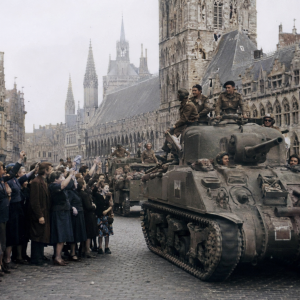
In 1944, the Scots Greys returned to Britain and prepared for the liberation of north-west Europe. After landing in Normandy, they fought through France, Belgium and the Netherlands before entering Germany. Their Sherman tanks supported infantry formations, attacked fortified positions and helped exploit Allied breakthroughs.
The 3rd Carabiniers served in the Far East and fought against the Japanese in Burma. Their tanks operated in exceptionally difficult conditions, including dense jungle, poor roads, monsoon rain and numerous river crossings. The protection and firepower they provided were vital to British and Indian infantry during the campaign to drive Japanese forces out of Burma.
After 1945, the British Army underwent repeated reductions as the Empire contracted and military priorities changed. Historic cavalry regiments were amalgamated to preserve their traditions within a smaller force. On 2 July 1971, the 3rd Carabiniers and the Royal Scots Greys united at Holyrood in Edinburgh to form The Royal Scots Dragoon Guards (Carabiniers and Greys).
The amalgamation joined the Indian and Far Eastern traditions of the Carabiniers with the Scottish, European and armoured heritage of the Greys. The French eagle captured at Waterloo remained central to the new regiment’s insignia, while the name preserved the identity of both its principal predecessors.
During the Cold War, the regiment served mainly as an armoured formation equipped with main battle tanks. Much of its strength was stationed in West Germany as part of the British Army of the Rhine. Its role was to help defend NATO territory against a possible Warsaw Pact invasion.
Crews trained for fast-moving armoured warfare involving tanks, reconnaissance vehicles, artillery and aircraft. The regiment operated Chieftain and later Challenger tanks. Although the feared invasion never came, Cold War service demanded constant readiness, with soldiers expected to operate in all weather and under the possible threat of conventional, chemical or nuclear attack.
Following Iraq’s invasion of Kuwait in 1990, the Royal Scots Dragoon Guards deployed to the Gulf as part of Operation GRANBY. Equipped with Challenger 1 tanks, the regiment crossed into Iraq during the coalition ground offensive in February 1991. British armoured forces advanced rapidly through Iraqi defensive positions, destroying enemy tanks and other armoured vehicles. Kuwait was liberated after a remarkably short ground campaign.
The regiment later contributed to operations in Iraq following the 2003 invasion. These deployments differed greatly from conventional armoured warfare, with soldiers conducting patrols, protecting bases, training local security forces and working among civilian communities in an unstable environment.
The Royal Scots Dragoon Guards also served in Afghanistan, where its soldiers operated armoured vehicles and carried out reconnaissance and ground-holding duties. They faced the constant dangers of improvised explosive devices, ambushes and attacks on isolated positions. These campaigns demonstrated how cavalry soldiers could operate from heavy armour, lighter reconnaissance vehicles or on foot alongside infantry.
As part of a later restructuring of the British Army, the regiment changed from a heavy armoured formation to a light cavalry role and became equipped with the Jackal family of high-mobility vehicles. The Jackal is designed for reconnaissance, rapid movement and fire support. It relies more on speed, observation and tactical awareness than the thick armour of a main battle tank.
The regiment’s modern tasks include locating the enemy, gathering information, screening larger formations and conducting mobile patrols. Although its equipment has changed dramatically since the days of horse-mounted dragoons, reconnaissance, flexibility and bold manoeuvre remain at the centre of its cavalry role.
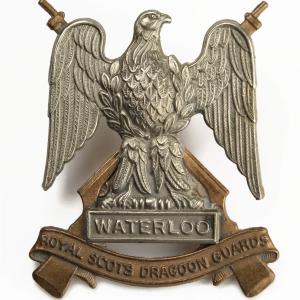
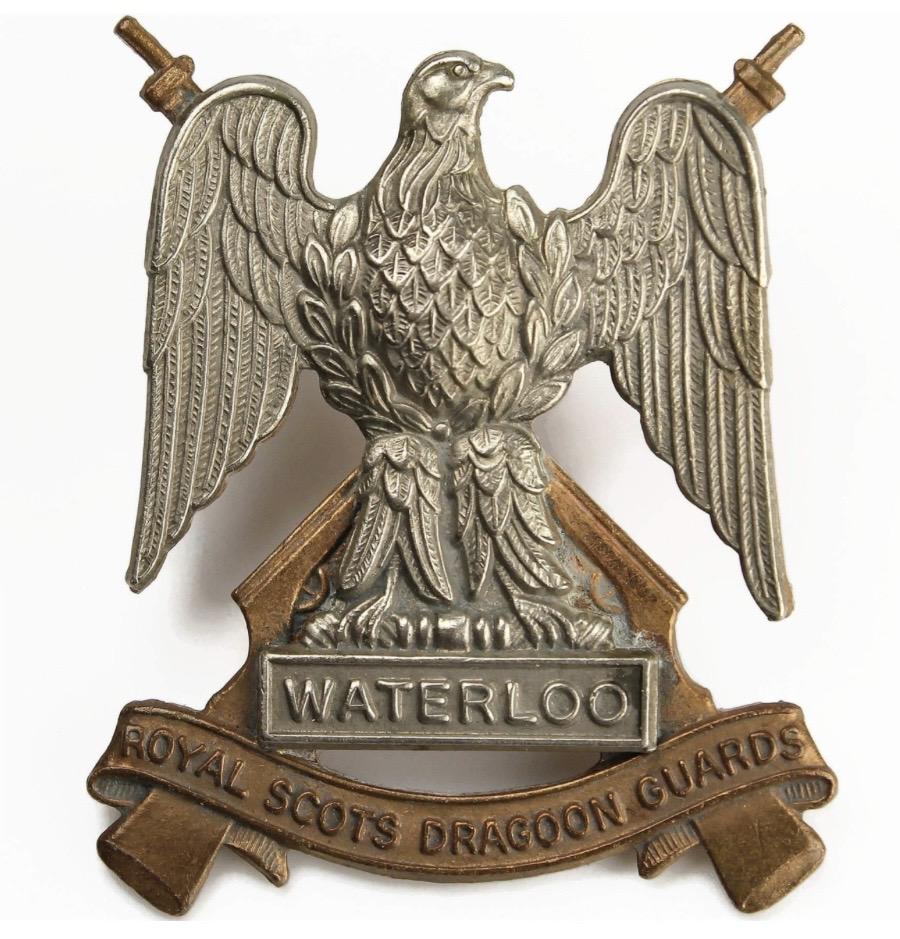
The regiment preserves many traditions inherited from its predecessors. Its soldiers are recognisable on ceremonial occasions by their tall bearskin caps and distinctive white plumes. The French eagle captured at Waterloo appears in the cap badge, while the regimental motto, “Nemo Me Impune Lacessit,” is generally translated as “No one provokes me with impunity.”
Waterloo Day is commemorated each year in memory of the Union Brigade’s charge and Sergeant Charles Ewart’s capture of the French eagle. Balaclava Day recalls the Crimean War and the victorious charge of the Heavy Brigade. Despite spending much of its operational history overseas, the regiment continues to maintain close recruiting, ceremonial and cultural links with Scotland.
The Royal Scots Dragoon Guards achieved an unusual distinction away from the battlefield when their recording of “Amazing Grace,” featuring the Pipes and Drums, reached number one in the United Kingdom singles chart in 1972. It became an international success and remains one of the best-known military music recordings ever released.
The history of the Royal Scots Dragoon Guards is the combined story of several cavalry regiments raised at different times and eventually united through amalgamation. Their soldiers progressed from grey horses and carbines to Sherman tanks, Challenger main battle tanks and modern reconnaissance vehicles. They fought in cavalry formations, served dismounted in the trenches, crossed the North African desert and patrolled the roads of Iraq and Afghanistan.
The capture of the French eagle at Waterloo remains their most famous achievement, but the regiment’s wider history is equally distinguished. From Blenheim and Balaclava to El Alamein, Burma and the Gulf, successive generations adapted to new weapons, enemies and forms of warfare. Today, the Royal Scots Dragoon Guards continue to carry the standards, battle honours and traditions of Scotland’s historic cavalry, preserving a proud record of courage, mobility, discipline and determination stretching back more than three centuries.