Regelbau Bunkers
The concrete bunkers of the Atlantic Wall in Normandy were not the work of one architect in the ordinary sense. They were the product of a standardised German military engineering system, developed from earlier fortification experience and then applied on a huge scale along the occupied coastline of western Europe. The key word was Regelbau, meaning standard construction or standard design. A Regelbau bunker was not improvised from scratch each time it was built. It belonged to a numbered catalogue of approved designs, each intended for a particular military purpose: a machine-gun position, an anti-tank gun casemate, a command post, an observation bunker, a personnel shelter, an ammunition store, or a naval fire-control position.
The system came about because Germany had already been thinking deeply about permanent fortifications before the Atlantic Wall was built. In the 1930s, German fortress engineers worked on defensive positions such as the Westwall, known to the Allies as the Siegfried Line. From that experience they learned that concrete fortification could not be treated as a collection of one-off local building projects. It required standard plans, standard armour fittings, standard doors, standard ventilation systems, standard embrasures and standard construction grades. By the time Germany occupied France, Belgium, the Netherlands, Denmark and Norway, it already had a culture of fortress engineering that could be expanded across the Atlantic coast.
The Atlantic Wall was therefore less a continuous wall than a chain of strongpoints, batteries, beach defences, observation posts and hardened shelters. In Normandy, these positions were fitted into the natural shape of the coast: cliffs, dunes, ports, villages, road exits and likely landing beaches. The German engineers did not simply pour concrete wherever they wished. They chose designs from the Regelbau catalogue according to tactical need. A road junction might need an anti-tank casemate. A battery might need a naval command bunker. A beach exit might be covered by machine guns from an armoured cupola. A gun position might need ammunition rooms, crew shelter, gas protection, communications, escape routes and overhead cover. The genius of the system, from an engineering point of view, was that all of this could be planned using known patterns.
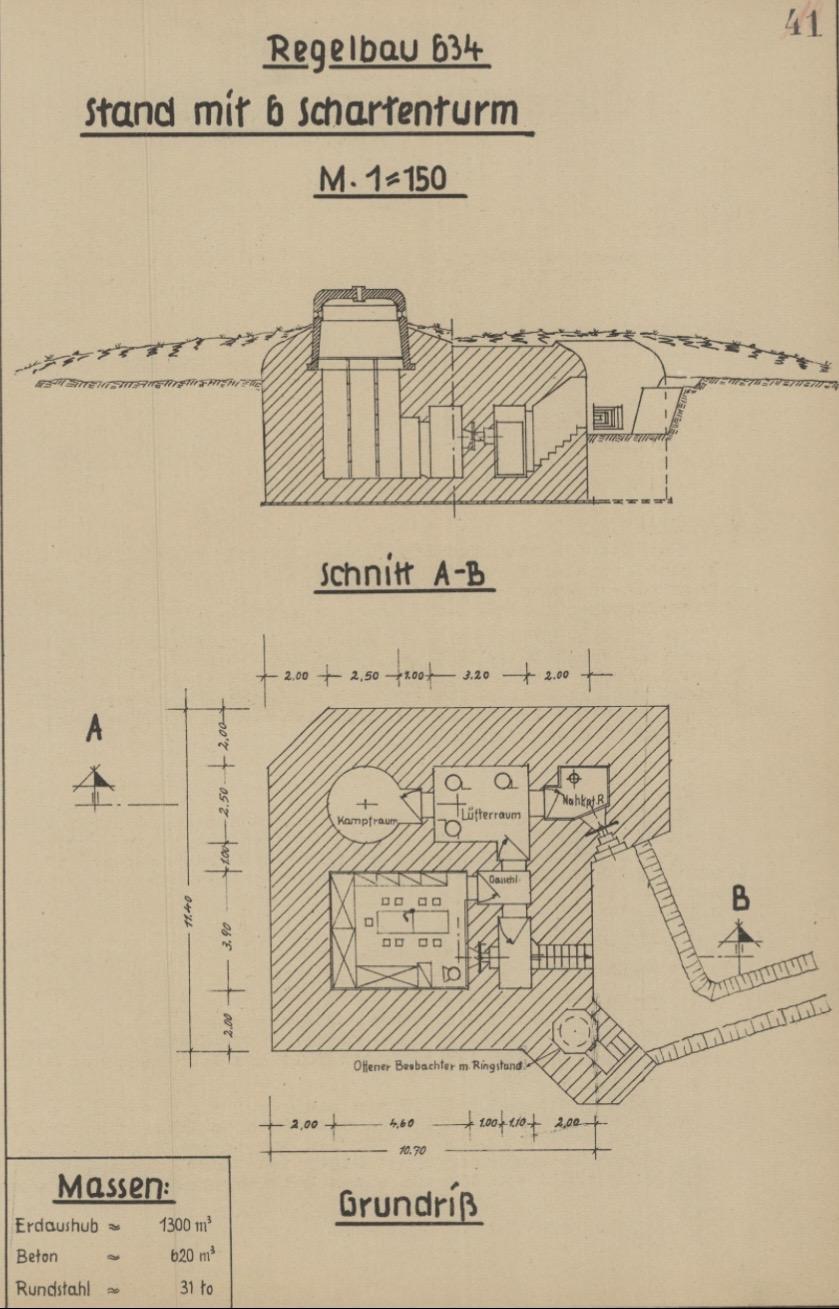
One example was the Regelbau 634, known in German as Stand mit 6-Schartenturm, a combat bunker with a six-embrasure armoured turret. Its role was very different from an open field position. Instead of exposing machine-gunners behind sandbags or in a simple concrete slit trench, the 634 placed the weapon crew inside a reinforced bunker under a heavy steel cupola. The turret had six firing openings, allowing machine guns to cover a wide arc. This made it useful for all-round defence of a strongpoint, particularly where infantry might approach from more than one direction. The bunker also included internal accommodation for the crew and the necessary protective systems that made it a self-contained fighting position. Compared with a casemate firing in one fixed direction, the 634 was more flexible, but it depended on scarce armour components and required careful installation of the cupola.
The Regelbau 676 was a different kind of design. It was a small casemate for the 4.7 cm fortress anti-tank gun, often referred to as the 4.7 cm Festungspak. This type reflected a common German solution on the Atlantic Wall: use a protected concrete chamber to house a gun that could fire through an embrasure across a road, beach approach or likely vehicle route. The 676 was not designed for all-round machine-gun defence like the 634. Its purpose was more specialised. It gave a small anti-tank gun protection against shell splinters, small arms and aerial attack while allowing it to fire along a predetermined line. In Normandy and elsewhere, such a bunker would be sited to create an ambush effect, firing across an approach rather than straight out in the most obvious direction. This kind of flanking fire was central to German defensive thinking.
The Regelbau 677 was larger and more powerful in purpose. It was a casemate for the 8.8 cm Pak 43/41, a much heavier anti-tank gun. This design represented the attempt to harden a powerful weapon against bombardment while still allowing it to dominate a sector of ground. Unlike the smaller 676, the 677 had to accommodate a much larger gun, more recoil, heavier ammunition and a wider working space for the crew. It was therefore a more demanding engineering problem. The embrasure had to be large enough to allow the weapon to function, but every opening in a bunker was also a weakness. German bunker design constantly balanced field of fire against protection. A wide opening gave a better firing angle, but it also gave enemy shells, blast and fragments a way in. The 677 shows this compromise very clearly: it was built to protect a formidable gun, but the gun still needed a mouth through which to fight.
The M 262 belonged to a different family, associated with Kriegsmarine coastal defence rather than ordinary army field positions. The letter M indicated a naval design. Naval coastal batteries needed observation, range-finding and fire-control bunkers as much as they needed gun casemates. A bunker such as the M 262 was therefore not simply a place to hide troops. It formed part of the command and observation system that allowed coastal artillery to identify targets, calculate ranges and direct fire. In a coastal defence network, this kind of bunker was as important as the gun itself. Without observation and communications, heavy guns could not be used effectively against ships or landing craft. The M-series designs show that the Atlantic Wall was not just an army project but a combined defensive system involving the army, navy and air force, each with its own requirements.
The differences between these designs reveal the logic of the whole Regelbau system. The 634 was an armoured machine-gun strongpoint with a six-embrasure turret. The 676 was a small anti-tank casemate for a 4.7 cm gun. The 677 was a larger anti-tank casemate for the 8.8 cm Pak 43/41. The M 262 was a naval command or observation-related bunker connected to coastal artillery control. They were not variations of the same bunker. They were different answers to different battlefield questions. How do you give infantry a protected all-round machine-gun position? Use a turret bunker such as the 634. How do you cover a road or beach approach with a small anti-tank gun? Use a casemate such as the 676. How do you protect a heavier anti-tank gun while still giving it a firing aperture? Use a larger gun casemate such as the 677. How do you control coastal artillery fire? Use a naval observation or command bunker such as the M 262.
Standardisation had many advantages. It allowed engineers to calculate concrete, steel, timber and labour requirements in advance. It meant that armour plate, doors, ventilation systems, gas-proof fittings, periscopes, cupolas and gun mounts could be ordered from factories in known patterns. It simplified training because construction crews and engineers could work from familiar plans. It also allowed military commanders to request a type of bunker by number, rather than explain every dimension and fitting from the beginning. On a project as huge as the Atlantic Wall, this mattered enormously. The German coastline defence programme stretched from Norway to the Bay of Biscay and beyond, so speed and repetition were vital.
Yet standardisation also had limits. The Atlantic coast was not uniform. Normandy was not the same as Denmark, Norway or the Pas-de-Calais. Local terrain, soil conditions, water tables, existing villages, cliffs, beaches and roads all forced modifications. A Regelbau design might be adapted, rotated, partly buried, camouflaged or connected to trenches and open positions. In some places the Germans used captured weapons, especially Czech, French or Soviet guns, and this affected bunker choice. In other places they lacked the steel armour or concrete needed to complete the ideal plan. As the war turned against Germany, shortages became more serious. Standard design did not always mean perfect construction.
The organisation that turned these designs into concrete reality was Organisation Todt. It had begun before the war as a vast engineering and construction body associated with Fritz Todt, who had been involved in major state building projects including the autobahn and the Westwall. When Germany began building the Atlantic Wall, Organisation Todt became the essential construction machine. It organised contractors, transport, materials, technical supervision and labour. Its work was not simply engineering in the neutral sense. It was part of the Nazi war economy and relied heavily on forced labour, prisoners of war, conscripted workers and poorly paid local labourers from occupied countries. Behind the clean lines of the bunker drawings lay a brutal human reality.
Fritz Todt died in an air crash in February 1942. After his death, Albert Speer rose to greater power as Minister of Armaments and War Production and took over responsibility for Organisation Todt within the wider machinery of the German war economy. Speer’s role was not that of the designer of individual bunkers. He was an organiser, administrator and political manager of production. Under his direction, Organisation Todt became even more closely tied to armaments, labour exploitation and the attempt to rationalise German wartime construction. The Atlantic Wall, with its enormous appetite for cement, steel, fuel, rail transport and labour, fitted into Speer’s wider effort to mobilise resources for a war Germany was increasingly struggling to sustain.
Erwin Rommel’s influence came later and was tactical rather than architectural. When Rommel was given responsibility for Army Group B in northern France, he inspected the coastal defences and concluded that the invasion had to be defeated on or near the beaches. His experience in North Africa had taught him the danger of Allied air power. He believed that once the Allies established a firm bridgehead, German reserves would be bombed and delayed before they could counterattack effectively. As a result, Rommel pushed for stronger forward defences: more mines, more beach obstacles, more anti-tank ditches, more underwater obstructions, more wire, more field fortifications and better-sited weapons.
Rommel did not invent the Regelbau bunker types, nor did he personally design the 634, 676, 677 or M 262. His impact was in how the defences were used and intensified. He wanted the Atlantic Wall to become a killing zone at the water’s edge. This emphasis increased the importance of protected firing positions, flanking fire, anti-tank coverage of beach exits and hardened observation points. In Normandy, however, there was never enough time, labour, steel or concrete to make the wall as strong as German propaganda claimed. Some positions were formidable, but others were incomplete, poorly armed or thinly held.
The Normandy bunkers therefore represent a meeting point between design theory and wartime reality. On paper, the Regelbau system was rational, numbered, standardised and efficient. In the field, each bunker became part of a local defensive landscape shaped by terrain, supply shortages, labour conditions, command priorities and the pressure of impending invasion. A Regelbau 634 with its six-embrasure turret was a highly specialised infantry defence work. A 676 was a compact anti-tank casemate. A 677 was a more ambitious shelter for a heavy 8.8 cm weapon. An M 262 belonged to the naval fire-control world of observation and coastal artillery. Together, they show how the Atlantic Wall was not one design but a catalogue of military solutions cast in reinforced concrete.
The irony is that the very standardisation that made the system efficient also made it legible. Allied intelligence, aerial reconnaissance, resistance reports and postwar surveys could identify bunker types and infer their purpose. A numbered concrete design told a story: what weapon it held, what arc it covered, what crew it protected and what role it played in the strongpoint. On 6 June 1944, the Atlantic Wall in Normandy was tested not as an engineering catalogue but as a battlefield system. Some bunkers inflicted terrible losses; others were bypassed, blinded, isolated or attacked from the rear. The designs were often strong, but the defence as a whole could not overcome Allied naval firepower, air superiority, engineering, infantry assault and operational persistence.
The bunkers remain today because concrete outlasts the regimes and armies that build it. Their drawings look precise and technical, but they are also documents of occupation, forced labour and military fear. They show a Germany trying to solve strategic weakness with standardised engineering: numbered plans, reinforced roofs, armoured doors, cupolas, gun rooms and observation slits. The names 634, 676, 677 and M 262 may seem like dry catalogue entries, but each one represents a particular answer to the same question that haunted the German command in the west: how could an exposed coastline be turned into a fortress before the Allies returned?