Nautilus reaches N.Pole
On 3 August 1958, deep beneath the frozen Arctic Ocean, the United States Navy achieved one of the most remarkable feats in the history of submarine warfare when USS Nautilus became the first ship ever to reach the geographic North Pole. The achievement was far more than an adventurous voyage into one of the most inaccessible regions of the planet. At the height of the Cold War, it demonstrated that nuclear-powered submarines could travel beneath the Arctic ice for long periods, cross from the Pacific to the Atlantic by an entirely new route and potentially operate in waters that had previously provided the Soviet Union with a considerable degree of geographical protection.
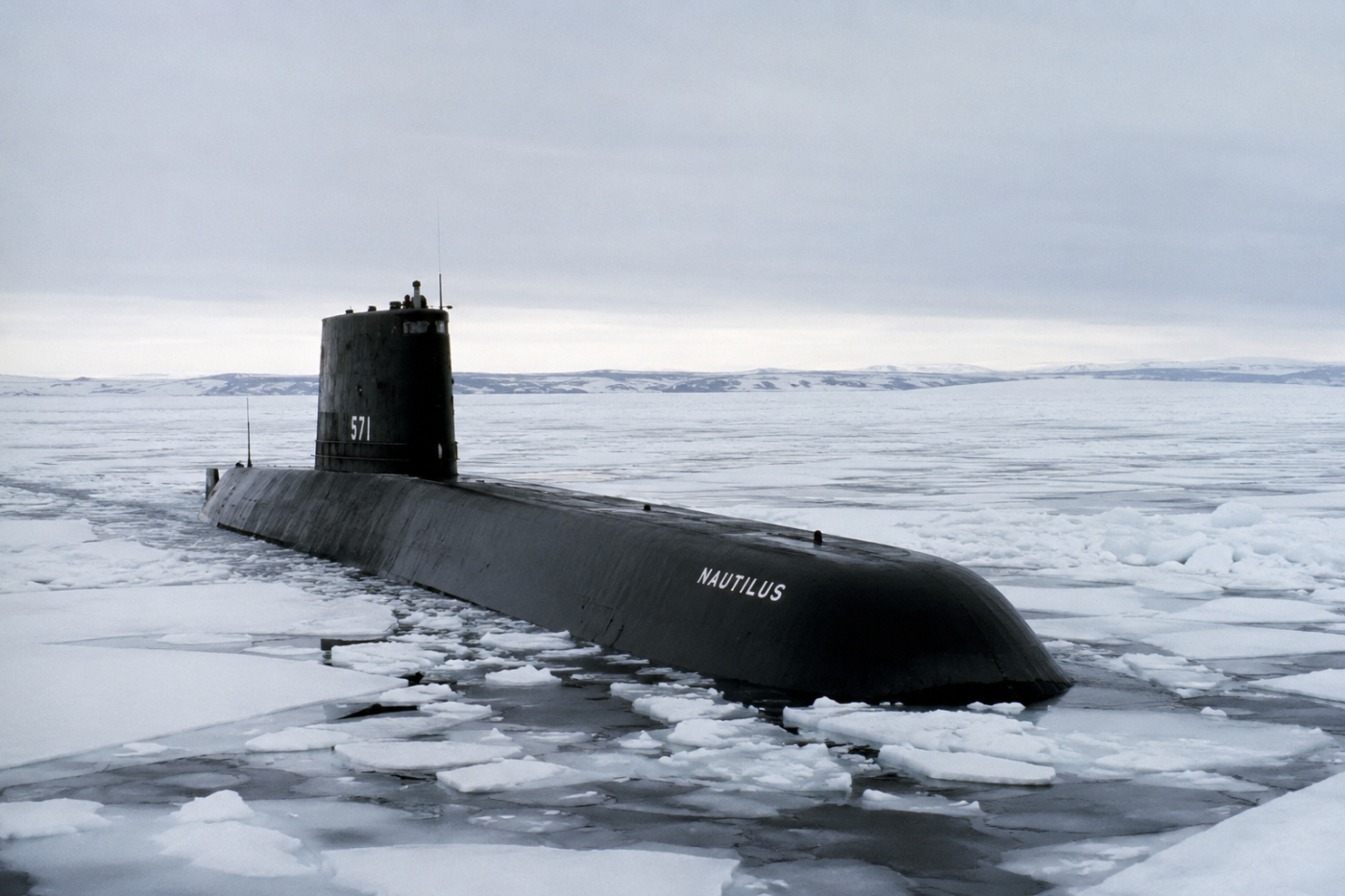
USS Nautilus, designated SSN-571, was already a revolutionary vessel. Commissioned in 1954, she was the world’s first operational nuclear-powered submarine. Unlike conventional diesel-electric submarines, which relied on batteries while submerged and periodically had to surface or raise a snorkel to run their diesel engines and recharge them, Nautilus could remain underwater for extraordinarily long periods. Her nuclear reactor provided propulsion without requiring atmospheric oxygen, completely changing the possibilities of submarine warfare.
By the late 1950s the United States Navy was beginning to understand just how significant this technological change might be. Earlier trials with Nautilus had already demonstrated that many anti-submarine warfare techniques developed during the Second World War were becoming obsolete. A nuclear submarine could remain submerged, travel quickly over enormous distances and leave an area before surface ships and aircraft could effectively locate and attack it.
The Arctic therefore became an area of particular interest.
For conventional submarines the polar ice cap presented an enormous obstacle. A diesel-electric submarine operating beneath thick ice could find itself unable to surface when its batteries required charging or in an emergency. Nuclear propulsion removed much of this restriction. In theory, a nuclear submarine could enter beneath the ice on one side of the Arctic Ocean and travel for thousands of miles without surfacing.
This possibility had enormous military implications because the Arctic lay directly between North America and the Soviet Union.
USS Nautilus was commanded during the historic voyage by Commander William Robert Anderson, an experienced American submariner who had assumed command of the vessel in June 1957. Anderson understood that the mission would test not only the submarine but also the ability of its crew to navigate through a region where many of the normal methods used by ships were either unreliable or impossible.
The secret operation was given the codename Operation Sunshine.
Nautilus initially departed Seattle on 9 June 1958 to make an attempt at crossing beneath the polar ice. This first effort demonstrated just how dangerous such an operation could be. The submarine encountered difficult conditions in the relatively shallow waters of the Chukchi Sea, where deep-draught ice extended downwards towards the seabed. Nautilus could not safely pass between the bottom of the ice and the sea floor.
Anderson made the decision to abandon the attempt rather than risk the submarine and her crew.
Nautilus subsequently headed to Pearl Harbor, Hawaii, where preparations were made for another attempt. The failure was kept secret, and on 23 July 1958 Nautilus departed Pearl Harbor under highly classified orders for a second attempt at reaching and passing beneath the North Pole.
This time Anderson selected a different approach.
Nautilus travelled north through the Pacific towards the Bering Strait and the Arctic. Conditions remained extremely demanding. Beneath the ice there were few opportunities to surface, visibility was effectively nonexistent and conventional celestial navigation was impossible. The submarine therefore depended heavily upon instruments, sonar, careful plotting and specialised navigation equipment.
Knowing the thickness and shape of the ice above the submarine was also vital. Arctic ice was not simply a flat sheet floating on the surface. Sections of ice could be forced together, producing pressure ridges with large projections extending downwards beneath the water. In shallow areas these could drastically reduce the safe space through which a submarine could manoeuvre.
There was therefore little room for error.
On 1 August Nautilus submerged in the Barrow Sea and began the critical section of the operation beneath the polar ice.
For the men aboard, the world outside effectively disappeared. There was no daylight, horizon or visible indication of their position. Above them lay an enormous moving ceiling of ice. Beneath them lay the Arctic seabed. Navigation had to be conducted almost entirely through instruments.
The further north Nautilus travelled, the more unusual navigation became. Magnetic compasses become increasingly unreliable close to the magnetic polar regions, and the convergence of longitude lines around the geographic pole creates additional difficulties. Specialised inertial navigation equipment therefore played an important role in determining the submarine’s position.
Commander Anderson and his officers continually checked their progress.
Finally, late on 3 August 1958, Nautilus reached latitude 90 degrees north.
At approximately 11:15 p.m. Eastern Daylight Time, the submarine passed beneath the geographic North Pole at a depth of roughly 400 feet below the ice.
Anderson announced the achievement to the crew with a message that would become associated permanently with the voyage:
“For the world, our country, and the Navy — the North Pole.”
There was no dramatic view outside the submarine and no flag could be planted on the ice. Nautilus simply continued moving beneath one of the most remote places on Earth. Yet militarily and technologically the moment was extraordinary.
A submarine had reached the North Pole entirely from beneath the Arctic ice.
Nautilus continued onwards rather than immediately attempting to surface. She remained submerged for another four days and eventually emerged from beneath the ice near Greenland on 7 August. In doing so, the submarine had demonstrated something arguably even more important than merely reaching the North Pole: it had successfully crossed beneath the Arctic from the Pacific side towards the Atlantic.
The United States Navy immediately recognised the strategic importance of what had been achieved.
Throughout much of naval history geography had provided countries with natural defensive barriers. The Soviet Union possessed enormous northern coastlines facing the Arctic Ocean, but the polar ice had traditionally made these waters exceptionally difficult for hostile naval forces to use.
Nuclear submarines changed that calculation.
The voyage of Nautilus proved that the Arctic ice cap was not necessarily an impenetrable barrier. Instead, it could potentially become a concealed operating area for nuclear-powered submarines.
From a military perspective this was revolutionary.
A submarine travelling beneath the Arctic could approach areas close to the Soviet Union while remaining hidden underneath thousands of square miles of ice. Surface ships could not easily follow it. Aircraft could not simply look down and locate it. Even locating a nuclear submarine in open water was difficult; finding one beneath the Arctic ice presented an even greater challenge.
The ice itself could therefore become a form of protection for the submarine.
There was also the question of routes between oceans. The traditional movement of naval forces between the Pacific and Atlantic required enormously longer journeys. A nuclear submarine capable of crossing beneath the Arctic potentially possessed another strategic route between the two oceans.
The timing was particularly important.
In 1958 the Cold War between the United States and Soviet Union was intensifying rapidly. The Soviet launch of Sputnik in October 1957 had demonstrated impressive Soviet rocket technology and created considerable concern in the United States about the technological balance between the two superpowers.
Long-range missiles were becoming increasingly important, and both sides were seeking methods of ensuring that they could retaliate even if their homeland suffered a surprise nuclear attack.
Submarines would eventually become one of the most important answers to that problem.
A ballistic-missile submarine hidden beneath the ocean was extraordinarily difficult for an enemy to destroy in a first strike. Even if land-based bombers and missile installations were attacked, submarines remaining at sea could still launch retaliatory nuclear weapons.
The successful Arctic voyage of Nautilus therefore pointed towards a future in which submarines might operate underneath the polar ice, concealed from enemy surveillance and potentially within range of strategically important targets.
Nautilus herself was not a Polaris ballistic-missile submarine, but the lessons demonstrated by her voyage had enormous relevance to the rapidly developing American nuclear submarine fleet.
The voyage also caused military planners to reconsider the strategic geography of the Arctic.
On a conventional map the United States and Soviet Union could appear separated by enormous distances. Viewed from the top of the globe, however, the Arctic was the shortest region between much of North America and the Soviet Union. During the Cold War this made the polar region increasingly important for bombers, early-warning radar stations, missiles and submarines.
Instead of being considered a largely inaccessible frozen wilderness, the Arctic was becoming a potential military operating area.
The success of Nautilus also had important implications for anti-submarine warfare. The United States Navy had already discovered during exercises that nuclear submarines presented much more difficult targets than their diesel-electric predecessors. Under Arctic ice these difficulties multiplied.
Surface warships could not freely operate through much of the ice pack. Aircraft could not use many conventional detection methods against a submarine protected by thick ice. A submarine could also potentially exploit variations in ice, water temperature and underwater acoustics to conceal its movement.
This meant the United States had demonstrated a capability that it also had to assume the Soviet Union would eventually acquire.
The voyage therefore represented both an advantage and a warning.
If American submarines could operate beneath the polar ice, Soviet nuclear submarines would eventually be capable of doing the same. The Arctic would consequently become an increasingly important theatre of underwater intelligence gathering, submarine tracking and nuclear deterrence throughout the remainder of the Cold War.
There was also enormous political value in the achievement.
President Dwight D. Eisenhower was quickly informed of the successful crossing. Anderson travelled to Washington, where he and his crew received national recognition. The officers and men of Nautilus were awarded the Presidential Unit Citation, one of the highest collective honours that can be awarded to an American military unit, while Anderson received the Legion of Merit.
The achievement helped demonstrate that the United States remained capable of major technological breakthroughs despite growing concern about Soviet advances following Sputnik.
It was also an extraordinary demonstration of the potential of nuclear propulsion.
Only a few years earlier a voyage of this type would have been virtually impossible. A conventional submarine attempting to remain submerged beneath the Arctic for such a distance would eventually have exhausted its batteries and needed access to the atmosphere. Nautilus showed that nuclear power had effectively removed one of the fundamental limitations that had governed submarine warfare since its beginning.
The submarine no longer had to behave like a surface vessel that could temporarily disappear beneath the water.
It could become a vessel whose natural operating environment was permanently underwater.
This distinction fundamentally changed naval warfare.
Following the achievement of Nautilus, further American operations proved that the Arctic could become a regular operating environment for nuclear submarines. Later in 1958 USS Skate travelled beneath the polar ice, and in March 1959 Skate became the first submarine to surface at the North Pole.
These voyages built upon what Anderson and the crew of Nautilus had demonstrated in August 1958.
For naval strategists, the importance extended far beyond exploration. Nuclear-powered submarines offered stealth, endurance and speed. Combined with submarine-launched ballistic missiles, these characteristics would eventually create one of the most survivable elements of the American nuclear deterrent.
The Arctic became particularly attractive because submarines could potentially hide beneath its ice while remaining relatively close to Soviet territory.
During later decades of the Cold War both American and Soviet submarines routinely operated beneath the Arctic, playing a secretive and extremely dangerous game of detection, intelligence gathering and deterrence.
Much of that world can be traced back to the voyage of USS Nautilus.
When she departed Pearl Harbor on 23 July 1958, Nautilus was carrying out a highly secret and uncertain experiment. There was no guarantee that the submarine would successfully navigate through the dangerous ice conditions or that its navigation systems would function accurately close to the pole. The earlier failed attempt had already demonstrated the risks.
Eleven days later, at 90 degrees north, Commander William R. Anderson and his crew proved that the Arctic could be crossed from beneath.
The achievement altered perceptions of the submarine and of the Arctic itself. To explorers, reaching the North Pole had traditionally represented the conquest of one of the last great geographical frontiers. To the United States Navy in 1958, however, the achievement represented something more profound.
It demonstrated that a nuclear submarine could go where conventional naval forces could not, remain hidden where conventional ships could not follow and potentially approach an enemy through a region once considered almost inaccessible.
USS Nautilus had not merely reached the North Pole.
She had demonstrated that nuclear power had opened an entirely new battlefield beneath the Arctic ice, one that would become strategically vital during the Cold War and remain important to submarine warfare for decades to come.