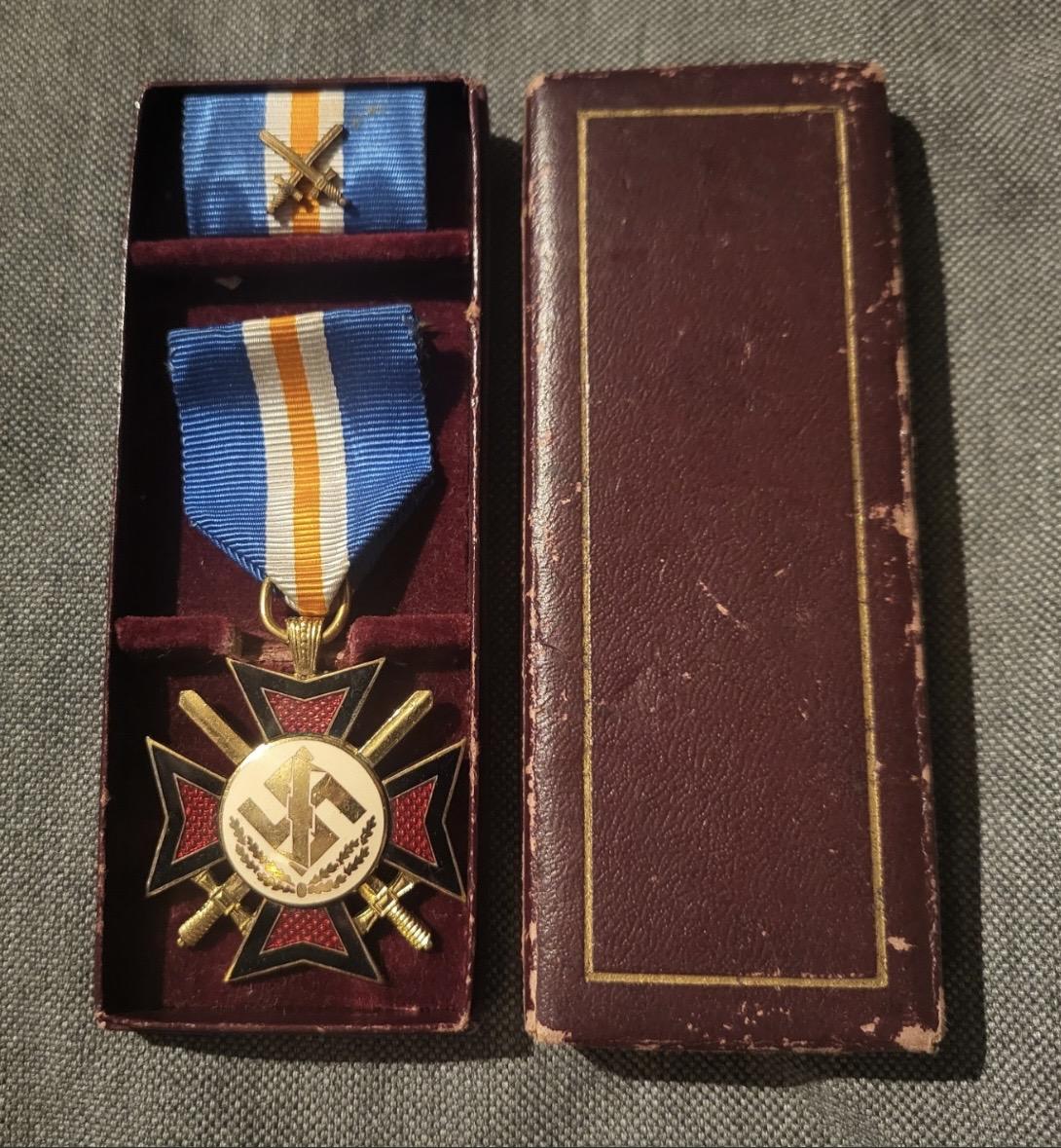
Mussert Cross
The Mussert Cross was created during the German occupation of the Netherlands as a decoration for Dutch volunteers on the Eastern Front, particularly NSB members serving in Waffen-SS formations. Although examples were manufactured, the German authorities never recognised it as an official military award.
Anton Mussert founded the NSB in 1931. After the German invasion of the Netherlands in May 1940, the movement openly collaborated with the occupation authorities. Mussert hoped to lead a formally independent National Socialist Netherlands within a German-dominated Europe. He therefore initially resisted large-scale recruitment of NSB members for the Waffen-SS, since service under direct German command conflicted with his nationalist ambitions. This position, however, left him vulnerable to the more radical, SS-oriented wing of the movement, which regarded Dutch independence as less important than integration into a Greater Germanic Reich. The SS authorities even considered replacing Mussert with Henk Feldmeijer, leader of the Nederlandsche SS. Fearing that his rivals might gain German support at his expense, Mussert gradually abandoned his resistance to recruitment. After the invasion of the Soviet Union in June 1941, he called upon NSB members to join the Vrijwilligerslegioen Nederland, hoping to demonstrate his usefulness to the Germans and protect his position as the future leader of the Netherlands.
Many of these volunteers joined the Vrijwilligerslegioen Nederland, which was presented as a Dutch national formation but formed part of the Waffen-SS from the beginning. They wore German uniforms, swore an oath of allegiance to Adolf Hitler and served under German command. Mussert nevertheless wanted them to be regarded as Dutch National Socialist soldiers who remained loyal to him and to the NSB. The Mussert Cross was intended to express that connection.
The cross was instituted in 1941 and was also known as the Oostlandkruis, or Eastern Lands Cross. Its design combined military imagery with the political symbols of the NSB. It took the form of an eight-pointed cross made of gilded and enamelled metal. The arms were red with broad black borders. Two crossed swords appeared behind the cross to represent military service. At the centre was a white circular medallion containing a black swastika and a golden wolfsangel. The wolfsangel was the main symbol of the NSB. Oak leaves were added as traditional symbols of courage, loyalty and military achievement. On the reverse appeared the words “MUSSERT 1941”. Around the centre was the NSB motto “HOU EN TROU”, which can be translated as “remain loyal and true”.
The use of Mussert’s name was significant. Most military decorations referred to a country, monarch or military campaign. This cross instead emphasised personal loyalty to the leader of a political movement. A proposed recipientwould not only have been honoured for his service on the Eastern Front but would also have been identified as a loyal follower of Mussert.
The ribbon carried the colours light blue, white and orange. These were based on the orange-white-blue Prinsenvlag, or Prince’s Flag, although they were arranged symmetrically on the narrow ribbon as blue-white-orange-white-blue. The orange stripe was placed in the centre.
The Prince’s Flag dated from the Dutch Revolt and the Eighty Years’ War against Spanish rule. Its orange colour referred to William of Orange, who became the leading figure in the revolt against King Philip II of Spain. During the sixteenth and seventeenth centuries, orange-white-blue and red-white-blue flags were both used in the Dutch Republic. Red gradually replaced orange, and red-white-blue eventually became the national flag. The NSB rejected this development. It promoted the Prince’s Flag as the only genuine Dutch flag and treated the red-white-blue tricolour as a later corruption of the national tradition. For the NSB, orange-white-blue represented William of Orange, the struggle against foreign rule and what it regarded as the heroic origins of the Dutch nation. The movement displayed the Prince’s Flag at meetings and used its colours on uniforms, posters and decorations. By adopting the Prince’s Flag, the NSB attempted to connect its own movement to the Dutch struggle for independence. The contradiction was clear. The original flag had been associated with a revolt against foreign domination, while the NSB was cooperating with the German occupation of the Netherlands.
The ribbon of the Mussert Cross therefore presented the Waffen-SS volunteers as representatives of what the NSB considered the true Netherlands. Together with the wolfsangel, swastika and Mussert’s name, the ribbon combined Dutch nationalist imagery with loyalty to Nazi Germany.
The Germans refused to recognise the decoration. Once the volunteers entered the Waffen-SS, their uniforms, discipline and awards were controlled by German authorities. Mussert had no command over them and could not decide which medals they were permitted to wear. Crosses, ribbons, ribbon bars and presentation cases had already been produced, but the decoration was never officially awarded. The rejection demonstrated the weakness of Mussert’s position. He attempted to behave like the head of an independent state, but he remained the leader of a collaborationist movement that depended entirely on German support. The Germans accepted Dutch recruits for the Waffen-SS, but they did not allow Mussert to create his own military tradition around them. The Mussert Cross never achieved the status of an official German or Dutch military medal.
The volunteers for whom the cross had been intended fought in a brutal campaign. Dutch Waffen-SS units served around Leningrad and in other parts of the Soviet Union. They suffered heavy losses while taking part in Germany’s war of occupation. After Germany’s defeat in May 1945, the NSB was banned and Mussert was arrested. He was convicted of high treason and executed on 7 May 1946. Many objects connected to the NSB were destroyed or hidden after the liberation. A small number of Mussert Crosses survived and later entered museums and private collections.
Credit to Tom Dankers Historian.