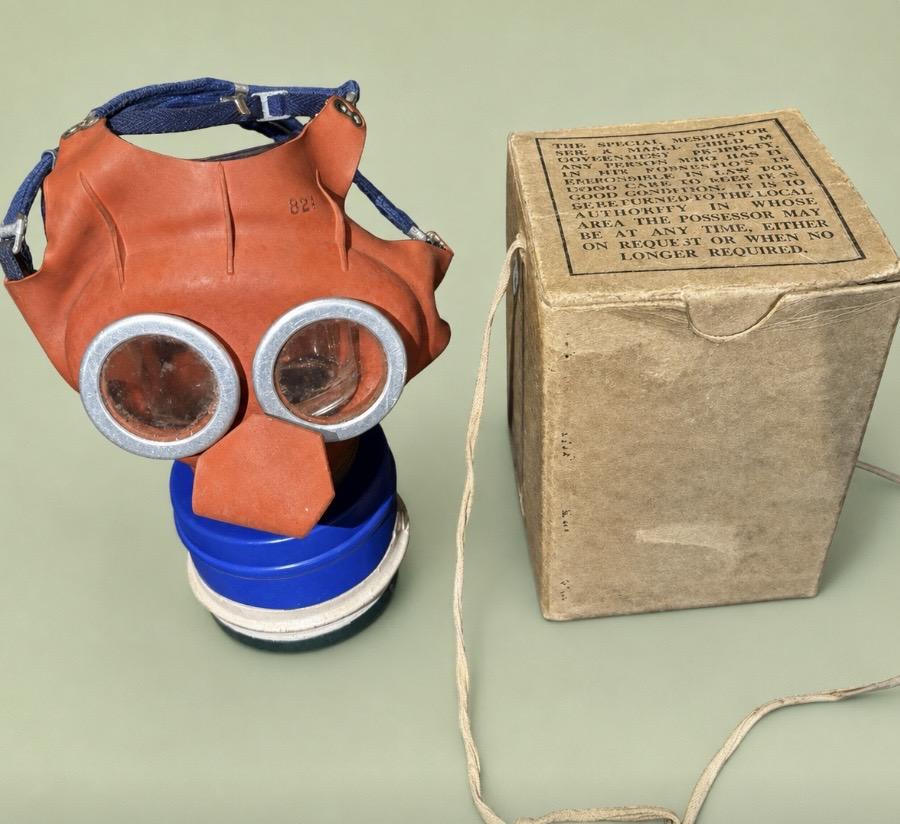
Micky Mouse Gas Mask
One of the most distinctive and instantly recognisable pieces of British Home Front equipment from the Second World War is the brightly coloured children’s gas mask that became popularly known as the “Mickey Mouse” gas mask. Designed for very young children, it was an attempt to make one of the most frightening realities of wartime Britain appear a little less terrifying. With its vivid red rubber facepiece, blue detailing around the eyepieces and unusual projecting nose, the mask looked very different from the sombre black and khaki respirators carried by adults. Today, surviving examples have become highly collectable pieces of Home Front history and provide a fascinating reminder of the preparations Britain made for a chemical attack that, fortunately, never came.
The fear of poison gas was deeply ingrained in the British public by the outbreak of the Second World War. Chemical weapons had caused terrible casualties during the First World War, and British authorities believed there was a very real possibility that German aircraft could drop chemical agents on towns and cities during a future bombing campaign. As war approached, the government embarked upon an enormous programme to provide civilian respirators for virtually the entire population. By September 1939, around 38 million gas masks had been issued across Britain, although this figure covered the various types intended for adults and children rather than the Mickey Mouse pattern alone.
Different respirators were required for different age groups. Babies who were too young to wear a conventional face mask were provided with a special protective helmet or enclosure into which filtered air had to be pumped by an adult. Older children could use respirators closer in construction to the adult versions, but children roughly between the ages of two and five presented a particular problem. A smaller mask was required to fit their faces securely, and there was also concern that frightened children might resist having a strange and intimidating rubber respirator placed over their face.
The answer was the small child’s respirator officially known in surviving museum records as the Anti-Gas Small Child Respirator, Type C2. The Imperial War Museums catalogues examples of the British civilian Type C2 under its familiar “Mickey Mouse” nickname. The nickname did not mean that the mask was actually shaped as an accurate representation of Walt Disney’s famous cartoon character. Instead, the bright colours and slightly playful appearance were intended to make the equipment appear friendlier to a small child. The London Museum records that these masks were standard government issue for children aged approximately two to five years and notes that their supposed resemblance to Mickey Mouse was intended to make wearing one seem more like dressing up than putting on frightening emergency equipment.
The most familiar examples have a red rubber facepiece with contrasting blue rubber around the circular eyepieces. The projecting rubber nose or breathing section gave the respirator its particularly unusual appearance. The materials used in surviving examples include rubber, cotton fibre, metal and glass. The flexible rubber formed the main face seal, while glass viewing lenses allowed the child to see when the mask was being worn. Metal components were used in areas such as the filter assembly and fittings, while fabric and elasticated materials formed part of the system used to secure the respirator around the head.
As with an adult civilian respirator, contaminated air was intended to pass through a filter canister before reaching the wearer. The filter contained materials designed to remove or neutralise dangerous chemical agents and particles. Collectors should remember that wartime respirator filters can contain hazardous substances and deteriorating materials, and old filters should never be opened, dismantled or worn. A surviving Second World War gas mask should be regarded purely as a historical display object rather than functioning protective equipment.
Manufacture of Britain’s wartime respirators was spread across a substantial industrial programme involving specialist rubber manufacturers and other contractors. The Avon Rubber Company was one important British producer of civilian respirators and associated equipment; the Imperial War Museums, for example, holds a wartime child’s respirator and carrier identified as having been made by Avon Rubber Company. Individual surviving Mickey Mouse masks may carry moulded markings, dates, manufacturer information or inspection stamps that can help identify where and when a particular example was produced.
It is sometimes claimed that a specific number of Mickey Mouse children’s masks were manufactured, but an exact and universally accepted production total for the British Type C2 alone is difficult to establish from reliable surviving published records. The often quoted figure of around 38 million refers to the enormous overall issue of civilian gas masks in Britain by the outbreak of war and should not be interpreted as 38 million Mickey Mouse masks. The actual number of small-child respirators would have represented only a fraction of the total, although the fact that they were standard issue for an entire young age group means production must still have been considerable. Without a surviving consolidated government production record separating every model and contractor, it is safer to describe the exact Type C2 production total as uncertain rather than repeat an unsupported figure.
When war was declared in September 1939, the gas mask became part of everyday British life. Civilians were expected to keep their respirators close at hand, and children took them to school in carrying boxes or containers. Schools held gas-mask drills in which pupils practised putting their respirators on quickly and learned how to behave during an air raid or suspected gas attack. For a young child, the experience of having the face enclosed in rubber while breathing through a filter could be uncomfortable and alarming. The bright appearance of the Mickey Mouse version was therefore part of a much larger effort to persuade children that wearing their protective equipment was normal and necessary.
Despite the enormous preparations, poison gas was never used against the British civilian population during the German bombing campaign. The masks were therefore carried and repeatedly practised with but never required for the mass chemical attack for which they had been designed. As the war continued and the immediate fear of gas warfare declined, enthusiasm for carrying respirators everywhere also gradually diminished, although the possibility of chemical warfare never disappeared completely from official planning.
From a collector’s point of view, the Mickey Mouse children’s gas mask is considerably more visually striking than the standard civilian respirator and has strong appeal to collectors of Home Front memorabilia, civil defence equipment and Second World War social history. Its connection with childhood during wartime also gives it an emotional significance that many purely military objects do not possess. A complete example immediately tells a story about how war affected ordinary families and even the youngest members of society.
Values vary greatly according to condition and completeness. Examples with supple, brightly coloured rubber, intact glass lenses, original straps and a complete filter are generally more desirable than masks that have hardened, cracked or suffered serious deterioration. The original cardboard carrying carton or other associated container can significantly improve the interest of a set, particularly when the box retains printed instructions, labels or the name of the child who originally owned it. Provenance linking a mask to a particular family, school or location can add further historical importance.
Original wartime dates and manufacturer markings are particularly worth examining. Collectors generally prefer untouched examples showing honest age rather than masks that have been heavily cleaned, painted or restored. Rubber naturally deteriorates with time, and many surviving masks have become stiff or distorted after more than eight decades. Finding an example that still displays strong original red and blue colouring can therefore be particularly attractive.
Prices on the collectors’ market can range considerably. Ordinary incomplete or heavily aged examples may sell relatively modestly, while particularly good complete examples with an original box and clear wartime markings can command substantially more. Auction results demonstrate how condition and accompanying items affect value; for example, a mixed group offered in Britain in 2022 that included a boxed G.C. Mk III “Mickey Mouse” child’s gas mask together with several other respirators sold at a hammer price of £65, although this was a group lot rather than a valuation of the child’s mask by itself. Asking prices from dealers and online sellers are often considerably higher than actual auction results, so collectors should compare genuine completed sales rather than relying purely on advertised prices.
The most desirable examples are generally those that remain complete and can be positively identified as genuine wartime British issue. A good example consisting of the mask, original filter, head harness and carrying box makes an excellent centrepiece in a Home Front collection. Named examples can be even more interesting because research may reveal something about the child who once carried the respirator and the community in which they lived.
Care should be taken when storing one. The rubber should not be subjected to unnecessary flexing, strong sunlight or extremes of temperature. The mask should never be placed over a person’s face for photographs or demonstrations, both because of the age and condition of the material and because the contents of old wartime filters should be treated with caution. Keeping the respirator supported in a stable position and avoiding unnecessary handling will help preserve it for the future.
There is also occasional confusion between the British Mickey Mouse respirator and a completely different American children’s gas mask developed during the Second World War with the involvement of the Walt Disney organisation. The American design was created after the United States entered the war and was deliberately associated with Mickey Mouse to encourage children to accept the idea of wearing protective equipment. The familiar red and blue British Type C2, however, belongs to Britain’s own extensive civilian air-raid and anti-gas preparations and should not be confused with the rarer American Disney-related design.
More than eighty years later, the British Mickey Mouse gas mask remains one of the most memorable objects associated with childhood on the Home Front. Its bright colours stand in strange contrast to the deadly threat it was designed to counter. Behind its almost toy-like appearance was a serious piece of protective equipment produced at a time when the government genuinely feared that Britain’s cities might be attacked with poison gas. Although the feared chemical bombardment never arrived, thousands of surviving photographs and personal memories recall children carrying their masks to school and practising how to put them on.
For today’s collector, an original example represents far more than another piece of wartime equipment. It illustrates the extraordinary scale of Britain’s preparations for total war and the efforts made to protect and reassure its youngest citizens. Complete examples with strong colour, original components, wartime markings and their carrying boxes are increasingly desirable, and as surviving rubber continues to deteriorate with age, well-preserved specimens are likely to remain among the most distinctive and fascinating items in any British Home Front collection.