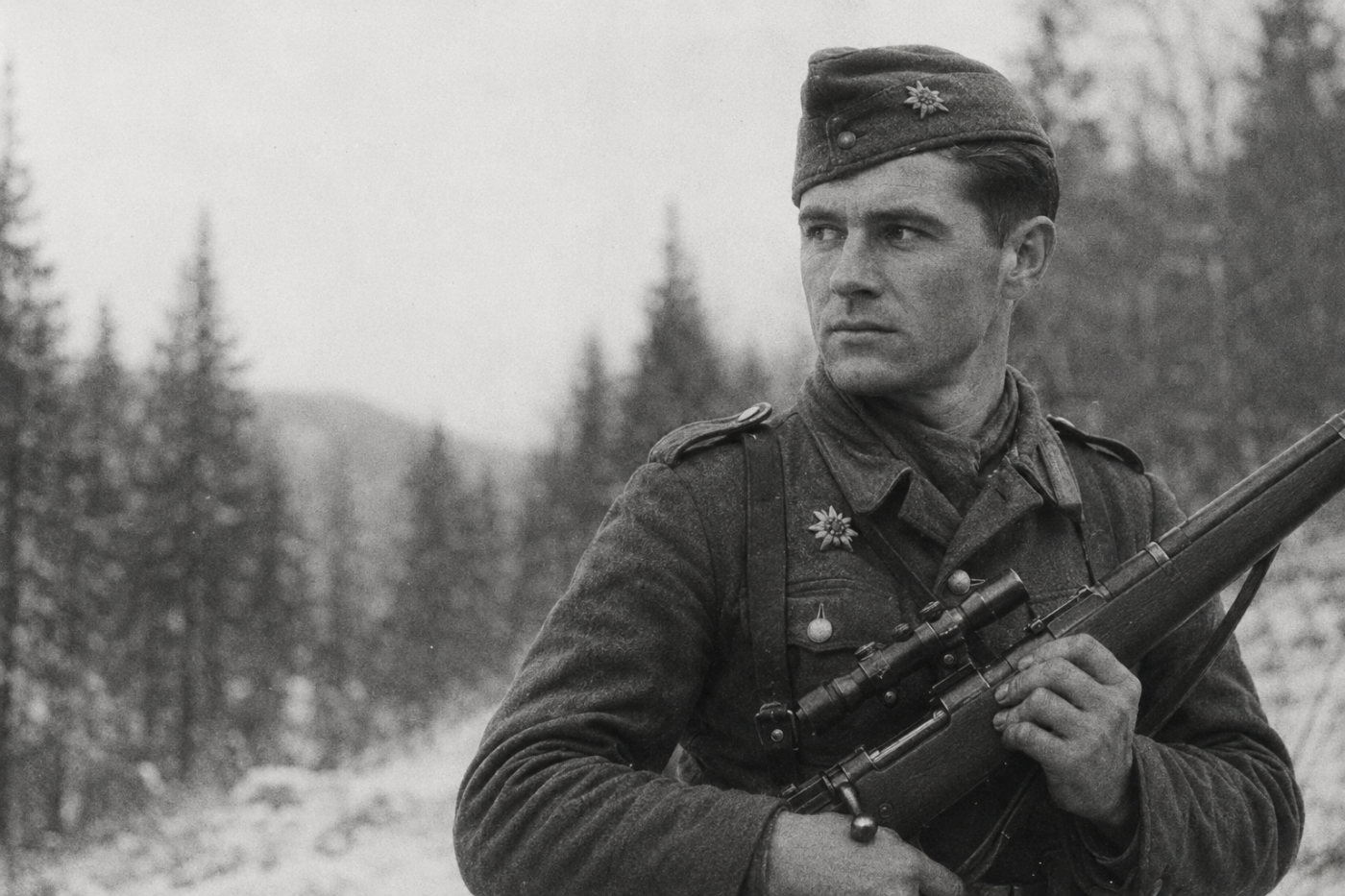
Matthäus Hetzenauer Sniper
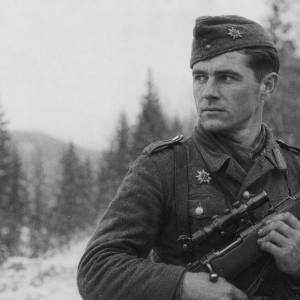
Matthäus Hetzenauer became the highest-scoring sniper in the German Wehrmacht, credited by German military records with 345 confirmed kills on the Eastern Front. Although frequently described as Germany’s deadliest sniper, Hetzenauer was Austrian, born on 23 December 1924 in the small Tyrolean village of Brixen im Thale. Austria had been annexed by Nazi Germany in 1938, and like thousands of other young Austrians, he was later called into German military service.
Hetzenauer was the son of Simon and Magdalena Hetzenauer, members of a Tyrolean farming family accustomed to the demanding conditions of the Austrian Alps. Growing up among mountains, forests and severe winters may have helped him develop the patience, fieldcraft and ability to judge distance that later made him an exceptionally effective sniper. Little is recorded about his childhood, but his early years were spent in this isolated rural community rather than preparing for a military career.
He entered the German Army during 1943 and was assigned to the Gebirgsjäger, the Wehrmacht’s specialised mountain infantry. After undergoing general military instruction, his exceptional shooting ability brought him to the attention of his instructors. From 27 March until 16 July 1944, he completed specialist sniper training at the Seetaler Alpe training ground in Styria. There, he was taught camouflage, concealment, observation, range estimation, target recognition and how to remain motionless for long periods without revealing his position.
Hetzenauer was subsequently posted to the 7th Company of Gebirgsjäger Regiment 144, part of the 3rd Gebirgsjäger Division. He entered front-line service at a time when the German Army was retreating before the advancing Red Army. During the final year of the war, he fought in Romania, the Carpathian Mountains, Hungary and Slovakia.
His principal weapon was a sniper version of the Karabiner 98k bolt-action rifle fitted with a six-power telescopic sight. He also used the semi-automatic Gewehr 43 with a four-power ZF4 sight, particularly when the tactical situation required faster follow-up shots.
Hetzenauer was trained to identify important targets rather than fire indiscriminately. Enemy officers, machine-gunners, artillery observers, anti-tank crews and other snipers were given priority. He frequently operated from carefully prepared positions and remained concealed for hours while watching Soviet lines and waiting for a valuable target to appear.
A shot at approximately 1,100 metres has often been attributed to him, although individual wartime claims of this kind are extremely difficult to verify independently. His official total of 345 confirmed kills was recorded under the German Army’s wartime confirmation system and made him the most successful documented sniper in the Wehrmacht. This achievement, however, was made while serving Nazi Germany during the exceptionally brutal war against the Soviet Union.
On 6 November 1944, Hetzenauer suffered a head injury during Soviet artillery fire. He survived and returned to duty, receiving the Black Wound Badge three days later. His division commander, Generalleutnant Paul Klatt, eventually recommended him for the Knight’s Cross. The recommendation praised Hetzenauer’s actions under artillery fire and infantry attacks and stated that his sniper operations had inflicted casualties equivalent to approximately two enemy companies.
Hetzenauer received the Iron Cross Second Class on 1 September 1944, the Black Wound Badge on 9 November, the Silver Infantry Assault Badge on 13 November and the Iron Cross First Class on 25 November. On 3 December 1944, he received the Gold Sniper’s Badge, an exceptionally rare decoration awarded for achieving at least 60 confirmed sniper kills.
His highest decoration was the Knight’s Cross of the Iron Cross, awarded on 17 April 1945. Hetzenauer was only twenty years old and held the relatively junior rank of Gefreiter when he received it. He was one of only a very small number of German snipers to be awarded the Knight’s Cross.
His decorations and battlefield success could not alter the outcome of the war. In May 1945, only weeks after receiving the Knight’s Cross, Hetzenauer was captured by Soviet forces near Schwarzwasser in Czechoslovakia. He was transported into Soviet captivity and spent almost five years as a prisoner of war under extremely harsh conditions.
Hetzenauer was finally released and returned to Austria on 10 January 1950. He settled once again in his native Brixen im Thale, married Maria Beihammer and became the father of three children. Unlike some celebrated wartime marksmen, he largely withdrew from public attention and returned to the farming community in which he had been raised.
Matthäus Hetzenauer died in Brixen im Thale on 3 October 2004 following a long illness. He was seventy-nine years old. His credited total of 345 confirmed kills remains the highest attributed to any sniper serving in the German Wehrmacht during the Second World War, making him one of the conflict’s most formidable and controversial marksmen.