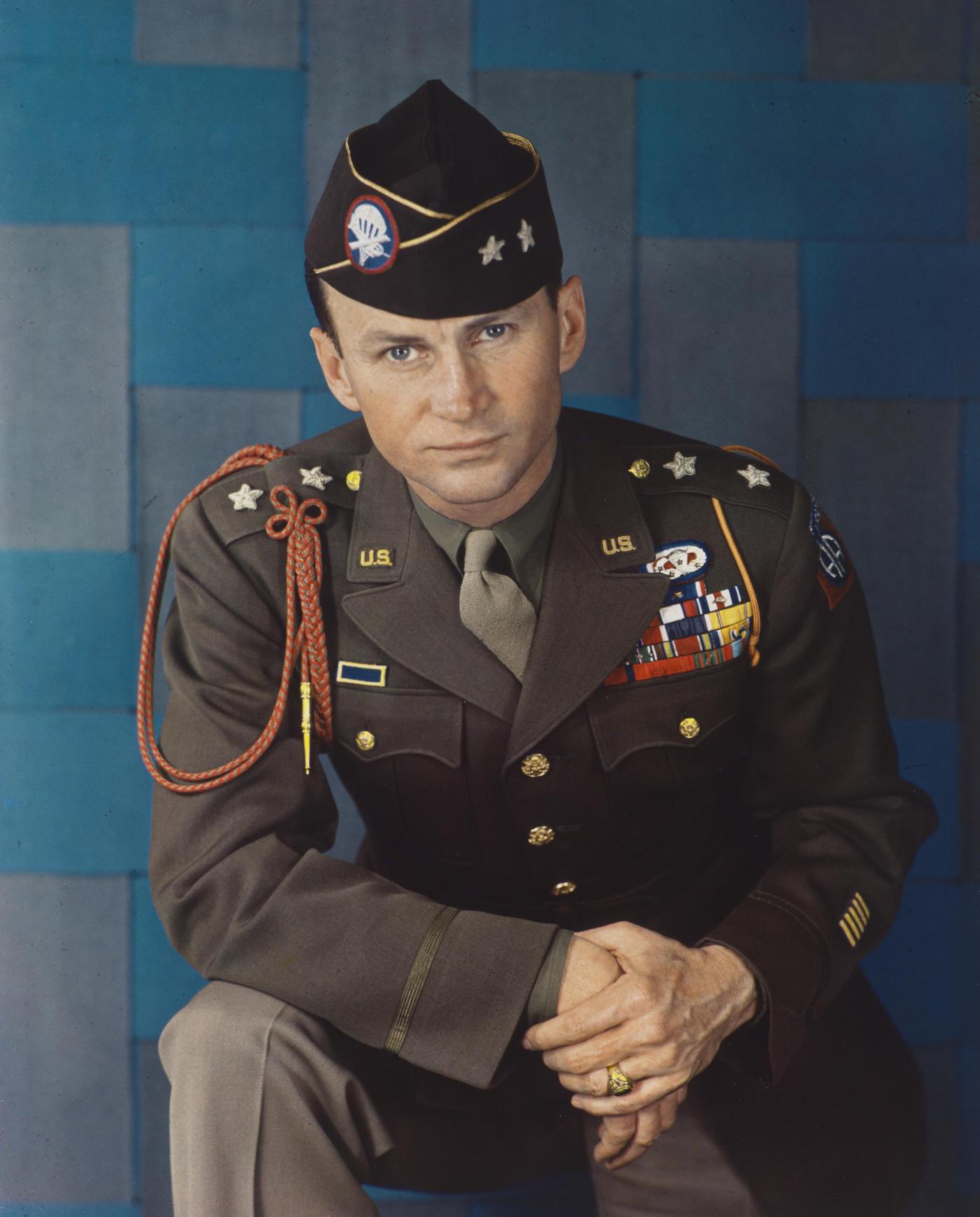
Major General James Gavin
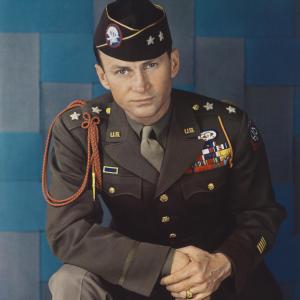
James Maurice Gavin rose from an impoverished childhood to become one of the youngest and most respected American divisional commanders of the Second World War. Known to his men as “Slim Jim” and to history as “The Jumping General”, he believed that an airborne commander should face the same dangers as the soldiers he led. Rather than directing operations from the safety of a distant headquarters, Gavin jumped into battle carrying an M1 rifle and fought alongside his paratroopers on the ground.
He was born James Nally Ryan in Brooklyn, New York, on 22 March 1907. At about two years old he was placed in the Convent of Mercy orphanage before being adopted by Martin and Mary Gavin, a working-class couple from the coal-mining town of Mount Carmel, Pennsylvania. Renamed James Maurice Gavin, he grew up in a household where money was scarce and the prospect of spending his life in the mines appeared increasingly likely.
Gavin delivered newspapers and worked in a barber’s shop before leaving school after the eighth grade to help support his family. Listening to miners describe their hard lives convinced him that he wanted a different future. He became fascinated by military history, particularly the American Civil War, and developed an ambition to attend the United States Military Academy at West Point. In March 1924, shortly before his seventeenth birthday, he left Mount Carmel and travelled to New York. Because he was underage, he claimed to be an orphan and obtained permission to enlist in the United States Army.
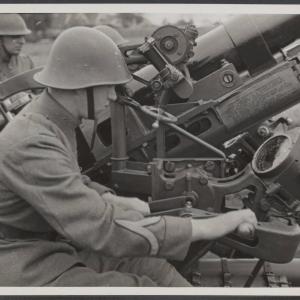
He was posted to the Coast Artillery at Fort Sherman in Panama, where he served on a 155mm gun crew. Gavin used every spare moment to educate himself, reading military history and studying for the competitive examination that could secure him a place at West Point. Despite his limited formal education, he passed and entered the academy in 1925. He frequently rose at 4.30 in the morning to study, eventually graduating in June 1929 and receiving his commission as a second lieutenant in the infantry.
His early service included a posting with the 25th Infantry Regiment, one of the Army’s segregated African-American units, on the Mexican border. He later attended the Infantry School at Fort Benning, where he came under the influence of officers including George C. Marshall and Joseph Stilwell. Their emphasis on initiative, physical fitness and commanders leading from the front helped shape Gavin’s own approach to leadership.
As the threat of another world war increased, Gavin became deeply interested in the possibilities of airborne warfare. He volunteered for parachute training in 1941 and helped formulate the American Army’s early airborne doctrine. He studied German and Soviet airborne operations and wrote much of the first American field manual dealing with the tactics and employment of parachute troops. His intelligence, energy and willingness to test his own ideas brought rapid promotion, and in 1942 he was given command of the newly formed 505th Parachute Infantry Regiment.
Gavin led the 505th into battle during Operation Husky, the Allied invasion of Sicily, on the night of 9 July 1943. Strong winds and navigational difficulties scattered the American paratroopers over a wide area, leaving Gavin miles from his intended landing zone with only a small group of men. Rather than wait for his regiment to assemble, he gathered every soldier he could find and moved towards the sound of the fighting. His improvised force helped hold the vital Biazzo Ridge against German armour, preventing the enemy from breaking through towards the invasion beaches.
Two months later Gavin and his paratroopers jumped into Italy during the Salerno landings. With the Allied beachhead under severe pressure, the 505th was dropped as an emergency reinforcement and was quickly committed to the fighting around Altavilla. Gavin’s performance in Sicily and Italy established his reputation as a brave and highly capable airborne commander. He was promoted to brigadier general and appointed assistant divisional commander of the 82nd Airborne Division.
In the early hours of 6 June 1944, Gavin made his third combat jump, landing in Normandy as part of the airborne assault behind Utah Beach. The 82nd had been ordered to secure Sainte-Mère-Église, seize bridges and causeways across the flooded ground surrounding the Merderet River and prevent German reinforcements from reaching the beaches. Once again, aircraft were scattered and many paratroopers landed far from their objectives.
Gavin landed near Sainte-Mère-Église and immediately began organising isolated groups into fighting units. Some of the fiercest combat took place around the bridge and causeway at La Fière, where American paratroopers resisted repeated German attacks. Gavin moved continually between threatened positions, often under fire, directing the defence and encouraging exhausted soldiers. The fighting at La Fière lasted several days and became one of the bloodiest small-unit battles of the Normandy campaign.
In August 1944 Gavin took command of the 82nd Airborne Division. Only thirty-seven years old, he was the youngest American major general commanding a division during the war. His first major operation as divisional commander came the following month when the 82nd participated in Operation Market Garden, the ambitious Allied attempt to seize a chain of bridges through the Netherlands and advance into Germany.
Gavin’s division landed around Nijmegen and Groesbeek on 17 September. Its objectives included the bridge over the River Maas at Grave, the Maas–Waal Canal crossings, the strategically important Groesbeek Heights and the great road bridge across the River Waal at Nijmegen. Gavin injured his back during the landing but remained in command. The heights had to be protected against German counter-attacks coming from the nearby Reichswald, while the Nijmegen bridges were essential to the advance of the British armoured column moving north towards Arnhem.
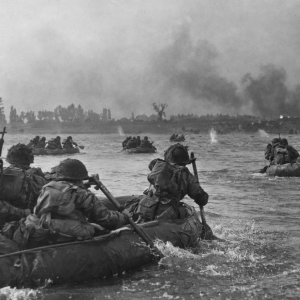
On 20 September, soldiers of the 504th Parachute Infantry Regiment crossed the Waal in canvas assault boats under devastating German fire. After establishing a foothold on the northern bank, they attacked the bridge from the rear while British tanks advanced from the south. Nijmegen Bridge was captured intact, but the delay and the strength of German resistance meant that the isolated British airborne troops at Arnhem could no longer be relieved. Market Garden failed to achieve its final objective, although Gavin’s division had captured most of the positions assigned to it.
The 82nd returned to battle in December 1944 after the Germans launched their surprise offensive through the Ardennes. Gavin’s men were hurried into Belgium and placed on the northern shoulder of what became known as the Battle of the Bulge. They fought around Stoumont, La Gleize and the Salm River against powerful German armoured formations. When ordered to withdraw to a shorter defensive line, Gavin personally supervised the movement, ensuring that it did not become a retreat. The 82nd later joined the counter-offensive that drove the Germans back towards their original positions.
During the final months of the war Gavin led the division into Germany, through the Ruhr and across the Elbe. The 82nd finished its fighting near Ludwigslust, where large numbers of German soldiers surrendered. It later served as an occupation force in Berlin, earning the title “America’s Guard of Honour” for the discipline and appearance of its soldiers.
Gavin remained in the Army after the war and continued to campaign for highly mobile forces capable of moving by aircraft and helicopter. He also supported racial integration and welcomed the African-American 555th Parachute Infantry Battalion into the 82nd Airborne Division at a time when much of the American military remained segregated. Rising to lieutenant general, he held several senior appointments and became the Army’s chief of research and development. He retired in 1958 after disagreeing with the growing dependence on nuclear weapons at the expense of properly equipped conventional forces.
In civilian life Gavin became a successful business executive and continued to write about defence and military affairs. President John F. Kennedy appointed him United States Ambassador to France in 1961, where his wartime reputation and relationship with General Charles de Gaulle helped strengthen relations between the two countries. He later became an outspoken critic of American policy during the Vietnam War and argued that military power should never be used without clear political objectives.
James Gavin died in Baltimore on 23 February 1990, one month before his eighty-third birthday. He was buried at West Point, the academy he had struggled so hard to enter more than sixty years earlier. His remarkable journey from an orphanage and Pennsylvania coal town to the command of one of America’s most famous fighting divisions remains one of the great military stories of the Second World War. To the paratroopers of the 82nd Airborne Division, he was remembered above all as the general who shared their risks, carried the same rifle and never asked his men to go anywhere he was unwilling to go himself.