
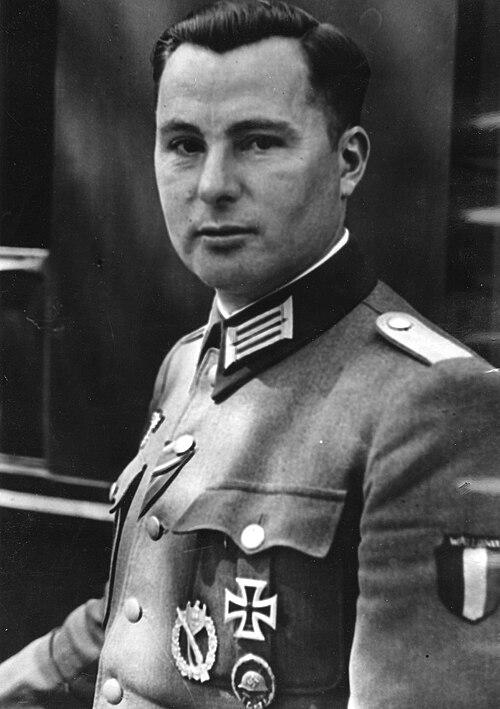
Léon Degrelle, Leader of the Rex party and Walloon Legion
Léon Degrelle was born on 15 June 1906 in Bouillon, in southern Belgium, into an upper middle class, strongly Catholic family. His father was a brewer and a local Catholic politician. Educated in Catholic schools, Degrelle encountered the authoritarian nationalism of Charles Maurras and Action française before entering the University of Louvain in 1925. Journalism and political agitation increasingly occupied his attention. He edited the student newspaper L’Avant-Garde and wrote for the Catholic daily Le XXe Siècle. These activities brought him patrons among Catholic clergy and experience in reaching an audience through controversy.
In 1930, Degrelle took charge of the Catholic publishing house Éditions Rex, whose name referred to Christus Rex, or Christ the King. He expanded its publications and used them to demand a renewal of Catholic public life. Rex initially belonged to this religious and conservative environment, not to an established Belgian Nazi movement. Its young activists distrusted liberalism, socialism and parliamentary compromise. Degrelle gradually turned their campaign into a personal political movement, attacking the connections between Catholic politicians and financial interests. His confrontation with Catholic leaders at Kortrijk in November 1935 helped make the break with the party leadership irreversible.
The economic depression and political scandals gave Degrelle’s attacks a wider audience. Belgium’s political life was dominated by the Catholic, Socialist and Liberal parties, and Rex attracted voters who felt these parties had failed them. In the election of 24 May 1936, it won approximately 11.5 per cent of the national vote and twenty-one parliamentary seats. Degrelle promised strong leadership, a united Belgium and a society based on family and Christian values. Although most of his support came from French-speaking Belgium, he presented Rex as a movement for the whole country.
Success encouraged Degrelle to seek power quickly. He developed ties with Fascist Italy and Nazi Germany, meeting Hitler in 1936. In October that year, he also signed an agreement with the Flemish nationalist VNV. Despite his calls for Belgian unity, the agreement proposed replacing Belgium’s centralized system with a federal state. This concession to Flemish nationalism alienated supporters who expected him to defend a strong, centralized Belgium.
In April 1937, Degrelle forced a Brussels by-election, hoping to turn it into a decisive confrontation with the government. Instead, the main parties united behind Prime Minister Paul van Zeeland, and Cardinal Van Roey warned Catholics against Rex. Degrelle suffered a crushing defeat. By the 1939 election, Rex retained only four seats. As supporters departed, the movement became more openly fascist, and antisemitism increasingly accompanied its anti-communism and attacks on parliamentary democracy.
When Germany invaded Belgium on 10 May 1940, Belgian authorities arrested Degrelle and transferred him to French custody. Released after France’s defeat, he returned to Brussels in July, hoping that the occupation would give him a new route to power. The German military administration, however, showed little interest in making him Belgium’s leader. Degrelle responded with increasingly open support for Hitler and National Socialism, hoping that stronger declarations of loyalty would finally win German backing. This strategy only deepened his difficulties: his pro-German course drove more supporters away from Rex, while the military administration remained unwilling to grant him the authority he sought.
Germany’s invasion of the Soviet Union on 22 June 1941 therefore offered Degrelle a chance to revive his shrinking movement and demonstrate its usefulness to the occupiers. German propaganda portrayed the campaign as a European struggle against Bolshevism, an appeal that Rex could use to rally anti-communist supporters. With German permission, it began recruiting French-speaking Belgians for the Légion Wallonie, or Walloon Legion. Degrelle presented military service as a way to secure Belgium’s place in a German-dominated Europe. He also hoped that supplying soldiers would earn him the political influence that declarations of loyalty had failed to bring.
The Legion initially belonged to the German Army as Infantry Battalion 373. The SS excluded Walloons because it did not consider them Germanic, and Degrelle’s ambition for a united Belgian legion gave way to separate Flemish and French-speaking formations. Recruitment initially disappointed him, so he announced that he would join as an ordinary soldier to encourage others to enlist. About 850 volunteers, most of them Rexists, left Brussels on 8 August 1941. Their departure also took many activists away from Rex, further weakening the political organization Degrelle had hoped to revive. After training in Germany, the Legion was sent east. Its first major fighting came in Ukraine in February 1942, followed later that year by operations in the Caucasus.
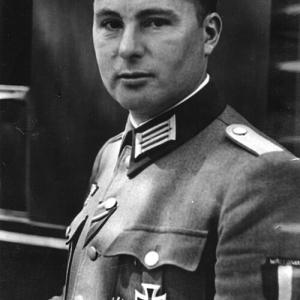
Military life quickly exposed the distance between recruiting speeches and actual service. Cold, illness, exhaustion and combat reduced the Legion’s strength, while repeated recruiting drives drew men away from Rex’s political organization. Not every volunteer had the same commitment: alongside convinced anti-communists were men seeking adventure or escape from poverty and personal difficulties. Degrelle nevertheless acquired significant combat experience and rose through the military ranks. He took part in fighting, received the Iron Cross and gained a commission as a lieutenant. Combat experience gave him an authority among his followers that his declining electoral career could no longer provide.
These experiences occurred within a war whose purpose extended far beyond defeating Soviet armies. Nazi plans linked conquest to racial domination, exploitation and genocide. Mass shootings of Jews, persecution of civilians and the catastrophic treatment of Soviet prisoners accompanied the German advance. Units of the German Army, as well as SS and police formations, participated in aspects of this criminal system. Degrelle’s letters from October 1941 indicate that he already knew about massacres of Jews. The volunteers’ military hardships cannot therefore be separated from the character of the war they were helping Germany wage.
During 1942, Degrelle increasingly sought support from the SS, including officers associated with the Wiking division. On 17 January 1943, he publicly proclaimed that the Walloons were Germanic despite speaking French. This claim helped reconcile his ambitions with Nazi racial doctrine. His plans for an enlarged Belgium were increasingly subordinated to membership of Hitler’s Germanic empire. The supposed “New Europe” was not a partnership of equal nations. After discussions with Heinrich Himmler in May, the Legion entered the Waffen-SS on 1 June 1943 as the SS-Sturmbrigade Wallonien. The brigade had a total of about 2000 soldiers.
Reinforced and reorganized, the brigade returned to Ukraine in November 1943 and served under the Wiking division. In early 1944, it became trapped with German forces in the Korsun-Cherkassy pocket. Soviet attacks and the eventual breakout inflicted devastating losses. The Walloon commander, Lucien Lippert, was killed; Degrelle was wounded but escaped in February. Much of the formation’s equipment was lost. Degrelle subsequently became an SS-Sturmbannführer, equivalent to major, and assumed command of the Walloon formation. The battle established his reputation within Nazi Germany even as it left his unit requiring another reconstruction.
On 20 February 1944, Hitler personally presented Degrelle with the Knight’s Cross of the Iron Cross. German propaganda made the surviving politician-soldier an example for foreign collaborators at a time when Germany badly needed encouraging stories. Staged appearances and parades in Brussels and Charleroi in April advertised the Walloons’ return. These celebrations followed devastating losses at Cherkassy: of the brigade’s roughly 2,000 men, only 632 were alive after the breakout. Yet military celebrations did not restore Rex’s popular following or make Degrelle Belgium’s ruler. At home, Rexists increasingly depended on German protection, occupied local administrative posts and participated in repression. Resistance attacks were followed by Rexist reprisals and political murders, tying the movement more closely to the occupation’s violence.
A Walloon detachment fought in Estonia during the summer of 1944, and Degrelle received the Oak Leaves to his Knight’s Cross. Meanwhile, the Allied advance forced Rexist collaborators to flee Belgium. That autumn, the Walloon formation was expanded on paper into the 28th SS Volunteer Grenadier Division Wallonien. Refugees and men transferred from other collaborationist organizations helped refill its ranks, but it remained far below normal divisional strength. In 1945, its combat units fought in Germany as Soviet forces advanced. Further losses and retreat broke up the formation; surviving groups eventually surrendered to the Western Allies.
Degrelle left the collapsing German front and reached Norway. On 7 May 1945, he departed by aircraft for Francoist Spain, intending eventually to continue to South America. The aircraft crash-landed at San Sebastián, leaving him injured but alive. Belgium had already sentenced him to death in absentia in December 1944. Its efforts to obtain his return became entangled in negotiations with Spain, Britain and the United States. Spanish obstruction and the other powers’ diplomatic priorities helped ensure that he was never handed over. In 1954, he acquired Spanish citizenship.
During almost half a century of exile, Degrelle continued to defend fascism and National Socialism. Through books, interviews and contacts with the European extreme right, he recast his career as that of a heroic anti-communist and European soldier. He also promoted Holocaust denial. His memoirs consequently require comparison with contemporary records: they are evidence of how he wanted his life remembered, not a reliable account on their own. He died in Málaga on 31 March 1994, having escaped the punishment imposed in Belgium.
Credit: Tom Dankers, Historian - Arnhems Oorlogsmuseum 40-45