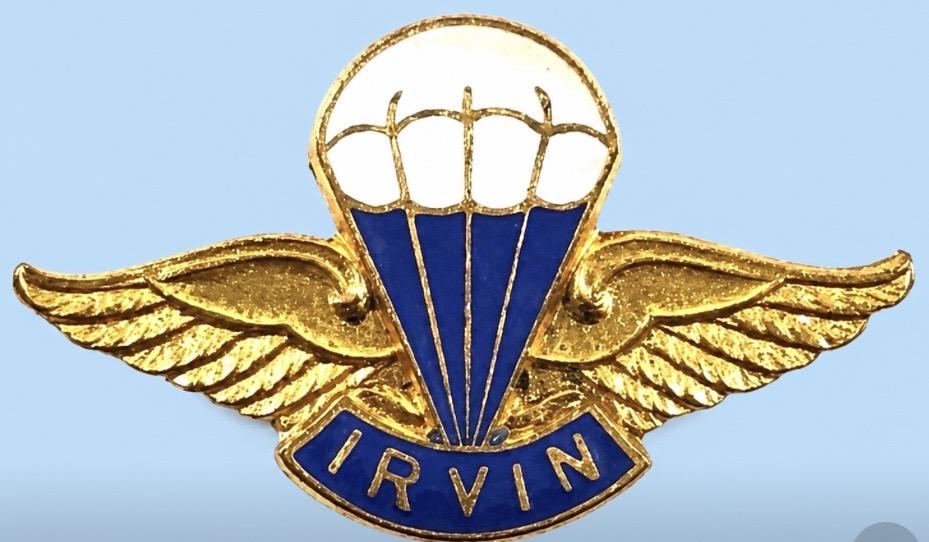
Irvin Parachute Company
The Irvin Air Chute Company became one of the most important but often overlooked manufacturers of the Second World War. Its parachutes were carried by RAF fighter pilots, bomber crews, observers and airborne troops, while larger versions were used to deliver weapons, ammunition, medical supplies and equipment. Thousands of Allied servicemen owed their lives to the company’s work, yet the story began not in Britain but with a young American stuntman who was prepared to risk his own life to prove that an airman could safely jump from a damaged aircraft.
Leslie Leroy Irvin was born in Los Angeles, California, in 1895. As a young man he became involved in ballooning, aerial displays and the rapidly developing American film industry. He performed as an aerial acrobat and parachutist at a time when jumping from an aircraft remained an extremely dangerous undertaking. Early parachutes were often attached to balloons or aircraft by a static line, and many were too bulky or unreliable to be practical emergency equipment for pilots.
During the final months of the First World War, the United States Army began examining ways of producing a dependable parachute that could be worn by an airman and opened manually after he had left his aircraft. Irvin joined a team of engineers, parachutists and aviation specialists working under Major Edward Hoffman at McCook Field in Ohio. The resulting Type A parachute combined a soft pack worn on the body, a manually operated ripcord and a small pilot chute that pulled the main canopy from its container.
On 28 April 1919, Irvin volunteered to test the new arrangement. He jumped from a de Havilland aircraft at approximately 1,500 feet, fell clear and pulled the ripcord to deploy the parachute. The canopy opened successfully, making him the first man to carry out a deliberate free-fall descent using a manually operated ripcord parachute of the modern type. He landed heavily and broke an ankle, but the equipment had worked and the possibilities were immediately apparent.
Less than two months later, on 18 June 1919, the Irving Air Chute Company was established in Buffalo, New York. The original company name was usually written as “Irving”, although its founder’s surname was Irvin. One widely repeated explanation is that the additional letter was introduced through a clerical error and remained part of the company name for many years. The business eventually returned to the Irvin spelling in 1970.
The first production parachutes were manufactured for the United States military. Irvin’s early experimental models had been assembled with the help of borrowed sewing equipment, but the new company introduced proper manufacturing methods, inspection procedures and controlled standards. Every seam, cord, harness fitting and section of canopy had to be reliable because a small defect could mean the difference between life and death.
The Royal Air Force became interested in Irvin equipment during the 1920s and placed an order for parachutes in 1925. To supply the RAF and other European customers, a British branch was established at Letchworth Garden City in Hertfordshire in 1926. The factory stood in Icknield Way East and became the centre of Irvin parachute production in Britain. A second facility was opened shortly before the Second World War as the company prepared for the enormous demand that appeared increasingly likely.
By the late 1930s, Irvin had become one of the largest and best-known parachute manufacturers in the world. Its equipment was being used by the air forces of around 45 countries. When war began in September 1939, the company already possessed valuable experience in producing emergency parachutes for aircrew, but it now faced the far greater challenge of equipping rapidly expanding Allied air forces and the newly formed airborne units.
The parachutes carried by RAF aircrew were not all identical. Fighter pilots commonly used seat-type parachutes, in which the packed canopy formed a cushion beneath the pilot. This arrangement was practical in the confined cockpit of aircraft such as the Spitfire and Hurricane. Other aircrew used back-type or chest-mounted parachutes depending on their position, duties and the available space inside the aircraft. Observers, navigators, wireless operators and air gunners required harnesses and packs suited to their working positions.
Each parachute consisted of several carefully integrated parts. The canopy was divided into shaped sections known as gores, which were cut to precise patterns and sewn together to form the familiar circular shape. Suspension lines connected the canopy to the harness, while reinforcing tapes spread the tremendous shock created when the parachute opened. The pack held the canopy and lines in the correct order, and the ripcord released the closing pins. A small pilot chute, assisted by springs on some designs, caught the airflow and extracted the main canopy.
Before and during the early part of the war, many personnel parachute canopies were manufactured from natural silk. Silk combined low weight with considerable strength and could be packed into a relatively small space. Undyed white silk also blended reasonably well against a bright sky. A single canopy required a substantial quantity of carefully woven fabric, and every length had to be inspected for weaving defects, uneven threads, stains or damage.
Much of the world’s raw silk had traditionally come from East Asia, particularly Japan. The disruption of international trade and Japan’s entry into the war in December 1941 made dependable supplies increasingly difficult to obtain. Existing stocks were strictly controlled and treated as an important strategic resource. This shortage accelerated the development and use of nylon, a synthetic fibre that was strong, light, resistant to mildew and capable of being produced without dependence on silkworm farming.
In Britain, nylon production was developed through British Nylon Spinners, a company formed jointly by Imperial Chemical Industries and Courtaulds in 1940. Production began at Coventry in January 1941, initially using polymer and spinning equipment supplied through the American DuPont organisation. Nylon gradually became increasingly important for parachute production as wartime access to natural silk became more uncertain. Silk did not disappear immediately, and wartime parachutes can be encountered with silk, nylon or components made from different available materials depending upon their date, type and place of manufacture.
The parachute harness was normally made from strong woven webbing, frequently cotton webbing on British wartime examples. The straps passed around the wearer’s shoulders, chest and legs so that the opening shock was distributed across the body. Steel buckles, adjustment slides, snap hooks and central release fittings allowed the harness to be secured and, when necessary, removed quickly after landing. Packs were made from hard-wearing textile materials, while leather, rubber, felt and other padding materials could be used in areas where the equipment pressed against the wearer or aircraft seat.
The workforce that transformed these raw materials into life-saving equipment consisted largely of women. Wartime mobilisation had drawn enormous numbers of men into the armed forces and heavy industry, and women filled many of the skilled production roles upon which aircraft and parachute manufacture depended. At Letchworth, rows of women worked at industrial sewing machines, joining canopy sections, attaching reinforcing tapes and completing the many demanding stitching operations required for each parachute.
This was not simply ordinary clothing work. Parachute machinists required patience, accuracy and a clear understanding that every line of stitching carried a human life. Long sections of lightweight canopy material could easily become twisted, contaminated or damaged. Workers had to control large amounts of fabric without pulling it out of shape, and seams had to be produced to an exact specification. A misplaced stitch, broken thread or small cut could weaken the canopy under the violence of deployment.
Women also worked as cutters, inspectors, packers, clerks and stores employees. Material was measured and cut on long tables before passing through different stages of production. Finished components were checked repeatedly, and completed canopies were examined against illuminated tables or in well-lit inspection areas so that even small defects could be identified. Parachutes were then packed by trained personnel according to a strict sequence that ensured the lines and canopy would deploy cleanly.
Although women formed most of the visible factory workforce, men continued to work in management, engineering, testing, maintenance, stores and specialist production roles. The company also employed designers and technical staff who worked with the Air Ministry, RAF parachute experts and other manufacturers to improve equipment as wartime experience revealed new problems.
In 1940, Irvin worked with the British firm GQ Parachutes to develop the X-Type parachute for airborne troops. Unlike an aircrew emergency parachute, which was normally opened manually after leaving an aircraft, the paratrooper’s main parachute was deployed by a static line attached inside the transport aircraft. As the soldier jumped, the line pulled the parachute pack open and began the deployment sequence automatically.
The X-Type became one of the principal British troop parachutes of the war. It was used during the growth of Britain’s airborne forces and remained associated with operations in North Africa, Sicily, Normandy, Arnhem and across the Rhine. Its design had to balance several competing requirements. It needed to open rapidly enough for relatively low-level military drops, yet the opening shock had to remain survivable for a heavily equipped soldier. It also had to be dependable when used by thousands of men jumping in darkness, bad weather and under enemy fire. The basic assembly proved so successful that variants remained in use for many years after 1945.
Production at Letchworth rose dramatically as the war expanded. At its peak, the factory was reportedly completing nearly 1,500 parachutes a week. A dependable final total for every Irvin parachute manufactured during the entire war does not appear to have been preserved in a single publicly available figure. Output also included different types of personnel, reserve and equipment parachutes, making simple totals difficult to compare. Nevertheless, a peak approaching 1,500 each week demonstrates the enormous scale of the operation. If maintained for only a year, that rate would represent close to 78,000 parachutes.
Every completed parachute required far more than sewing. Hardware had to be machined or pressed, webbing woven, cords manufactured, packs assembled and metal parts protected against corrosion. The work depended upon a network of textile mills, chemical companies, metalworking firms and government-controlled suppliers. Materials arriving at the factory were recorded and inspected before entering production, and any batch that failed to meet the required strength or consistency could not safely be used.
Quality control was exceptionally strict. Samples of cloth, webbing and cord could be subjected to tensile testing to establish how much force they would withstand. Stitching was checked for correct spacing and tension. Metal components were inspected for cracks, rough edges or deformation that might damage the webbing. Finished parachutes were identified by labels and inspection markings that allowed their origin and production history to be traced.
Parachutes were also subject to careful maintenance after delivery. RAF parachute sections and specialist riggers inspected, aired, repaired and repacked them. Moisture, oil, dirt, sunlight and rough handling could all damage a canopy. A parachute carried in an aircraft for long periods therefore required periodic unpacking and inspection even if it had never been used. The rigger who packed it shared the same responsibility as the worker who had originally manufactured it.
The factory workers were sometimes visited by airmen whose lives had been saved by Irvin equipment. Such visits provided a direct connection between the repetitive work of the production line and the reality of air combat. One recorded visit to the Letchworth works took place on 4 February 1941, when RAF airmen spoke to the workforce about the parachutes that had enabled them to escape from stricken aircraft. For women who spent long shifts guiding silk through sewing machines, seeing a living airman standing before them must have been a powerful reminder of the importance of their work.
Leslie Irvin also created one of aviation’s most unusual organisations, the Caterpillar Club. Membership was open to those whose lives had been saved by parachuting from a disabled aircraft. Its name referred to the silkworm caterpillar that produced the silk from which early canopies were made. Qualifying airmen received a small gold caterpillar badge and a certificate, and membership became a deeply personal distinction among wartime aircrew.
By the end of 1945, the Caterpillar Club had approximately 34,000 recorded members, although not every person who escaped by parachute was necessarily registered. The successor company states that Irvin parachutes saved more than 10,000 lives during the Second World War alone. Later estimates have suggested that Irvin equipment may have saved around 100,000 people over the company’s full history.
The company did not restrict its activities to parachutes. Irvin became closely associated with the famous sheepskin flying jacket worn by RAF aircrew. As aircraft climbed to greater altitudes, crews endured extreme cold in unheated cabins and cockpits. The heavy leather and sheepskin Irvin flying jacket became one of the best-known items of British wartime aviation clothing and remains highly collectable today.
Irvin also produced specialised harness clothing, including combined garments and parachute harness arrangements intended to improve comfort and reduce the amount of separate equipment worn by aircrew. One example was the RAF “Harnesuit”, a combined flying garment and parachute harness manufactured by the company. These projects demonstrated that Irvin was not merely a sewing factory but an aviation engineering business concerned with the complete problem of keeping airmen alive.
Parachutes manufactured by Irvin accompanied Allied forces throughout the war. Fighter pilots used them during the Battle of Britain and subsequent operations over occupied Europe. Bomber crews relied upon them during the night offensive against Germany, often having only seconds to escape from a burning or disintegrating aircraft. Airborne soldiers descended beneath them during major assaults, while cargo parachutes delivered supplies to troops, resistance groups and isolated units.
The value of a reliable parachute extended beyond the person it saved. Experienced pilots and aircrew represented years of training and operational knowledge. When an airman escaped from a damaged aircraft, the parachute preserved a skilled individual who might return to duty. For airborne forces, dependable parachutes made it possible to place formed bodies of soldiers behind enemy lines and seize bridges, airfields and strategic positions that might otherwise have required a costly ground assault.
After the war, Irvin continued to develop parachute and survival equipment for military and civilian use. The arrival of high-speed jet aircraft created new challenges. Parachutes had to work with ejector seats, withstand greater deployment speeds and operate at much higher altitudes. The company became involved in aircraft braking parachutes, cargo delivery systems, escape equipment and the recovery of aerospace vehicles and other large payloads.
The business passed through several changes of name and ownership. The American operation became Irvin Industries in 1970 and Irvin Aerospace in 1996 before becoming part of Airborne Systems. In Britain, the historic Irvin business was eventually combined with GQ Parachutes, the company with which it had worked on the wartime X-Type. The merged organisation became known as IRVIN-GQ in 2001, was later branded as Airborne Systems and readopted the IrvinGQ name in 2018.
Today, IrvinGQ operates from Llangeinor near Bridgend in South Wales and continues the work that began with Leslie Irvin’s experimental jump in 1919. It designs and manufactures military parachutes, aerial delivery systems, cargo-handling equipment, survival products and equipment capable of delivering extremely large loads. The modern company employs more than 250 people across its UK and French operations and serves military and aerospace customers around the world.
Modern parachutes use advanced synthetic fabrics, high-strength webbing, computer-assisted design and sophisticated testing methods that Leslie Irvin could scarcely have imagined. Yet the essential purpose remains unchanged. Every component must function correctly, every seam must hold and every packed canopy must deploy in the proper sequence.
The story of the Irvin Air Chute Company is therefore more than the history of a successful manufacturer. It is the story of experimental courage, industrial skill and the largely female workforce whose precision saved lives far beyond the factory walls. At the height of the Second World War, women in Letchworth handled great lengths of silk and nylon, assembled harnesses and inspected thousands of stitches, knowing that somewhere over Britain or occupied Europe an airman might one day place his entire trust in their work.
From the first deliberate free-fall jump in 1919 to the mass airborne operations of the Second World War and today’s advanced aerial delivery systems, the Irvin name has remained closely connected with survival in the air. Its parachutes carried men into battle, brought supplies to isolated troops and gave countless airmen a final means of escape from burning aircraft. More than a century after the company was founded, its successor continues to manufacture equipment designed around the same uncompromising principle: when every other option has failed, the parachute must not.