Hyde Park Bombing
On the morning of 20 July 1982, one of London’s most familiar military traditions was transformed in seconds into a scene of terrible carnage when a Provisional Irish Republican Army bomb exploded as soldiers of the Household Cavalry rode through Hyde Park. The attack killed four soldiers of the Blues and Royals, left others badly wounded and killed seven of the regiment’s horses. It remains one of the most shocking terrorist attacks carried out in Britain during the Troubles.
The soldiers were taking part in their normal ceremonial duties, riding from their barracks in Knightsbridge towards Horse Guards Parade for the Changing of the Guard. Mounted on their distinctive black cavalry horses, the troop was passing along South Carriage Drive at the southern edge of Hyde Park when the bomb exploded at approximately 10.43 in the morning.
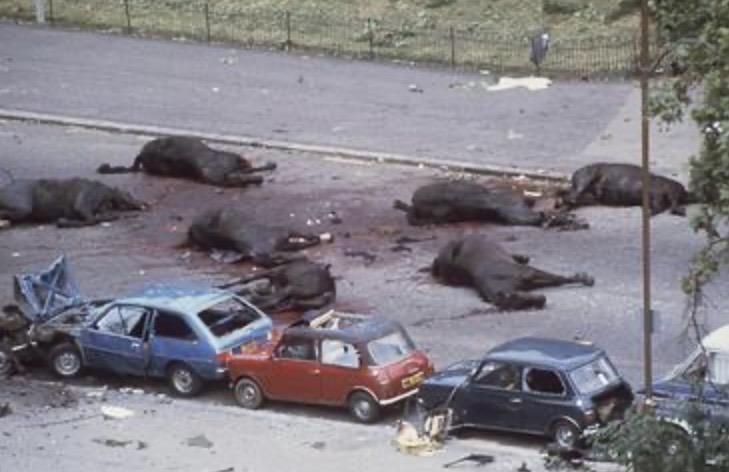
The device had been concealed inside a parked blue Morris Marina. Packed with explosives and nails intended to act as deadly shrapnel, the bomb was positioned so that the Household Cavalry would pass directly alongside it. As the mounted soldiers approached, the device was detonated, sending a devastating blast through the formation of men and horses.
The peaceful summer morning instantly became a scene of chaos. Soldiers were thrown from their saddles, horses collapsed in the road and fragments from the bomb tore through those caught close to the explosion. Witnesses described scenes of confusion as injured horses attempted to escape while soldiers, police officers, emergency workers and members of the public rushed to help.
Four young soldiers of the Blues and Royals lost their lives as a result of the attack: Lieutenant Dennis Daly, aged 23, Squadron Quartermaster Corporal Roy Bright, aged 36, Lance Corporal Jeffrey Young, aged 19, and Trooper Simon Tipper, also aged 19. Some were killed at the scene while others died from the terrible injuries they had suffered.
The horses, which were an essential part of the Household Cavalry and were cared for with enormous affection by their riders and grooms, also suffered devastating injuries. Seven horses named Cedric, Epaulette, Falcon, Rochester, Waterford, Yeastvite and Zara were killed or had to be humanely destroyed because their wounds were too severe for them to survive.
Among the wounded horses was Sefton, a black cavalry horse whose remarkable survival would become one of the best-known stories to emerge from the tragedy. Sefton suffered numerous wounds from the explosion and flying debris, including serious injuries to his neck and body. Despite the severity of his condition, Army veterinary surgeons and their assistants worked desperately to save him.
His recovery captured the attention of the British public. Letters, cards and donations arrived from people across the country who had been deeply affected by the suffering of the horses. Sefton eventually recovered sufficiently to return to ceremonial duties and was later named Horse of the Year in recognition of his courage and remarkable survival. He became a lasting symbol of the animals caught up in the attack and of the close relationship between the Household Cavalry soldiers and their horses.
The horror of 20 July was not over. Just over two hours after the Hyde Park explosion, another IRA bomb detonated beneath a bandstand in Regent’s Park, where musicians from the Band of the 1st Battalion, Royal Green Jackets were performing a lunchtime concert. Seven soldiers were killed in that second attack and many more people were wounded.
Together, the Hyde Park and Regent’s Park bombings killed eleven British soldiers and wounded dozens of others. The attacks caused widespread outrage across Britain and beyond. The Provisional IRA claimed responsibility for the bombings, which formed part of its campaign during the decades-long conflict known as the Troubles.
The Hyde Park attack was particularly disturbing because it deliberately struck at a highly visible ceremonial tradition in the centre of London. The Household Cavalry could be seen riding through the capital every day, and the familiar sight of mounted soldiers travelling between their barracks and Horse Guards had become part of London life. The bombers exploited that predictable routine to place an explosive device directly in the troop’s path.
For the survivors, families and regiment, the consequences lasted far beyond the events of that morning. Those who witnessed the explosion carried memories of the devastation for the rest of their lives, while the Household Cavalry mourned both the soldiers and the horses lost in the attack.
The search for justice continued for decades. In 2019, following a civil action brought by relatives of the victims, the High Court ruled that John Downey had been an active participant in the Hyde Park bombing and was jointly responsible with others for the attack. The ruling came many years after an earlier criminal prosecution against him had collapsed.
Today, a memorial near the site of the bombing remembers Lieutenant Dennis Daly, Squadron Quartermaster Corporal Roy Bright, Lance Corporal Jeffrey Young and Trooper Simon Tipper. The seven horses that died are also remembered as part of the tragedy.
More than four decades later, the Hyde Park bombing remains a deeply painful chapter in British military history. What began as an ordinary morning of ceremonial duty ended with young soldiers dead, comrades seriously injured and magnificent cavalry horses lying wounded and dying on a London road. The image of the shattered Household Cavalry formation became one of the defining reminders of the violence of the Troubles reaching into the heart of the British capital.
The soldiers and horses who lost their lives on 20 July 1982 continue to be remembered by the Household Cavalry and by the wider military community. Their memorial stands as a permanent reminder of a horrific act of terrorism and of a morning when a centuries-old military tradition was struck by violence without warning.