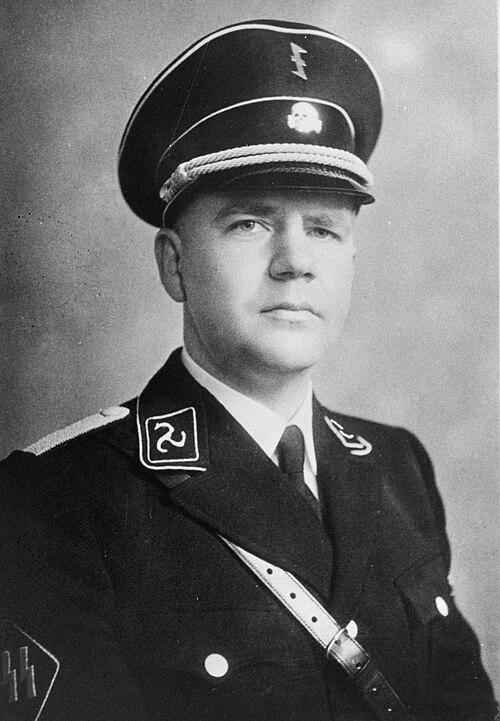
Henk Feldmeijer
On 30 November 1910, Johannes Hendrik Feldmeijer was born in Assen. His family name was originally Veldmeijer, but his father, a professional soldier, changed it to Feldmeijer in 1915. Henk, as he was usually called, grew up in a respectable middle-class home and performed very well at school. After completing the HBS in 1928, he began studying mathematics and physics at the University of Groningen. He appeared to have the ability to build an academic career, but politics gradually became more important than his studies. His military service in 1931 also brought him into contact with the young Dutch fascist movement. This was the beginning of a development that would turn a talented student into one of the most radical Dutch Nazis of the Second World War.
In September 1932, Feldmeijer became the 479th member of the Nationaal-Socialistische Beweging, better known as the NSB. He soon made speeches in and around Groningen in which he attacked parliamentary democracy and presented NSB leader Anton Mussert as the strong leader the Netherlands needed. His speaking ability was noticed, and after abandoning his university studies in 1935, he became a full-time party activist in Utrecht. However, Feldmeijer was already moving beyond Mussert's Dutch nationalist ideas. He admired Hitler, adopted an openly racist and antisemitic worldview, and established contacts with the German SS. This placed him in the volkisch wing of the NSB. A conflict with Mussert sent him away from the party headquarters in 1937, but in 1939 he returned to prominence as leader of the Mussert-Garde, a small paramilitary youth organization modelled on the SS.
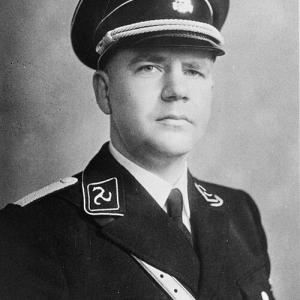
Feldmeijer's position changed completely after the German invasion of the Netherlands on 10 May 1940. A few days before the invasion, the Dutch authorities had arrested him as a politically dangerous person. He was transported south with other imprisoned NSB members and was eventually freed by German troops near Calais. After returning to the occupied Netherlands, he quickly gained the confidence of the German SS leadership. Heinrich Himmler and his representative in the Netherlands, Hanns Albin Rauter, wanted a Dutch SS organization that could spread their ideology and increase German influence within the NSB. On 11 September 1940, the Nederlandsche SS was officially established, with the 29-year-old Feldmeijer as its Voorman, or leader. Formally it was a department of the NSB, but in practice Feldmeijer also answered to Rauter and Himmler.
The Nederlandsche SS was therefore an organization with two masters. Its members were selected according to SS racial standards, received ideological and physical training, and were expected to show personal loyalty to Adolf Hitler. Feldmeijer wanted them to form the political elite of a future Greater Germanic empire. The organization never grew beyond approximately 4,000 members, but the occupation authorities saw it as a useful instrument for placing reliable Nazis in the NSB and in public institutions. On 1 November 1942, its name was changed to the Germaansche SS in Nederland. This made the real purpose even clearer: Dutch national identity had to become less important, while unity with Germany and the other so-called Germanic peoples had to come first.
This goal brought Feldmeijer into a lasting conflict with Mussert. Mussert collaborated with Germany and hoped to become the leader of a largely independent Dutch state within a German-dominated Europe. Feldmeijer, on the other hand, believed that the Netherlands should become part of a Greater Germanic Reich under Hitler. The German SS used him to watch Mussert, pressure the NSB, and promote more radical policies. At times, German officials even considered Feldmeijer as a possible replacement for Mussert. Publicly, the two men sometimes appeared together in order to show unity, but behind the scenes there was deep distrust. Feldmeijer's loyalty ultimately belonged to Himmler and the SS rather than to the leader of his own Dutch party.
Recruitment for the Waffen-SS was one of the most important tasks of Feldmeijer and his organization. Almost immediately after the Nederlandsche SS was created, he encouraged its members to prove themselves as soldiers. After the German invasion of the Soviet Union on 22 June 1941, recruitment propaganda described the Eastern Front as a European crusade against Bolshevism. Dutch volunteers served in formations such as the Volunteer Legion Netherlands and SS Division Wiking, although not every volunteer was a member of the Nederlandsche SS. In practice, these men entered a racial and ideological war in which the Waffen-SS was closely connected to occupation, mass violence, and the persecution and murder of Jews. The political SS in the Netherlands thus became an important reservoir for the military SS at the front.
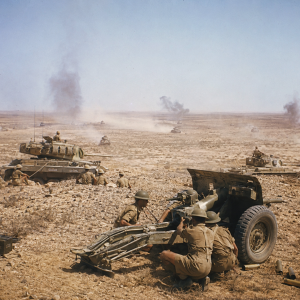
Feldmeijer also believed that he could not ask others to fight while remaining safely in the Netherlands. In April 1941, he served as a gunner with the Leibstandarte SS Adolf Hitler during the German campaign in Yugoslavia and Greece. He returned to the front in 1942 and joined SS Division Wiking in the Soviet Union. Feldmeijer was not inside Stalingrad, but he experienced the collapse of the German offensive from the neighbouring sector and saw the wounded, exhaustion, cold, and retreat that followed.
When Feldmeijer returned to the Netherlands in March 1943, his front service had given him military decorations and greater prestige among his followers. It had also made his politics even more violent. In speeches, he claimed that the front was now everywhere and that every hard measure was acceptable if it helped Germany win the war. He supported the forced employment of Dutch workers in Germany and openly defended the removal of the Jews from the Netherlands. Members of the Dutch SS assisted the police and German services in hunting people who were in hiding. Feldmeijer also praised sacrifice and death, especially after the defeat at Stalingrad. Violence was no longer only something that happened far away on the Eastern Front. In his view, the methods and mentality of that front could also be used against opponents in the Netherlands.
The clearest result of this radicalization was Aktion Silbertanne. During 1943, the Dutch resistance carried out a series of attacks on prominent collaborators. Rauter and Feldmeijer answered with secret reprisal killings. Beginning in September 1943, Dutch SS men and members of the German security services visited the homes of civilians who were known for their anti-Nazi views and shot them without arrest or trial. The victims had usually not been involved in the attack for which they were killed. During the final phase of the operation, Feldmeijer selected Eastern Front veterans for a special unit called Sonderkommando Feldmeijer because he believed that front soldiers possessed the necessary hardness. Between September 1943 and the autumn of 1944, approximately 45 people were murdered in the Silbertanne campaign. These killings show that Dutch SS members were not merely following German orders, but also played an active role in Nazi terror in their own country.
Even as Germany moved towards defeat, Feldmeijer continued to present the war as a struggle that had to end in victory or death. After the Allied advance and the panic of Dolle Dinsdag on 5 September 1944, many Dutch Nazis fled to Germany, but Feldmeijer condemned them and attempted to form his own combat unit. In February 1945, he was given a command within Landstorm Nederland and prepared to fight at the front in the Betuwe. On 22 February, while travelling by car near Raalte, his vehicle was attacked by an Allied aircraft. Feldmeijer was killed at the age of 34. Himmler reacted by describing him as the man who could have shaped the future of the Netherlands, while pointedly blaming Mussert for never understanding his value.
Feldmeijer's death meant that he never had to stand trial for his role in the occupation and the Silbertanne murders. The Dutch SS disappeared with the defeat of Nazi Germany, and many of its surviving members were arrested after the liberation. For many years, Feldmeijer remained less well known than Mussert. However, later historical research showed that he had been one of the most important links between the NSB, the German SS, the Eastern Front, and political murder in the Netherlands.
Credit: Tom Dankers, Historian - Arnhems Oorlogsmuseum 40-45