French Lebel Bayonet
The French Model 1886 Lebel bayonet became one of the most instantly recognisable weapons carried by the soldiers of France during the First World War. Long, slender and unmistakable in appearance, it was designed alongside the revolutionary Lebel Model 1886 rifle and remained closely associated with the French infantryman throughout the brutal fighting of 1914–1918. To generations of soldiers it became far more than simply an attachment for a rifle. Its distinctive profile became part of the visual identity of the poilu, the ordinary French infantryman who endured four years of trench warfare from the Marne and Verdun to the Somme and the final Allied offensives of 1918.
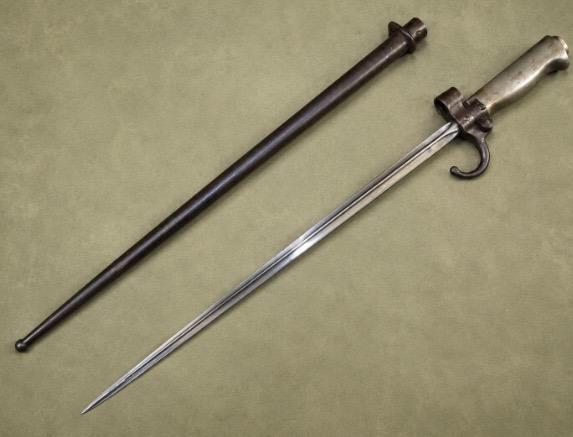
Officially known as the Épée-Baïonnette Modèle 1886, the weapon was developed for use with the new French Model 1886 service rifle. The Lebel rifle represented a major step forward in military firearms technology, and the bayonet designed to accompany it was equally distinctive. Rather than using the broad, flat blade seen on many earlier bayonets, the French adopted a long, narrow blade with a cruciform cross-section. An original Model 1886 example held by the Imperial War Museums has a blade approximately 52 centimetres long, giving the complete bayonet an exceptionally long and elegant appearance.
The cruciform blade was formed with four projecting ribs running along its length. This construction created a blade that was relatively light for its size while remaining rigid enough for thrusting. It was not intended to function as a conventional fighting knife or cutting weapon. Its principal purpose was the thrust, turning the rifle and fixed bayonet into something approaching a short spear. With the bayonet attached to the end of the already lengthy Lebel rifle, a French infantryman possessed considerable reach during close combat.
The original Model 1886 bayonet had a characteristic hooked quillon projecting from the crossguard. The hook was a feature inherited from earlier bayonet designs and was theoretically useful for catching an opponent's weapon or assisting in close-quarter fighting. The grip was made entirely from metal rather than wood, giving the weapon a particularly distinctive appearance. A locking mechanism secured the bayonet to the rifle, while a steel scabbard protected the long blade when it was carried on the soldier's equipment.
Although universally associated with the Lebel rifle, the bayonet existed in a number of variations as French small-arms requirements changed. During the First World War, simplified versions appeared in which the hooked quillon was removed, producing the pattern generally associated with the Model 1886/15. The removal simplified manufacture at a time when the French Army required enormous quantities of weapons and equipment for an expanding wartime army. The Imperial War Museums identifies the Model 1886/15 as a development of the original Model 1886 bayonet, retaining the distinctive cruciform blade.
When war broke out in August 1914, French military thinking still placed considerable importance on offensive spirit and the bayonet charge. Infantry training before the war emphasised determination, aggression and the willingness to close with the enemy. French soldiers went into battle wearing their famous red trousers and carrying long Lebel rifles tipped with equally imposing bayonets. The reality of modern warfare would quickly prove far more complicated. Machine guns, rapid-firing artillery and barbed wire made massed infantry charges extraordinarily costly, but the bayonet remained an essential part of the French soldier's equipment.
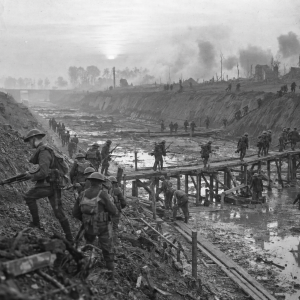
As the Western Front settled into trench warfare, the circumstances in which bayonets might be used changed dramatically. Soldiers still fixed bayonets before attacks and carried them during trench raids, patrols and assaults on enemy positions. In the confined world of a trench system, however, the extraordinary length of the Lebel rifle and its bayonet could become an inconvenience. Fighting might take place around narrow traverses, inside dugouts or among shell holes where there was little room to manoeuvre. Soldiers therefore supplemented their rifles with revolvers, grenades, trench clubs, knives and improvised weapons, yet the bayonet continued to have enormous psychological importance.
Its long needle-like form became closely linked with the popular name “Rosalie”. The term entered French wartime culture and was reinforced through patriotic songs and propaganda, presenting the bayonet almost as a personal companion of the infantryman. The name helped transform an ordinary piece of military equipment into a symbol of French resistance and offensive determination. The association became so strong that images of French soldiers charging with fixed bayonets appeared repeatedly in wartime illustrations and patriotic imagery.
In reality, battlefield use was often less romantic than the propaganda suggested. Many attacks ended before opposing soldiers ever reached bayonet range. Artillery caused the majority of battlefield casualties, while machine guns and rifles dominated open ground. Nevertheless, close fighting certainly occurred during assaults on trenches, strongpoints, villages and fortified positions. A soldier entering an enemy trench with a fixed bayonet possessed a weapon capable of delivering a powerful thrust, and the mere sight of approaching infantry with bayonets fixed could have a considerable psychological effect.
The Lebel bayonet was particularly well suited to thrusting because of the rigidity of its cruciform blade, although the design also had disadvantages. The long, narrow point could be damaged or broken during hard service, while its length made it less practical for general utility work than the shorter knife bayonets increasingly favoured by other armies. Surviving examples can sometimes be encountered with shortened or repointed blades, reflecting either later modification or attempts to repair damaged weapons during their service lives.
The steel scabbard was itself a simple but important part of the equipment. Carried from the soldier's belt or equipment, it protected both the blade and the man carrying it. Surviving wartime examples frequently show dents, wear and loss of finish, reminders that these were working military objects carried through mud, rain and the extreme conditions of trench warfare rather than ceremonial weapons intended simply for display.
The bayonet's length also reflected military thinking inherited from the nineteenth century. Infantry rifles had gradually become shorter as firearms improved, but armies remained concerned that soldiers should still possess sufficient reach when fighting cavalry or opposing infantry. A long bayonet effectively restored some of the length lost as muskets and rifles became more compact. By 1914, however, warfare was changing rapidly, and the enormous casualties of the First World War accelerated a general movement towards shorter and more practical bayonet designs.
Despite these changes, the Model 1886 pattern remained in widespread French service throughout the conflict. It could be seen in the hands of French soldiers fighting in almost every major campaign on the Western Front. From the desperate battles of 1914 through Verdun in 1916 and the final campaigns of 1918, the long cruciform bayonet remained attached to the equipment of millions of French servicemen.
The weapon is also closely connected with the vast industrial effort required to arm France during the war. Millions of men passed through the French Army, creating an enormous demand for rifles, bayonets, ammunition and equipment. Designs therefore had to be adapted and simplified wherever possible. The removal of the original hooked quillon from later bayonets was one visible example of this process, eliminating a feature that was no longer considered essential while making large-scale production easier.
Today, collectors generally encounter both early versions retaining the hooked quillon and later simplified examples without it. Differences in grips, markings, manufacture and later modifications can make the subject surprisingly complex. Individual bayonets may bear inspection or manufacturing marks, while the condition of the blade and scabbard can reveal something of the life the weapon experienced. Some survive almost untouched, while others carry the scars of decades of military service and subsequent storage.
The Model 1886 also outlived the conflict that made it famous. Large numbers remained available after the Armistice of November 1918, and the French military continued to hold enormous stocks of Lebel rifles and associated equipment during the inter-war years. Modified and shortened examples therefore continued to appear long after the First World War had ended. The Smithsonian's National Museum of American History, for example, holds a modified French Lebel Model 1886 spike bayonet in its collection, demonstrating the continued evolution and alteration of the design.
For modern collectors and military historians, the French Lebel bayonet remains one of the most evocative pieces of equipment from the Great War. Its long cruciform blade is instantly recognisable and immediately associated with the French Army of 1914–1918. It represents an era in which military doctrine was caught between nineteenth-century ideas of massed infantry attack and the emerging industrial warfare of machine guns, heavy artillery and deeply fortified trench systems.
Carried by the poilus who defended France through some of the most terrible battles in its history, the bayonet became a symbol of endurance as much as aggression. Whether fixed to a rifle before an assault, hanging in its steel scabbard from a soldier's equipment or appearing in the patriotic imagery of wartime France, the so-called Rosalie became inseparable from the story of the French infantryman.
More than a century later, surviving examples still possess a remarkable presence. Their unusually long, narrow blades and unmistakable cruciform construction make them unlike almost any ordinary knife or sword bayonet. They are physical reminders of the millions of French soldiers who served during the First World War and of a conflict in which an apparently simple weapon designed in the 1880s remained in service through one of the most technologically destructive wars the world had yet seen.