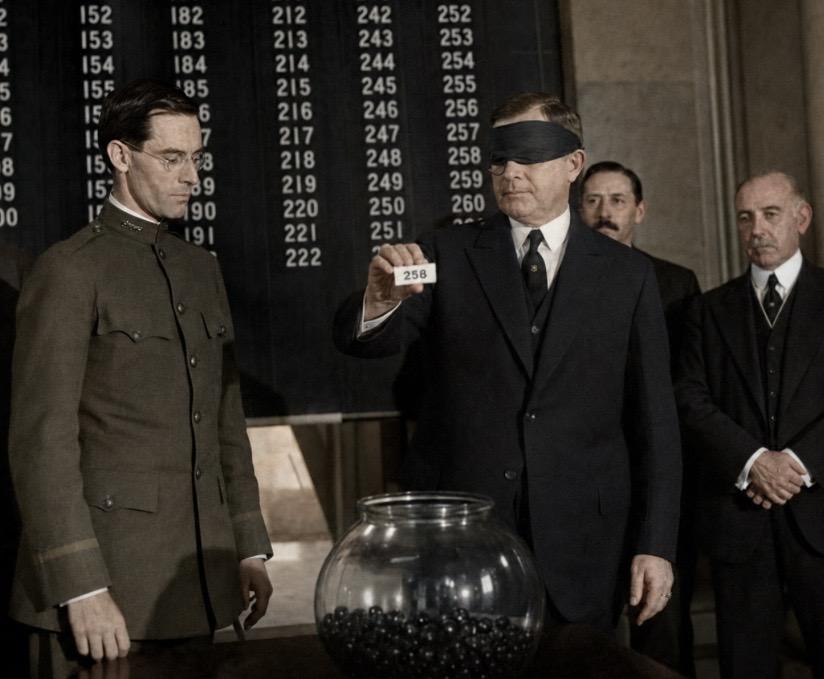
First Lottery Draft
On 20 July 1917, the United States conducted its first national military draft lottery of the First World War, drawing thousands of numbered capsules from a large glass bowl in Washington, D.C. The event was intended to determine the order in which millions of registered American men would be called before their local draft boards for examination and possible service in the armed forces. It was an extraordinary moment in American history, transforming the nation’s recently introduced system of compulsory military service into a visible and highly public ceremony.
The United States had entered the First World War on 6 April 1917, nearly three years after fighting had begun in Europe. President Woodrow Wilson had previously attempted to keep the country neutral, but Germany’s renewed campaign of unrestricted submarine warfare, attacks on shipping and the revelation of the Zimmermann Telegram helped turn American opinion towards intervention. Once war had been declared, the government faced the enormous task of creating an army capable of fighting alongside the exhausted forces of Britain, France and their allies.
America’s Regular Army was far too small for a major European war. Although volunteers came forward after the declaration of war, military planners understood that voluntary enlistment alone would not produce the large and steadily supplied force that was required. Britain, France, Germany and the other principal European powers already had millions of men under arms, while the United States needed to recruit, train, equip and transport an army across the Atlantic.
President Wilson and Secretary of War Newton D. Baker therefore accepted that some form of compulsory service was unavoidable. The result was the Selective Service Act, signed into law by Wilson on 18 May 1917. The Act authorised the federal government to raise troops through conscription and initially required men aged from 21 to 30 to register for possible military service. Unlike the controversial draft used during the American Civil War, the new system did not allow a wealthy man to escape service by paying a fee or hiring a substitute.
Responsibility for organising the enormous programme fell largely upon Brigadier General Enoch H. Crowder, the Provost Marshal General of the United States Army. Crowder helped design a decentralised system based upon thousands of local draft boards. These boards were made up of civilians who knew their communities and were expected to decide claims for exemption or deferment. The intention was to make selection appear fairer and less like a distant military order imposed without regard for local circumstances.
The first national registration day took place on 5 June 1917. Across the country, approximately ten million men between the required ages registered at schools, town halls, polling stations and other public buildings. Each man was assigned a serial number by his local draft board. The challenge was then to determine the order in which those serial numbers would be called.
It was not practical simply to begin with the lowest number at every local board, as this might have created predictable or uneven results. Instead, the authorities decided upon a national lottery. The same sequence of numbers would apply to every local board in the country. When a number was drawn in Washington, every man carrying that serial number in every registration district moved into the corresponding position in the national order of call.
The drawing took place in Room 226 of the Senate Office Building in Washington. At the centre of the room stood a large glass bowl, sometimes described as resembling an oversized goldfish bowl. Inside it were around 10,500 small capsules, each containing a slip of paper bearing a number. The capsules were placed in the bowl and thoroughly mixed with a large wooden ladle to reduce the possibility of any number being deliberately selected.
Government officials, military officers, journalists, photographers and invited observers crowded into the room. The public nature of the ceremony was important. The government wanted Americans to believe that the drawing was honest, impartial and beyond political interference. At a time when compulsory military service remained controversial, the sight of officials drawing numbers blindly from a transparent bowl was intended to demonstrate that no district, family or individual could secretly be favoured.
Shortly before ten o’clock in the morning, Secretary of War Newton D. Baker stepped forward to make the first draw. Baker removed his spectacles and was blindfolded with a white cloth. After the capsules had been stirred, he reached down into the bowl and withdrew one. The capsule was opened and the number inside was announced as 258.
That simple number immediately affected thousands of lives. In every registration district where a man had been assigned serial number 258, he became the first person called for examination. It did not mean that every holder of the number was instantly sent into the Army. Each man still had to appear before his local board, undergo a medical examination and be considered for any lawful exemption or deferment. Nevertheless, number 258 placed its holders at the head of the line and became one of the most famous numbers in the history of American conscription.
The second number drawn was 2,522, followed by 9,613 and 4,532. Because many local boards had fewer registrants than some of the higher numbers drawn, a number such as 9,613 might not correspond to anyone in a smaller district. The drawing therefore had to continue until the entire range of serial numbers had been covered.
After Baker completed the first historic selection, other prominent figures took turns drawing capsules. They included General Crowder, Army Chief of Staff General Tasker H. Bliss, Senator George E. Chamberlain, chairman of the Senate Military Affairs Committee, Representative Julius Kahn and Representative S. Hubert Dent. Kahn and Dent had played important roles in guiding military legislation through Congress despite belonging to different political parties.
The ceremonial participation of military leaders and members of Congress helped present the draft as a national undertaking rather than the project of a single department. After the senior officials had made their selections, the lengthy work was continued by teams of blindfolded assistants, including students who repeatedly reached into the bowl and passed the capsules to officials who opened, read and recorded them.
Each number had to be announced clearly, checked and entered onto official lists. Telegraph operators and newspaper correspondents then transmitted the results across the country. Crowds gathered outside newspaper offices to read posted numbers, while families waited anxiously for news. In an age before radio broadcasting had become widespread, newspapers, telegrams and public notices carried the results to towns and cities throughout the nation.
The drawing continued for nearly twenty-four hours. The great glass bowl had to be stirred regularly to ensure that the remaining capsules did not settle into layers. The men involved became exhausted as the ceremony stretched through the day, into the night and finally towards the following morning. The last capsule was reportedly drawn shortly after two o’clock on the morning of 21 July.
The lottery established only the order in which men were considered; it did not decide guilt, punishment or even automatic entry into the Army. Local boards classified registrants according to their fitness, occupation and family circumstances. Men working in agriculture, essential industry or other occupations important to the war effort could sometimes receive deferment. Those who supported dependent wives, children or parents could also submit claims. Medical examinations removed men judged physically unfit for military service.
The system was nevertheless intrusive and deeply feared by many families. A letter summoning a man before his local board could mean separation, military training and eventual service in the trenches of France. For immigrant families, the process could be particularly confusing, especially where English was not their first language. Some communities resisted registration, while a smaller number of men attempted to evade the draft entirely.
There were also serious inequalities in the way the system operated. Local boards possessed considerable discretion, and decisions could be influenced by regional attitudes, social position, race and economic circumstances. African American men were drafted in large numbers but served in a segregated Army. Many were placed in labour and support units, although units such as the 369th Infantry Regiment later earned great distinction in combat under French command.
Despite criticism and resistance, the Selective Service system proved extremely effective in expanding the armed forces. Approximately 2.8 million men were eventually inducted through the wartime draft, forming more than half of the nearly 4.8 million Americans who served in the armed forces during the conflict. The system supplied the manpower needed to create the American Expeditionary Forces commanded in France by General John J. Pershing.
The men selected through the draft were sent to rapidly constructed training camps throughout the United States. There they received uniforms, weapons instruction, physical training and preparation for the unfamiliar conditions of industrial warfare. Many had never travelled far from their home states before entering the Army. Within months, they found themselves crossing the Atlantic in troopships threatened by German submarines.
By the spring and summer of 1918, American forces were arriving in France in increasingly large numbers. They helped stop the final German offensives and took part in major battles including Cantigny, Château-Thierry, Belleau Wood, Saint-Mihiel and the Meuse-Argonne Offensive. The presence of a growing American army provided the Allies with fresh manpower at a time when the European armies had suffered years of devastating casualties.
The age limits for registration were later expanded. In September 1918, men aged from 18 to 45 were required to register, greatly increasing the number available for possible service. The Armistice of 11 November 1918 ended the fighting before many of these later registrants could be called into the Army.
The glass bowl used in the 1917 lottery became a symbol of national mobilisation. It demonstrated how the fate of an individual could be altered by a tiny numbered slip sealed inside a capsule. To government officials, the bowl represented fairness, order and equal obligation. To many of the men and families awaiting the results, it represented uncertainty and the possibility of being sent into one of the most destructive wars the world had yet experienced.
The lottery also marked an important change in the relationship between the American citizen and the federal government. Never before had the United States organised compulsory military service on such a vast, centrally coordinated scale. The Civil War drafts had been widely criticised and had even helped provoke violent unrest, including the New York City Draft Riots of 1863. In 1917 the government attempted to avoid a repetition by combining national control with local administration and by presenting the selection process as open and impartial.
The first number drawn, 258, remained firmly associated with the event. Newspapers printed stories about the men who held it, and the number became a reminder that the decisions made inside the Senate Office Building reached immediately into ordinary homes and workplaces across America.
The procedure used in 1917 was different from the birthday-based draft lotteries remembered from the Vietnam War era. The First World War system drew individual registration serial numbers, with the resulting sequence applied across local districts. Later American lotteries developed different methods, but the principle of a highly visible random drawing remained.
The historic scene of Newton D. Baker, blindfolded beside a glass bowl and reaching among thousands of capsules, captured the scale and uncertainty of America’s entry into the First World War. What appeared to be a simple lottery was in reality the beginning of a vast human mobilisation. Behind every number stood a man, a family and a possible journey from civilian life to a training camp, an Atlantic troopship and the battlefields of France.