Drop Baskets
During the Second World War one of the most unusual pieces of British airborne equipment looked more suited to a country railway station or laundry room than a battlefield. Huge rectangular wicker baskets, generally known as airborne panniers, were developed to carry weapons, ammunition, food, medical equipment, wireless sets and other supplies that could be pushed from transport aircraft and delivered by parachute to troops fighting far beyond normal supply lines.
The idea was remarkably simple. Instead of constructing every supply container from steel, aluminium or timber, Britain already possessed a large and highly skilled basket-making industry capable of producing strong containers from willow. Wicker was light, comparatively inexpensive, flexible and surprisingly resistant to violent impacts. Rather than shattering like a rigid wooden box, the woven willow could bend and absorb some of the shock when the load struck the ground.
The airborne pannier is generally associated with the Royal Army Service Corps and Britain's rapidly developing airborne forces. The Airborne Assault Museum records that officers of 250 (Airborne) Light Composite Company RASC experimented with the idea of adapting a large wicker laundry pannier for airborne supply work. A successful demonstration was given on 8 February 1943, after which the concept developed into an important method of supplying airborne troops.
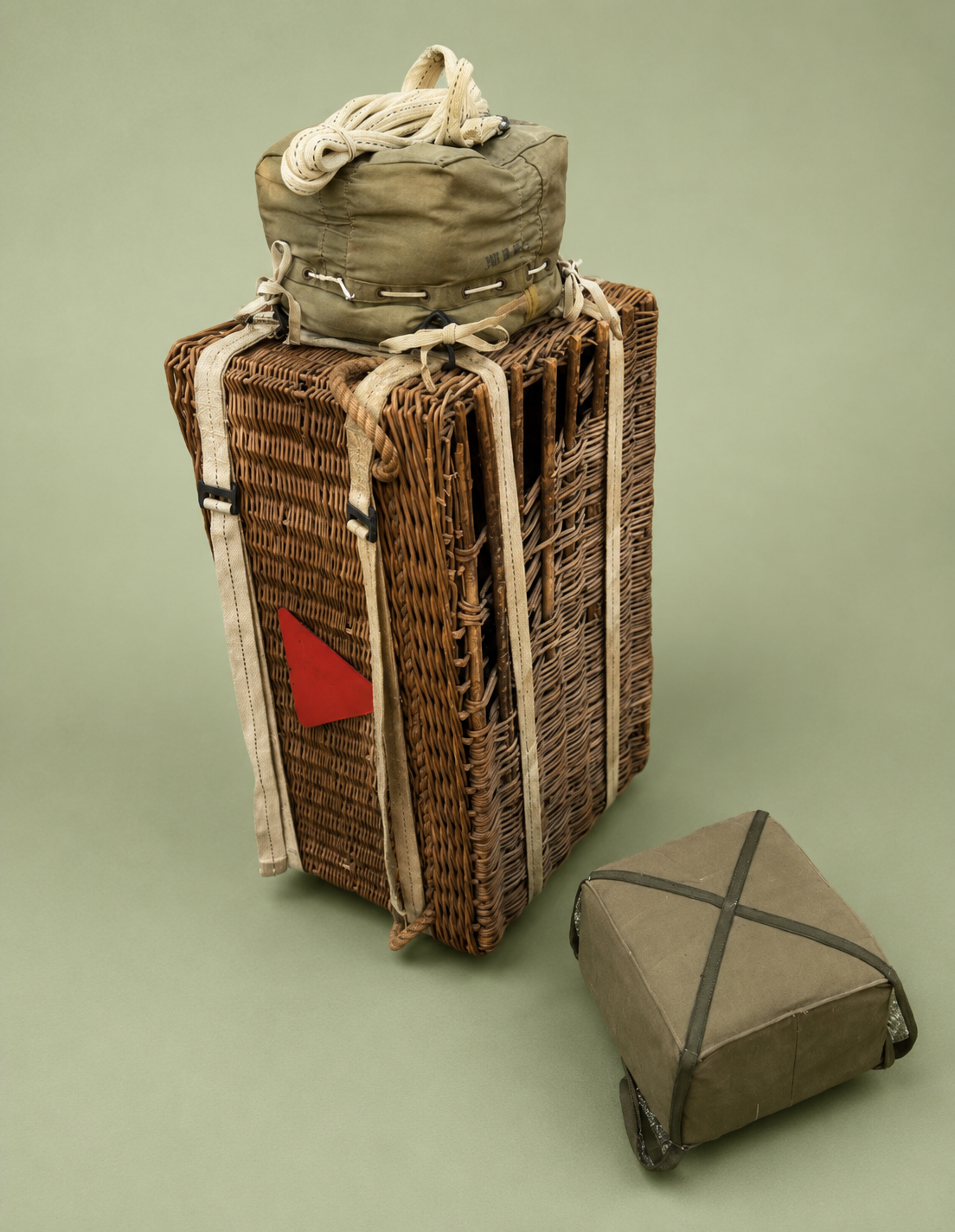
A typical pannier consisted of two large rectangular wicker sections. One was slightly smaller than the other, allowing the two halves to telescope together. This was a clever feature because the height of the container could be altered according to what was being carried. Once packed, strong webbing straps secured the halves together. Rope handles were woven into the upper section so that several men could carry the extremely heavy basket after it had been packed.
An example preserved by the Museum of English Rural Life measures approximately 36 inches by 22 inches by 16½ inches when closed. The double-wall arrangement created when the two baskets fitted together greatly increased its strength. The same museum records that the prototype was developed from an idea associated with Major Squirrel of Home Forces and W. Shelley of Salisbury and that an enormous wartime requirement eventually existed for these containers.
Millions were reportedly required as preparations for the invasion of Europe accelerated. Basket makers throughout Britain were brought into wartime production and the War Office took control of supplies of willow. Somerset became particularly important because the Somerset Levels had long been one of Britain's great willow-growing and basket-making areas. Men and women who had previously produced agricultural baskets, hampers and domestic wickerwork suddenly found themselves manufacturing equipment intended to descend from aircraft over battlefields.
One documented manufacturer was Geoffrey Musgrave & Son of Stoke St Gregory near Taunton in Somerset. A surviving example in the Museum of English Rural Life collection was produced there during the wartime period. Local histories from Stoke St Gregory also record women being recruited into basket making as wartime requirements increased, while normal civilian basket production was restricted.
The choice of willow made considerable military sense. Britain needed huge numbers of containers and metal was desperately required for aircraft, vehicles, weapons, ships and ammunition. A wicker container required relatively little strategically valuable material. Willow was renewable, available in Britain and could be fashioned largely by hand using an existing workforce.
There was another important advantage. Once the basket had landed, it could immediately be carried by its rope handles without specialist lifting equipment. In a battlefield situation several soldiers could grab a pannier and move its entire contents quickly away from an exposed dropping zone.
The strength of these baskets was considerable. Different surviving records give different figures for their loads, partly because panniers were used in several configurations. A wartime photograph taken in England in 1943 describes a loaded pannier, complete with parachute, weighing approximately 350 lb, or around 159 kg. Other airborne histories give a maximum pannier load in the region of 500 lb, approximately 227 kg. The difference probably reflects particular loads and parachute arrangements rather than every basket routinely being dropped at the maximum theoretical weight.
Inside could be almost anything required by troops on the ground. Ammunition boxes, small arms, grenades, rations, medical stores, wireless equipment, batteries, spare parts and other supplies could all be packed into panniers. Fragile objects were protected with padding. A surviving wartime caption describes panniers being packed with food, arms, ammunition, wireless sets and spares and protected by sandbags filled with straw to cushion the contents.
Some panniers carried identifying markings so that troops arriving at a supply dump could recognise their contents rapidly. One particularly interesting surviving example recovered around Oosterbeek in the Netherlands carries a red triangular marking and has been identified as an ammunition pannier. Such markings were extremely useful because unloading and sorting supplies during an airborne battle could take place under shellfire, mortar fire or attack from enemy troops. A soldier needed to know immediately whether a particular container held ammunition, medical stores or food rather than opening every basket individually.
This is probably the origin of many of the red triangles seen on surviving examples. They should not automatically be interpreted as unit badges. On documented airborne supply panniers the red triangle could indicate ammunition or a particular category of stores. Other letters, symbols and painted markings also appear on surviving examples, and systems could vary according to load, unit and operation.
Colour identification was also used elsewhere within the airborne supply system. Parachutes attached to supply containers could be colour coded according to their contents or according to the particular operation. Surviving records describe khaki, blue, yellow, red and white parachutes being used with Container Light Equipment loads. Troops watching supplies descending could therefore sometimes identify important stores before they had even reached the ground.
The panniers were commonly associated with the Douglas C-47 Dakota, one of the principal transport aircraft used by British airborne forces. Because a fully loaded basket could weigh several hundred pounds, aircraft could be equipped with roller arrangements that allowed the panniers to be moved towards the doorway before being pushed or released into the slipstream.
Air despatchers performed one of the most dangerous jobs involved in the system. Working inside an aircraft travelling at low altitude over enemy territory, they had to release extremely heavy loads accurately while the aircraft might be manoeuvring through anti-aircraft fire. A badly handled pannier moving around inside the aircraft could itself become extremely dangerous.
Some panniers were dispatched in pairs. One method became known among air despatch personnel as a form of “daisy chain”. Two panniers could be temporarily secured together, with their parachute systems arranged so that deployment separated them after they left the aircraft. This allowed supplies to be dispatched rapidly while preventing both baskets from remaining permanently attached during descent.
The parachutes themselves were substantial pieces of equipment. Depending upon the weight and configuration of the load, different cargo parachutes could be employed. Heavy loads required considerably larger canopies than normal personnel parachutes, and combinations of parachutes could be used for particularly heavy loads.
Not everything necessarily received a parachute. The Museum of English Rural Life records that sufficiently robust supplies could sometimes be dropped in wicker panniers without one. That gives some indication of just how strong the woven construction could be. Fragile equipment naturally required much greater protection.
Perhaps the most famous use of the baskets came during the great Allied airborne operations of 1944. They became part of the enormous logistical effort needed to sustain parachute and glider troops who might be fighting many miles beyond the advancing ground armies.
At Arnhem during Operation Market Garden the problem of aerial resupply became particularly serious. British troops around Arnhem and Oosterbeek depended increasingly upon supplies from the air as German forces surrounded their positions. Dakota and other transport crews repeatedly flew over the battlefield attempting to deliver ammunition, food and medical stores.
The tragedy was that many of the original dropping zones had fallen into German hands or were under German observation. Aircrews frequently flew into intense anti-aircraft fire while air despatchers continued pushing supplies from their aircraft. Numerous containers and panniers therefore landed outside the shrinking British perimeter and were recovered by German troops instead of the men desperately waiting for them.
Surviving wicker panniers still occasionally appear in the Arnhem and Oosterbeek area. After the battle local civilians naturally found enormous numbers of useful military objects scattered around the countryside. A large strong wicker basket was far too valuable to throw away. Some became household storage chests, laundry baskets, farm containers or bulb-storage baskets and remained in Dutch homes for decades. The Museum of English Rural Life records accounts of panniers dropped around Arnhem subsequently being used by Dutch farmers for storing bulbs.
There is also an interesting connection with the Special Operations Executive, although the equipment should not all be confused together. SOE aircraft regularly dropped weapons, explosives, radios, money, clothing and other supplies to resistance groups throughout occupied Europe, but the organisation made extensive use of specially designed cylindrical parachute containers rather than relying entirely upon the large airborne wicker pannier.
SOE developed several types of supply container. The C-type was particularly useful for long equipment including rifles and machine guns, while the H-type incorporated separate sections that could be divided after landing and carried away individually. RAF historical records state that an H-type container could have a gross weight of around 330 lb with a payload of approximately 235 lb. During 1944 shortages resulted in the Airborne Division's CLE container also being used temporarily by SOE.
This demonstrates how closely the secret-war supply system and the airborne supply system sometimes overlapped. Both faced exactly the same basic problem: how to deliver hundreds of pounds of equipment from an aircraft travelling over hostile territory and ensure that the contents survived hitting the ground.
SOE reception committees normally waited on isolated fields at night after receiving coded instructions through wireless messages or BBC broadcasts. Aircraft belonging to RAF Special Duties squadrons would locate the reception ground, often identified by lamps arranged in a predetermined pattern, before making a low-level run and releasing agents, containers and packages.
Once the containers landed, resistance fighters had to work quickly. Weapons, ammunition, explosives and radios were removed and hidden before German security forces could investigate. Cylindrical containers were sometimes broken down or concealed because simply leaving British parachute equipment scattered around the countryside could reveal the existence of a resistance reception ground.
The scale eventually became enormous. Weapons that had been manufactured in British factories could be packed into containers in England, loaded aboard aircraft and only hours later be lying in a French field ready for use by resistance fighters.
The same principle applied to British airborne forces. A soldier fighting at Arnhem, Normandy or elsewhere might receive ammunition that had left an English supply depot only a few hours earlier and had completed the final stage of its journey inside what appeared to be a gigantic laundry basket.
The wicker pannier therefore represents one of the more ingenious examples of wartime improvisation. It required no advanced electronics, engine or complicated mechanism. Its technology was centuries old: willow, rope and traditional basket-making skill.
Yet that ancient craft became part of one of the most modern forms of warfare then being developed. Aircraft, parachutes, airborne divisions and special forces depended upon craftsmen sitting in workshops weaving willow by hand.
Perhaps most remarkably, the pannier was deliberately expendable. Britain could produce them in enormous numbers, fill them with hundreds of pounds of equipment and throw them from aircraft knowing that many would be damaged, lost or captured. The important consideration was that enough reached the troops.
Today genuine airborne panniers are highly distinctive survivors of the Second World War. Their enormous size surprises many people seeing one for the first time, particularly when imagining several hundred pounds of ammunition packed inside and the entire basket disappearing through the open door of a Dakota.
Painted triangles, letters, wartime dates, manufacturer markings, webbing straps and surviving parachute fittings can sometimes reveal what an individual pannier once carried. An apparently insignificant red triangle may therefore tell part of its story, including examples associated with ammunition supply.
They are also reminders that wartime production extended far beyond tanks, rifles and aircraft. Willow growers in Somerset, country basket makers, women recruited into wartime workshops, RASC supply soldiers, RAF aircrews and airborne troops on distant battlefields were all connected by the same object.
Few pieces of military equipment demonstrate wartime practicality quite so effectively. Britain took the traditional wicker hamper, strengthened it, fitted it with webbing and rope, packed it with weapons and ammunition, attached a parachute and threw it out of an aircraft.
From the secret supply fields of occupied Europe to the desperate resupply flights over Arnhem, delivering equipment from the sky became essential to Allied airborne and special operations. Among the steel containers, parachutes and aircraft involved in that enormous operation, the humble woven basket proved itself capable of carrying hundreds of pounds into battle.