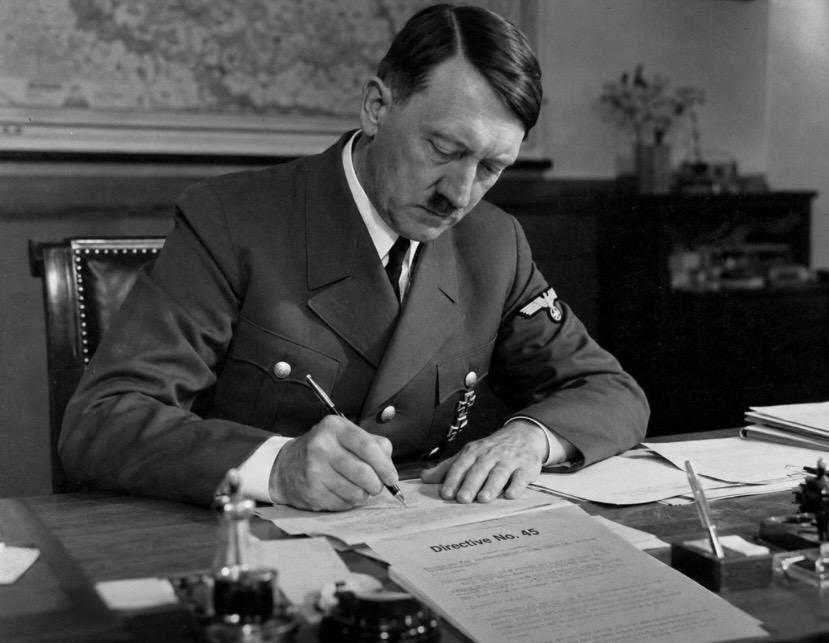
Directive 45
On 23 July 1942, Adolf Hitler issued Führer Directive No. 45, one of the most consequential orders of Germany’s war on the Eastern Front. Coming at a moment when the Wehrmacht appeared to be advancing rapidly across southern Russia, it expanded the objectives of the German summer offensive and committed German forces to simultaneous advances towards both Stalingrad and the oil-rich Caucasus. What appeared to be an opportunity to deliver a decisive blow against the Soviet Union would instead contribute to the dispersal of German strength and help set the stage for the catastrophe at Stalingrad.
The order was issued during Operation Blue, Germany’s great summer offensive of 1942. After the failure to defeat the Soviet Union during Operation Barbarossa the previous year, Hitler abandoned the idea of another major offensive along the entire Eastern Front. Instead, German attention shifted southwards. The Soviet Union’s vast oil resources had become increasingly important in Hitler’s thinking, while Germany itself faced a growing need for fuel to sustain its armed forces and war economy.
The principal strategic prize lay in the Caucasus. The oilfields at Maikop, Grozny and, above all, Baku represented a huge proportion of Soviet petroleum production. Hitler believed that capturing these resources would not only provide Germany with desperately needed oil but would also deprive the Red Army and Soviet industry of one of their most important sources of fuel. At the same time, reaching the River Volga would threaten one of the Soviet Union’s major transport arteries, along which oil and other supplies moved northwards from the Caucasus and Caspian region.
The German summer offensive began on 28 June 1942 and initially achieved impressive results. German armoured formations advanced rapidly through southern Russia, while Soviet armies withdrew eastwards rather than allowing themselves to be trapped in the enormous encirclements that had characterised the German victories of 1941. To Hitler, however, the retreat of the Red Army appeared to indicate that Soviet resistance in the south was collapsing.
This belief formed the background to the directive. Hitler considered that the main objectives initially assigned to the southern wing of the Eastern Front had largely been accomplished and now ordered the offensive to continue towards much more ambitious goals. Instead of concentrating German strength upon one objective before turning towards the next, the available forces would increasingly be required to operate along two widely separated axes.
Army Group A was given the task of driving southwards into the Caucasus in an operation known as Edelweiss. Its forces were to cross the lower Don, advance towards the Black Sea and penetrate the region, with the ultimate objective of seizing the major oil-producing areas. German mountain troops and armoured formations would eventually push deep into the region, operating across increasingly difficult terrain and at the end of extraordinarily long supply lines.
Army Group B, meanwhile, was responsible for the advance towards Stalingrad and the Volga. The operation associated with this thrust was known as Fischreiher, or Heron. Stalingrad had originally been important primarily because of its position on the Volga and its significance as an industrial and communications centre. Under the developing German strategy, however, the city gradually assumed an importance far beyond its initial military value.
The two offensives were now expected to proceed simultaneously. This marked a fundamental moment in the development of the 1942 campaign, as German forces were directed towards the Caucasus while others continued towards Stalingrad, creating two enormous strategic objectives separated by vast distances.
The decision placed extraordinary demands upon the Wehrmacht. German armies had already advanced hundreds of miles into Soviet territory. Every mile eastwards increased the difficulty of supplying fuel, ammunition, food and replacement equipment. Much of the Soviet railway network used a different gauge from that of Germany, forcing railway lines to be converted before they could fully support the advancing armies. Roads were often poor, while the enormous distances placed constant strain upon trucks and other transport vehicles.
Fuel was particularly important. The campaign itself had been launched partly to obtain oil, yet the German armoured and motorised forces needed enormous quantities of fuel simply to reach the oilfields. As the advance continued, supply columns had to travel ever greater distances to maintain the fighting formations at the front.
The division of the German effort also created an increasingly dangerous gap between the forces advancing towards the Caucasus and those fighting towards the Volga. The further Army Group A moved south and Army Group B moved east, the more difficult it became for the two groups to support one another. German commanders found themselves attempting to achieve enormous objectives with forces that were increasingly stretched across a vast front.
The initial advance of Army Group A remained impressive. Rostov-on-Don fell on 23 July, opening the gateway towards the Caucasus. German troops swept southwards and reached the Maikop oilfields in August, but Soviet forces had destroyed important installations before withdrawing. The Germans therefore captured territory but failed to obtain the immediate supplies of usable oil that Hitler had hoped for.
Other German formations pushed deeper into the Caucasus, and mountain troops famously reached the summit of Mount Elbrus, the highest mountain in the region. The symbolic achievement, however, did nothing to solve the growing strategic problems facing the offensive. The principal oil centres around Grozny and Baku remained far beyond the effective reach of the German armies, and the combination of Soviet resistance, difficult terrain and overstretched supply lines steadily reduced the momentum of the advance.
At the same time, the struggle for Stalingrad was becoming increasingly intense. The German Sixth Army under General Friedrich Paulus advanced towards the city, supported by elements of the Fourth Panzer Army. What had begun as an attempt to secure the Volga and protect the northern flank of the Caucasus offensive gradually developed into one of the largest and most brutal battles of the Second World War.
The city carried Stalin’s name, giving its capture immense propaganda significance for Hitler, while its defence became equally important to the Soviet leadership. As German forces became drawn into street fighting among factories, apartment blocks and ruined buildings, the battle consumed increasing numbers of men and enormous quantities of ammunition.
The consequences of the directive became increasingly apparent as the campaign progressed. Germany was attempting to capture the Caucasian oilfields, secure the Volga and defeat major Soviet forces around Stalingrad while maintaining a front stretching across hundreds of miles. The flanks of the German advance increasingly depended upon Romanian, Italian and Hungarian allied armies, many of which lacked the modern anti-tank weapons and equipment available to the strongest German formations.
The Soviet high command gradually recognised the opportunity created by the concentration of German forces inside Stalingrad and the relative weakness of the Axis armies protecting their extended flanks. On 19 November 1942, the Red Army launched Operation Uranus, attacking Romanian forces north and south of the city. Within days, the Soviet spearheads met and surrounded the German Sixth Army and other Axis formations inside the Stalingrad pocket.
The disaster transformed the entire strategic situation in southern Russia. With Sixth Army trapped at Stalingrad and Soviet forces threatening to advance towards Rostov, Army Group A faced the danger of being cut off in the Caucasus. German troops were eventually forced to withdraw from much of the territory they had fought so hard to capture. The great attempt to seize the Caucasian oilfields had failed, and the remaining forces of the Sixth Army surrendered at Stalingrad in early 1943.
This order has therefore become closely associated with one of Hitler’s most damaging strategic decisions on the Eastern Front. It reflected his growing confidence following the rapid German advances of the summer of 1942, but it also demonstrated the danger of allowing apparent battlefield success to produce objectives that exceeded the resources available to achieve them.
Instead of concentrating overwhelming strength against a single objective, German forces were committed to two enormous operations at the same time. The Caucasus offensive demanded a deep advance through difficult terrain towards distant oilfields, while the advance on Stalingrad drew the Wehrmacht into an increasingly costly battle on the Volga.
The campaign that followed did not fail because of this decision alone. Soviet resistance, Germany’s chronic logistical weaknesses, the immense distances of the Eastern Front and the growing strength of the Red Army all played crucial roles. Nevertheless, the order of 23 July 1942 stands as a defining moment in the campaign. At the height of apparent German success, Hitler committed his armies to objectives whose scale placed enormous pressure upon the Wehrmacht’s available manpower and logistical resources.
Within months, the optimism surrounding the German advance into southern Russia had disappeared. The oilfields of Baku remained in Soviet hands, the advance into the Caucasus had been reversed, and an entire German army had been destroyed at Stalingrad. What had begun as an ambitious attempt to cripple the Soviet war economy and secure Germany’s access to vital oil had instead resulted in one of the greatest strategic reversals of the war.
Führer Directive No. 45 therefore occupies an important place in the history of the Second World War. Issued on 23 July 1942, at a moment when victory in southern Russia appeared to Hitler to be within reach, it embodied the enormous ambitions of Germany’s 1942 campaign. By demanding simultaneous advances towards the Caucasus and Stalingrad, it helped stretch German power across an immense front and linked two campaigns that would ultimately end in failure. The consequences would be felt far beyond the frozen ruins of Stalingrad and the mountains of the Caucasus, marking a major stage in the gradual loss of Germany’s strategic initiative on the Eastern Front.