On this day in military history…
On Monday 18 September 1944, the second great airborne lift of Operation Market Garden flew towards Arnhem carrying reinforcements, artillery and equipment desperately needed by the British 1st Airborne Division. The operation was already falling behind schedule. Lieutenant-Colonel John Frost and approximately 740 men had reached the northern end of Arnhem road bridge, but most of the division remained several miles away, blocked by rapidly strengthening German defences around Arnhem and Oosterbeek.
The second lift should have arrived during the morning, allowing the newly landed troops to reinforce the advance while the Germans were still recovering from the surprise of the previous day. Thick fog over the English airfields delayed take-off for several hours, however, and the aircraft did not begin arriving over the Arnhem area until approximately 3pm. Those lost hours proved extremely costly. German commanders had identified the British landing grounds and were moving infantry, armoured vehicles and anti-aircraft weapons towards them.
The main fighting force aboard the second lift was Brigadier John “Shan” Hackett’s 4th Parachute Brigade. It contained the 10th, 11th and 156th Parachute Battalions, supported by engineers, signallers, medical personnel and anti-tank detachments. Around 1,900 men of the brigade were carried in approximately 124 Dakota transport aircraft, while a large formation of Horsa and Hamilcar gliders brought in the remaining elements of the division.
These included A and C Companies of the 2nd Battalion, South Staffordshire Regiment, another battery of 75mm pack howitzers, anti-tank guns, jeeps, trailers, ammunition, radios and specialist equipment. Thirty-five Stirling aircraft were also assigned to deliver urgently needed supplies.
The 4th Parachute Brigade was to land on Drop Zone Y at Ginkel Heath, approximately ten miles west of Arnhem. The gliders were directed towards Landing Zones S and X closer to Wolfheze. The ground should have been secure, but the soldiers of the 7th Battalion, King’s Own Scottish Borderers, who were defending the area, had been fighting increasingly determined German attacks throughout the morning. The British pathfinders of the 21st Independent Parachute Company were forced to place their navigation markers and coloured smoke while under fire.
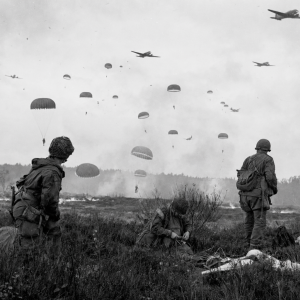
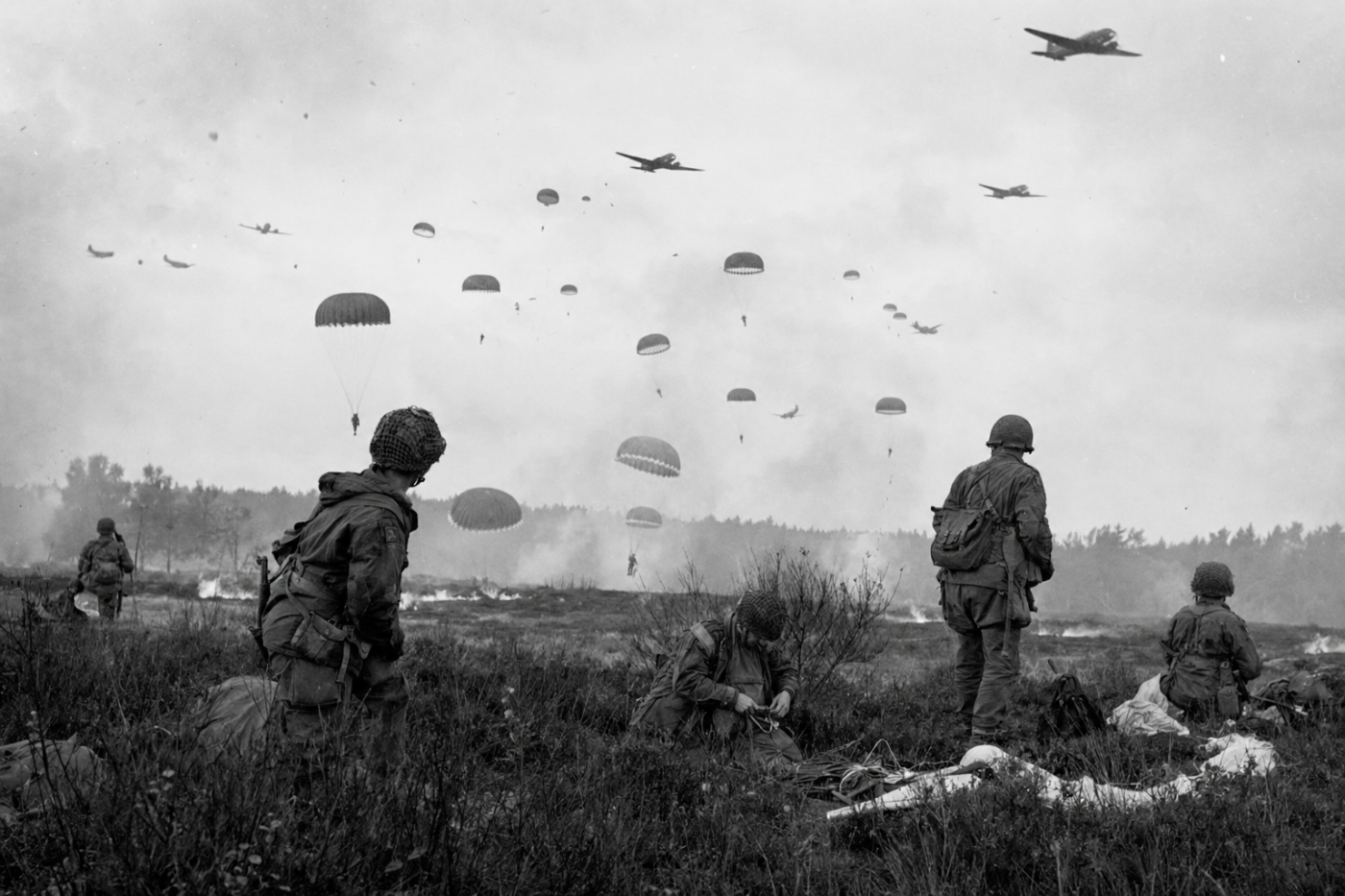
As the transport aircraft approached Ginkel Heath, the men looking through the open doors could see smoke, burning heather and weapons firing across the drop zone. German machine-gunners and riflemen opened fire on the low-flying Dakotas while anti-aircraft guns engaged them from below. One aircraft carrying members of the 156th Battalion’s machine-gun platoon was struck and crashed in flames, killing its crew and nineteen paratroopers. Other damaged aircraft struggled to remain airborne while men jumped early or landed among the surrounding woods.
Despite the intense ground fire, the American crews of the 314th and 315th Troop Carrier Groups held their aircraft steady. The drop was completed in only a few minutes, and most of the paratroopers landed on or close to the correct zone. Some came down directly among German positions, while others were caught in trees and fired upon before they could release their parachute harnesses. Dozens were killed, wounded or reported missing during the descent and assembly, but most reached their rendezvous points and quickly formed into fighting units.
The glider landings were equally dramatic. Horsa and Hamilcar gliders swept in at low level carrying men, guns, vehicles and ammunition. Although many landed successfully, others were damaged by enemy fire, struck trees or overturned on the rough ground. German aircraft had already strafed the landing areas during the morning, setting several abandoned gliders on fire. Glider pilots and airborne soldiers immediately began unloading jeeps, six-pounder anti-tank guns, mortars and 75mm pack howitzers while fighting continued around the perimeter.
By the time Brigadier Hackett reached divisional headquarters, the original plan had already been overtaken by events. Major-General Roy Urquhart, commander of the 1st Airborne Division, was temporarily trapped inside Arnhem and unable to control the battle. Brigadier Philip Hicks had assumed command and informed Hackett that the 11th Parachute Battalion was urgently required for another attempt to reach Frost at the bridge. Instead of advancing north of Arnhem with the remainder of the brigade, the 11th Battalion was detached and sent towards the town behind the South Staffordshires.
The remaining two battalions were ordered to continue with Hackett’s original mission and occupy the high ground north of Arnhem. The 156th Battalion moved off at about 5pm, followed by the 10th Battalion, but the delayed landing left them little daylight. German troops had established a strong defensive line along the roads and woods approaching Arnhem.
At approximately 9pm, the leading company of the 156th ran into heavy opposition near the Dreijenseweg. Its foremost platoon was ambushed and scattered, while an attempted flanking movement met further resistance. With darkness falling and communications failing, the battalion formed a defensive position in the woods and prepared to continue the attack at first light.
The 11th Parachute Battalion marched through the night towards Arnhem, collecting its glider-borne transport and anti-tank guns along the way. It eventually reached the area around St Elizabeth Hospital, where the exhausted survivors of the 1st and 3rd Parachute Battalions and the South Staffordshires were preparing another attempt to break through to the bridge. Their attack on the following morning would end in disaster against German tanks, self-propelled guns and strongly positioned infantry.
The second lift successfully delivered thousands of men and much of the division’s remaining heavy equipment, but it arrived too late to restore the original plan. Instead of landing on quiet ground and moving rapidly towards Arnhem, the troops descended into an expanding battlefield. The division was forced to defend its landing zones, reinforce the failing advance through Arnhem and confront German forces that were becoming stronger by the hour.
The courage of the aircrews, glider pilots, pathfinders and airborne soldiers ensured that the lift reached Arnhem despite fog, flak and direct ground fire. Yet the events of 18 September exposed the central weakness of the operation: the British division had been delivered in separate lifts onto landing grounds far from its main objective. The second lift brought fresh strength, but the delay allowed the Germans to place themselves between the newly arrived troops and the men fighting at the bridge. From that moment, the battle was no longer an advance to seize Arnhem—it was becoming a desperate struggle for survival.