
On this day in military history…
On 10 September 1943, German troops took control of Rome after a confused but often fierce struggle with Italian soldiers and armed civilians. The fall of the Italian capital came only two days after the public announcement of Italy’s armistice with the Allies and marked one of the most dramatic moments of the Italian campaign. A country that had entered the Second World War alongside Germany was now effectively divided in two, with German forces rapidly occupying much of central and northern Italy while the Allies advanced from the south.
The crisis had been developing for months. Benito Mussolini had been removed from power on 25 July 1943 following the collapse of the Fascist Grand Council’s support for him. King Victor Emmanuel III appointed Marshal Pietro Badoglio to lead a new government. Although Badoglio initially announced that Italy would continue the war alongside Germany, secret negotiations were already taking place with the Allies.
An armistice was signed at Cassibile in Sicily on 3 September 1943, but its existence remained secret for several days. When the agreement was publicly announced on the evening of 8 September, the Italian armed forces were thrown into confusion. Many commanders had received no clear instructions explaining how they were supposed to react to German troops who had until that moment officially been their allies.
Germany, however, had prepared for precisely this possibility. Hitler deeply distrusted the new Italian government and German forces had already been moved into positions throughout Italy. Under Operation Achse, German troops began rapidly disarming Italian formations and occupying strategically important cities, ports, roads and military installations following the announcement of the armistice.
Rome immediately became one of the most important objectives. German forces under Field Marshal Albert Kesselring were already positioned around the Italian capital, including experienced airborne troops of the 2nd Parachute Division. Although considerable Italian forces were available in and around Rome, the defence was crippled by confusion, uncertain orders and the disappearance of senior political and military leadership.
During the early hours of 9 September, King Victor Emmanuel III, Badoglio and other senior officials left Rome and travelled south towards territory that would soon be under Allied protection. Their departure created a serious command vacuum. Italian units around the capital were left trying to determine whether they should fight the Germans, negotiate with them or simply withdraw.
Despite the confusion, resistance developed. Italian formations including elements of the Granatieri di Sardegna Division, cavalry, Carabinieri and other units confronted advancing German troops on the approaches to Rome. One of the most important areas of fighting developed along the Via Ostiense and around Porta San Paolo, an ancient gateway on the southern side of the city.
The fighting intensified on 10 September. German troops attempted to force their way into the capital while Italian soldiers established defensive positions around Porta San Paolo, the Basilica of San Paolo and neighbouring streets. What made the battle particularly significant was that civilians also joined the defence. Men and women brought weapons, ammunition, food and assistance to Italian troops, while some civilians armed themselves and fought directly alongside the soldiers. Porta San Paolo would later become one of the symbolic birthplaces of armed resistance to the German occupation of Italy.
The German troops advancing towards the city were experienced and well organised. Italian defenders, in contrast, were operating without an effective overall command structure and with little understanding of the strategic situation. Nevertheless, fighting around Porta San Paolo became severe. Italian armoured vehicles and artillery were used against the advancing Germans while barricades appeared in streets around the gateway.
Among those involved were soldiers of the Granatieri di Sardegna, elements of the Lancieri di Montebello cavalry regiment and members of the Carabinieri. Groups of civilians and political opponents of Fascism also participated. The fighting therefore represented something more than a conventional clash between two armies. For many participants it became the first open battle against the German occupation and the beginning of what would develop into the Italian Resistance.
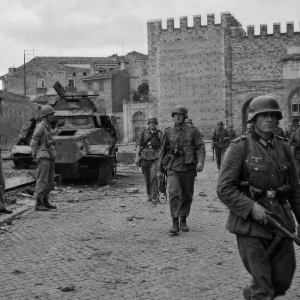
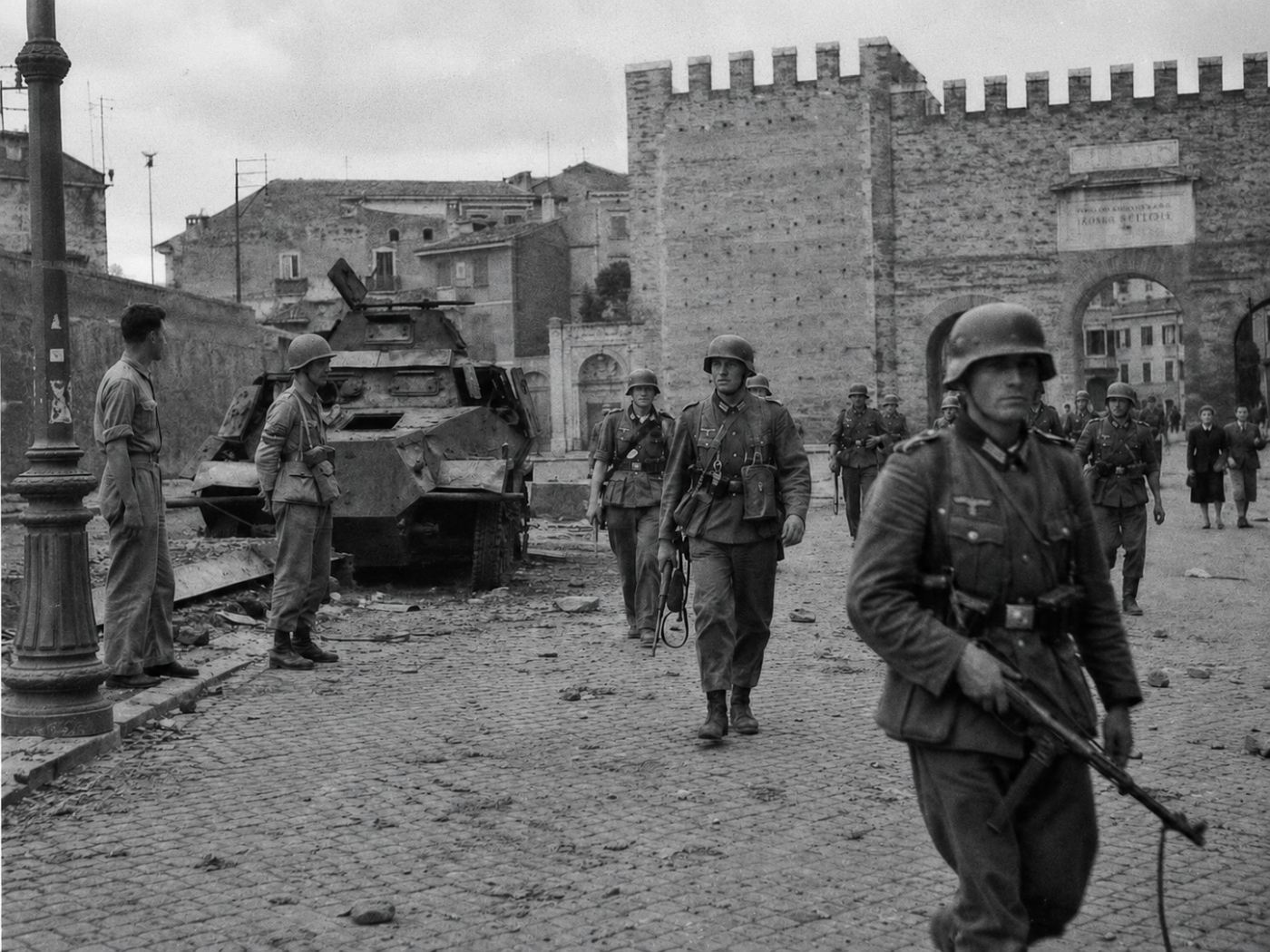
German troops gradually forced their way through the defensive positions. Their superior organisation, combined with the breakdown of Italian command and communications, made continued resistance increasingly difficult. Italian tanks and vehicles were knocked out or abandoned along the Via Ostiense and around Porta San Paolo. Contemporary photographs taken shortly afterwards show wrecked and immobilised Italian armour remaining beside the roads where the fighting had taken place.
By the afternoon it was clear that Rome could not be successfully defended. Negotiations had already begun between Italian representatives and German commanders. At approximately 4 p.m. on 10 September, a surrender agreement was signed. German forces were effectively given control of the capital, although Rome's previously declared status as an open city was nominally maintained.
German troops then moved into Rome and Italian military formations in the area were progressively disarmed. Soldiers who only days earlier had regarded the Germans as allies suddenly found themselves prisoners, fugitives or potential members of the growing resistance movement. Similar scenes occurred throughout Italy and across territories occupied by Italian forces in the Balkans and elsewhere as Germany implemented Operation Achse.
The occupation transformed daily life in Rome. German military authorities controlled the city while the SS and security organisations began hunting political opponents, escaped Allied prisoners, resistance members and Jews. Food shortages worsened and the population lived under increasingly harsh restrictions.
One of the darkest episodes came on 16 October 1943, when German forces carried out a mass roundup of Rome's Jewish population. More than a thousand Jewish men, women and children were seized and deported, the overwhelming majority eventually being murdered. The roundup demonstrated the brutal reality of German occupation and the danger now faced by Jewish families who had lived in Rome for generations.
Meanwhile, organised resistance expanded. Former Italian soldiers, anti-Fascists, communists, monarchists, Catholics and ordinary civilians became involved in underground groups. Weapons were hidden, intelligence was passed to the Allies and attacks were carried out against German troops and installations.
German reprisals could be savage. The most notorious occurred in March 1944 following a partisan attack against German police troops in Via Rasella. In retaliation, German forces murdered 335 prisoners and civilians in the Ardeatine Caves outside Rome. The massacre became one of the defining atrocities of the German occupation of Italy.
Rome remained under German control for almost nine months. Allied armies advancing northwards through Italy faced extremely difficult terrain and determined German defensive lines, including the fighting around Monte Cassino. Only after the Allied breakthrough in the spring of 1944 were German forces compelled to abandon the Italian capital.
On 4 June 1944, troops of the United States Fifth Army entered Rome. German formations had largely withdrawn northwards rather than attempting to fight a destructive battle inside the city. Romans poured into the streets to welcome the Allied soldiers, bringing an end to the occupation that had begun on 10 September 1943.
The events of 10 September have particular significance in Italian military history. The defence of Rome was ultimately unsuccessful, but the fighting around Porta San Paolo demonstrated that the German takeover was not completely unopposed. Italian soldiers who had received confused or nonexistent orders nevertheless chose to fight, and civilians joined them in the streets.
For this reason, Porta San Paolo became an important symbol of the Italian Resistance. The battle represented the moment when former allies openly became enemies and when Italy's war fundamentally changed. From September 1943 onwards, Italians would find themselves fighting Germans, Fascist forces loyal to Mussolini and, in some cases, one another in a bitter conflict that possessed many of the characteristics of a civil war.
The German occupation of Rome on 10 September 1943 therefore marked far more than the capture of another European capital. It represented the collapse of the wartime alliance between Fascist Italy and Nazi Germany, the disintegration of much of the Royal Italian Army and the beginning of a new and brutal phase of the war in Italy.
Around Porta San Paolo, Italian soldiers and ordinary Romans made their final attempt to prevent German troops from taking the city. Although overwhelmed, their resistance became one of the earliest and most enduring symbols of Italy's struggle against German occupation.