On this day in military history…
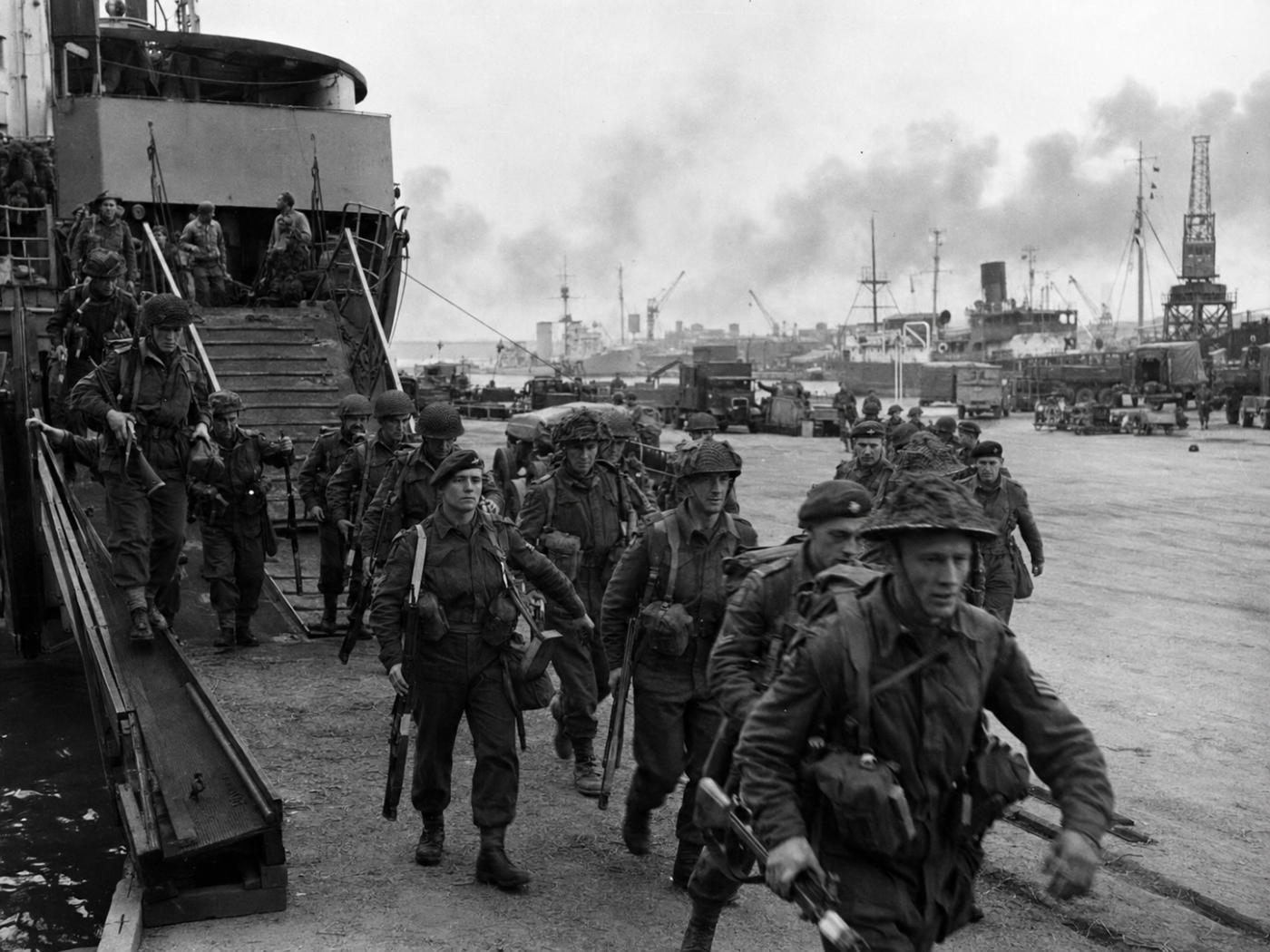
On 9 September 1943, as Allied troops were fighting their way ashore at Salerno on the opposite side of Italy, another British force was approaching the great naval port of Taranto. The operation had the unlikely codename Slapstick and was carried out by men of the British 1st Airborne Division. Yet unlike the airborne assaults for which the division had been trained, there would be no mass parachute drop and no gliders sweeping towards their landing zones. Instead, the paratroopers were carried directly into Taranto aboard Royal Navy warships in one of the most unusual operations of the Italian Campaign.
The operation developed from the rapidly changing political and military situation in Italy during the summer of 1943. Following the Allied conquest of Sicily, the Italian government sought a way out of the war. Benito Mussolini had been removed from power in July and secret negotiations began between Italy and the Allies. On 3 September an armistice was signed, although it was not publicly announced until the evening of 8 September. The announcement created enormous confusion throughout Italy. Italian units suddenly found themselves officially out of the Axis alliance while German forces immediately began implementing plans to disarm their former partners and occupy strategic positions.
During negotiations, the Italians had indicated that the important southern ports of Taranto and Brindisi could be made available to Allied troops. Allied commanders immediately recognised the opportunity. Taranto possessed one of the finest natural harbours in the Mediterranean and had long been one of the principal bases of the Italian Navy. Capturing it intact would give the Allies an important supply port on Italy's eastern coast while threatening German communications further north. Operation Slapstick would also complement the main Allied landing at Salerno, Operation Avalanche, which began on the same day.
The force selected for the mission was Major-General George Hopkinson's British 1st Airborne Division. The division contained experienced and highly trained parachute and airlanding troops, but there was an immediate problem: there were not enough transport aircraft available to carry out a major airborne landing. Landing craft were also heavily committed elsewhere, particularly to the operations at Salerno.
The solution was simple but highly unconventional. The airborne soldiers would become temporary naval passengers. Royal Navy cruisers and other warships were assembled to transport the division from North Africa across the Mediterranean directly into Taranto harbour. Men accustomed to preparing themselves to jump from aircraft instead climbed aboard warships carrying their weapons and equipment. Six cruisers were involved in carrying elements of the division during the movement into Taranto, with further troops following as the operation developed.
Among the first troops committed were men of the 2nd and 4th Parachute Brigades and supporting elements of the division. On board the ships there was considerable uncertainty about exactly what reception awaited them. Italy had surrendered, but German troops were already moving aggressively to take control of Italian territory. Nobody could be certain whether German forces had occupied the docks or whether Italian coastal defences might open fire through confusion or because individual commanders had refused to accept the armistice.
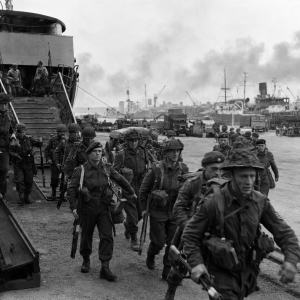
During the morning of 9 September the Royal Navy force entered Taranto. There was no great artillery duel and no storming of defended beaches. The British troops discovered that the Italians were prepared to cooperate and the initial occupation of the port was effectively unopposed. Airborne troops poured ashore from the ships and rapidly began securing the harbour installations, roads, bridges and important positions around the city. Contemporary Imperial War Museum material records troops approaching Taranto by landing craft as reinforcements arrived during Operation Slapstick.
The ease of the initial landing, however, could easily disguise how important the achievement was. Taranto had been captured largely intact. Instead of having to fight through demolished docks and wrecked harbour facilities, the Allies obtained a functioning port through which reinforcements, vehicles, ammunition, fuel and supplies could subsequently be moved.
The Germans were not prepared simply to abandon southern Italy. The principal German formation operating ahead of the British advance was the 1st Fallschirmjäger Division, whose paratroopers were experienced soldiers. Rather than fight a potentially disastrous battle for Taranto itself, German forces withdrew northwards while establishing roadblocks, demolitions and ambush positions designed to delay the British.
The operation therefore changed character very quickly. What had begun as an almost peaceful occupation of a port developed into an aggressive advance through southern Italy.
During the night of 9–10 September, troops of the 4th Parachute Brigade pushed inland from Taranto. By the morning they had reached Massafra, where local civilians welcomed the British soldiers. The advance then continued towards Mottola, where German troops offered resistance. Men of the 156th Parachute Battalion became involved in fighting as the Germans carried out their delaying withdrawal. It was here that the division began suffering its first battle casualties of the operation.
The British paratroopers faced conditions very different from those for which airborne soldiers were usually prepared. Instead of establishing a compact bridgehead around parachute landing zones, they were advancing considerable distances along Italian roads, through towns and across difficult countryside. Their mobility was initially limited, and much of their heavy equipment had to arrive separately. Nevertheless, the advance continued.
Brindisi, further along the Adriatic coast, also fell into Allied hands. Its capture was politically as well as militarily significant. King Victor Emmanuel III, Prime Minister Marshal Pietro Badoglio and members of the Italian government had fled Rome following the announcement of the armistice and eventually reached the Brindisi area. Allied control of southern Italy helped provide a secure territory from which the new Italian government could operate.
The greatest tragedy associated with the initial landing came not during fighting against the Germans but inside Taranto harbour itself. The fast British cruiser-minelayer HMS Abdiel had transported airborne troops and important equipment to the port. During the early hours of 10 September, while lying in Taranto harbour, Abdiel struck a mine. German E-boats had laid magnetic mines as they withdrew from the area. The explosion was devastating. Abdiel sank rapidly with heavy loss of life among both her crew and the soldiers aboard her. The ship was carrying equipment including anti-tank guns and ammunition intended for the airborne division. The disaster demonstrated that despite the apparently peaceful capture of Taranto, the harbour and surrounding waters remained extremely dangerous. Naval records identify the minefield as having been laid by German S-boats S-54 and S-61 as they escaped from Taranto.
Meanwhile, further inland the Germans continued their fighting withdrawal. Roadblocks were established at commanding positions and small groups of German paratroopers carried out ambushes before withdrawing again. The objective was not necessarily to hold every village but to slow the British advance long enough for German forces further north to reorganise.
During this advance the 1st Airborne Division suffered one of its most serious losses. Major-General George Hopkinson, the division's commander, went forward to observe fighting involving the 10th Parachute Battalion near Castellaneta. German machine-gun fire struck him while he was close to the front. He was seriously wounded and subsequently died, becoming the highest-ranking British airborne officer killed during the Italian campaign. Command of the division passed to Brigadier Ernest Down.
Despite the loss of their commander, the airborne troops continued pushing northwards. Their objectives became increasingly ambitious. The British wanted to secure the airfields around Foggia, which were of enormous strategic importance. From bases in southern Italy Allied aircraft could operate against targets across the Balkans, Austria, southern Germany and other parts of occupied Europe. Possession of the Foggia airfield complex would eventually greatly extend the reach of Allied strategic air power in the Mediterranean theatre.
As the British advanced, the distances involved became a growing problem. Airborne divisions were lightly equipped compared with conventional infantry formations and were not intended to conduct prolonged independent advances over such distances. Supplies had to travel along increasingly stretched routes from Taranto while German rearguards continued attempting to delay the advance. Nevertheless, within weeks the division had advanced roughly 125 miles from Taranto towards Foggia. Allied aircraft soon began operating from captured airfields, while conventional ground formations arrived to strengthen the position.
British V Corps headquarters landed at Taranto on 18 September. The veteran 78th Infantry Division began arriving shortly afterwards, followed by the 8th Indian Infantry Division. Their arrival allowed the lightly equipped airborne troops gradually to hand over responsibility for the continuing advance.
By 27 September elements of the 1st Airborne Division and 78th Division had reached Foggia. The airborne division's remarkable advance from the coast had effectively come to an end. Having landed at Taranto expecting an uncertain mission, its soldiers had helped secure a large area of southern Italy in less than three weeks.
Operation Slapstick is sometimes overshadowed by the much bloodier landings at Salerno. At Salerno, Allied troops faced determined German counterattacks and at several points the beachhead appeared dangerously vulnerable. Taranto was different. The initial landing itself encountered little opposition, leading to the mistaken impression that Slapstick was an insignificant operation.
Its strategic results were considerable. The Allies gained Taranto largely intact, obtained another major entry point for troops and supplies, secured important territory on Italy's Adriatic side and accelerated the German withdrawal from the extreme south. The operation also contributed to the capture of Brindisi and eventually Foggia, strengthening the Allied position across southern Italy.
It was also one of the strangest chapters in the history of Britain's wartime airborne forces. The men of the 1st Airborne Division had been organised and trained to descend onto enemy territory from aircraft. During Operation Slapstick they instead sailed into battle aboard Royal Navy cruisers, occupied one of Italy's greatest naval bases, and then fought their way more than a hundred miles inland against German paratroopers.
For many of those soldiers, Italy was only another stage in a much longer war. Much of the 1st Airborne Division later returned to Britain to prepare for operations in north-west Europe. Within a year the division would become famous for an altogether different airborne operation when its men flew into the Netherlands during Operation Market Garden and fought the desperate battle for Arnhem.
Operation Slapstick never achieved the fame of Arnhem, Normandy or Salerno, but on 9 September 1943 British airborne troops carried out an operation unlike almost any other of the Second World War. Arriving not beneath parachutes but aboard the ships of the Royal Navy, they seized Taranto, pushed rapidly into southern Italy and helped open another route for the Allied advance towards Nazi Germany.
It was an airborne invasion without the airborne landing – and one of the lesser-known successes of the Italian Campaign.