On this day in military history…
On 3rd September 1943, while Allied troops were beginning their invasion of the Italian mainland, one of the most important political events of the Second World War took place in almost complete secrecy. Italy, Germany’s principal European ally, signed an armistice with Britain and the United States, effectively agreeing to leave the Axis war. However, the surrender was kept secret for another five days and was not publicly announced until 8th September, creating a dangerous period in which Italian soldiers, German commanders, and even many senior Italian officers remained unaware that their country had already agreed to stop fighting the Allies.
Italy had entered the war alongside Nazi Germany in June 1940, but by 1943 the conflict had become disastrous. Italian forces had suffered enormous losses in North Africa, the Balkans, and on the Eastern Front, while Allied bombing increasingly devastated Italian cities and industry. The defeat of Axis forces in Tunisia in May 1943 was followed in July by the Allied invasion of Sicily, and the rapid deterioration of the military situation ultimately destroyed Benito Mussolini’s political position.
On 25th July 1943 Mussolini was removed from power after a meeting of the Fascist Grand Council. King Victor Emmanuel III dismissed him and appointed Marshal Pietro Badoglio as Prime Minister, and Mussolini was arrested shortly afterwards. Although Badoglio publicly announced that Italy would continue fighting alongside Germany, his government immediately began seeking a way out of the war in secret.
The situation was extremely dangerous because German troops were already stationed throughout Italy and Hitler deeply distrusted the new Italian leadership. German commanders began moving additional forces south of the Alps in anticipation of an Italian collapse, while Badoglio attempted to negotiate with the Allies while still convincing Germany that Italy remained loyal to the Axis. Secret contacts eventually developed between Italian representatives and the Allies, with negotiations centred on an unconditional armistice. Italian leaders hoped the Allies would land close to Rome before any announcement, but the Allies were preparing their own operations and would not allow Italy to control the timing.
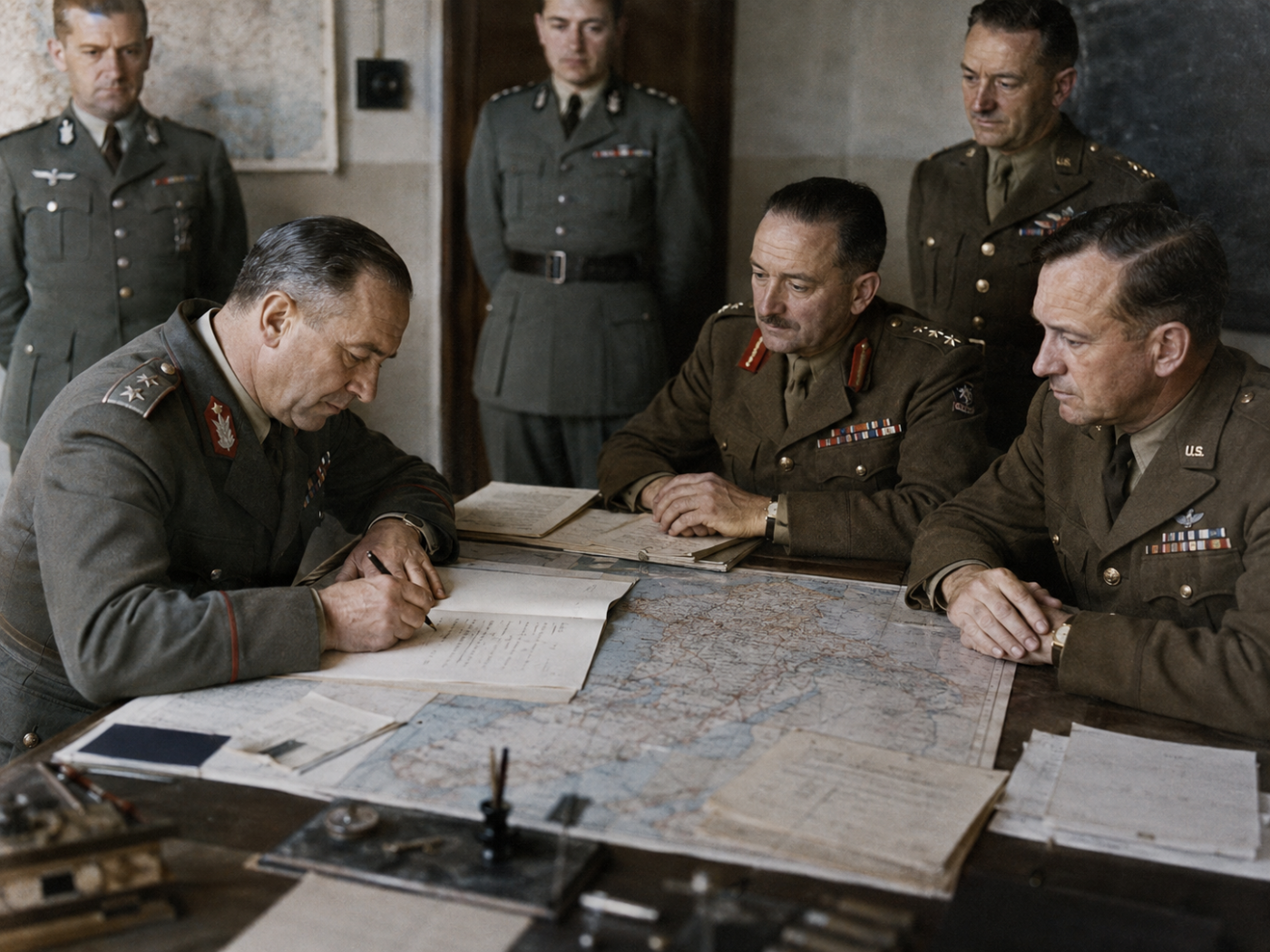
The decisive meeting took place at Cassibile near Syracuse in Sicily, where on 3rd September 1943 General Giuseppe Castellano signed the armistice on behalf of Italy and Major General Walter Bedell Smith signed for the Allies. At almost the same time, British forces under General Bernard Montgomery were crossing the Strait of Messina and landing on mainland Italy in Operation Baytown, meaning Italy was effectively agreeing to stop fighting the Allies on the very day Allied troops began their invasion.
The armistice required Italy to cease hostilities, surrender military facilities, and assist Allied operations where necessary, while the Italian fleet and air force were to move under Allied control rather than fall into German hands. However, the agreement included a crucial condition: it was to remain secret for the time being. This was largely for military reasons, as the Allies were preparing the larger landings at Salerno (Operation Avalanche) on 9th September and did not want Germany warned in advance. The Italian government also feared that an early announcement would allow German forces to occupy Rome, disarm the army, and arrest the King and government before Allied protection could arrive.
For five days Italy existed in an extraordinary situation, with its government having signed an armistice while millions of soldiers continued serving alongside German forces without knowing the war had effectively changed. The secrecy created widespread confusion, as instructions for Italian units were incomplete, unclear, or withheld entirely, leaving many commanders uncertain how to act. Meanwhile, the Germans had already prepared for this outcome through Operation Achse, a plan to disarm Italian forces and occupy key positions if Italy abandoned the Axis.
The crisis finally broke on 8th September 1943 when General Eisenhower publicly announced the armistice in a radio broadcast from Allied headquarters. Shortly afterwards, Marshal Badoglio confirmed the agreement in a broadcast to the Italian people, ordering Italian forces to cease hostilities against the Anglo-American forces and to resist attacks from any other direction, a clear reference to Germany. For Italian soldiers across Europe, the announcement came as a shock, as many had received no instructions and suddenly discovered that their alliance with Germany had ended.
The result was immediate chaos. German forces rapidly activated Operation Achse, seizing railways, ports, airfields, and military installations while surrounding Italian units and demanding their surrender. Some Italian formations complied due to lack of orders, while others resisted. In Rome, fighting broke out between Italian and German troops, but the Italian leadership failed to organise an effective defence, and during the night of 8th–9th September King Victor Emmanuel III, Badoglio, and senior officials fled the capital, leaving military commanders without political direction at a critical moment.
Across the armed forces the consequences were severe, as hundreds of thousands of Italian soldiers were disarmed and many were deported to Germany and occupied territories as forced labourers. In some areas resistance continued, most notably on the Greek island of Cephalonia where the Acqui Division fought German forces before being massacred after surrender. The Italian Navy was ordered to sail to Allied ports, and while much of the fleet complied, the battleship Roma was sunk by German aircraft on 9th September using radio-guided bombs, killing over 1,300 sailors.
The armistice did not end the war in Italy, as German forces quickly occupied much of the country and established defensive positions across the peninsula. Allied troops landing at Salerno on 9th September faced fierce resistance and nearly suffered defeat in one of the most intense battles of the campaign. Meanwhile, Mussolini, who had been imprisoned after his removal, was rescued by German forces on 12th September and installed as the leader of the German-controlled Italian Social Republic in the north.
Italy was effectively divided, with the south aligning with the Allies under the King and Badoglio government, which formally declared war on Germany on 13th October 1943 and became a co-belligerent. Italian forces then fought alongside the Allies, while in the north Mussolini’s regime continued fighting with Germany. This division led to a bitter civil war involving Fascist forces, Italian partisans, and government-aligned troops, and Italy remained a major battlefield until 1945.
The secret armistice signed at Cassibile on 3rd September 1943 therefore represented far more than Italy’s withdrawal from the Axis. It marked the collapse of Mussolini’s alliance with Hitler, but the five-day delay before its announcement created extraordinary confusion and allowed Germany to prepare for Italy’s defection. Once the armistice was finally revealed on 8th September, German forces rapidly occupied much of the country, the Italian military disintegrated, the government fled Rome, and Italy entered a new and devastating phase of the war that would last for nearly two more years.