On this day in military history…
On 27 August 1941 one of the most unusual encounters of the Battle of the Atlantic took place south of Iceland. German submarines were among the most feared weapons in the Nazi arsenal, normally hunted relentlessly by Allied aircraft and warships until they escaped beneath the Atlantic or were destroyed. On this occasion, however, an RAF aircraft achieved something extraordinary: it attacked a German U-boat so effectively that its crew surfaced, raised a white flag and surrendered. Even more remarkably, the captured submarine was later repaired, given a British crew and sent back to sea flying the White Ensign as HMS Graph.
The submarine involved was U-570, a Type VIIC U-boat built by Blohm & Voss in Hamburg. The Type VII became the workhorse of Germany's submarine campaign, and boats of this class would account for a considerable proportion of Allied shipping losses during the war. U-570 was a comparatively new vessel, having been commissioned into the Kriegsmarine on 15 May 1941. Her commanding officer was Kapitänleutnant Hans-Joachim Rahmlow and, after trials and repairs following an earlier accident, she departed on her first operational patrol in August 1941.
Only a few days into that patrol, U-570 was operating in the North Atlantic south of Iceland. At approximately the same time an RAF Coastal Command Lockheed Hudson of No. 269 Squadron was patrolling the area. The aircraft was piloted by Squadron Leader James Thompson. The Hudson had become an increasingly important weapon in the struggle against the U-boats, combining long range with bombs and depth charges that allowed Coastal Command crews to attack submarines caught on the surface.
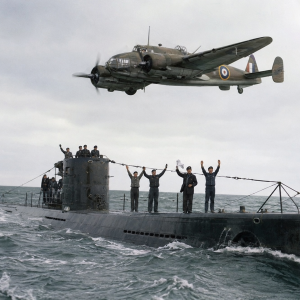
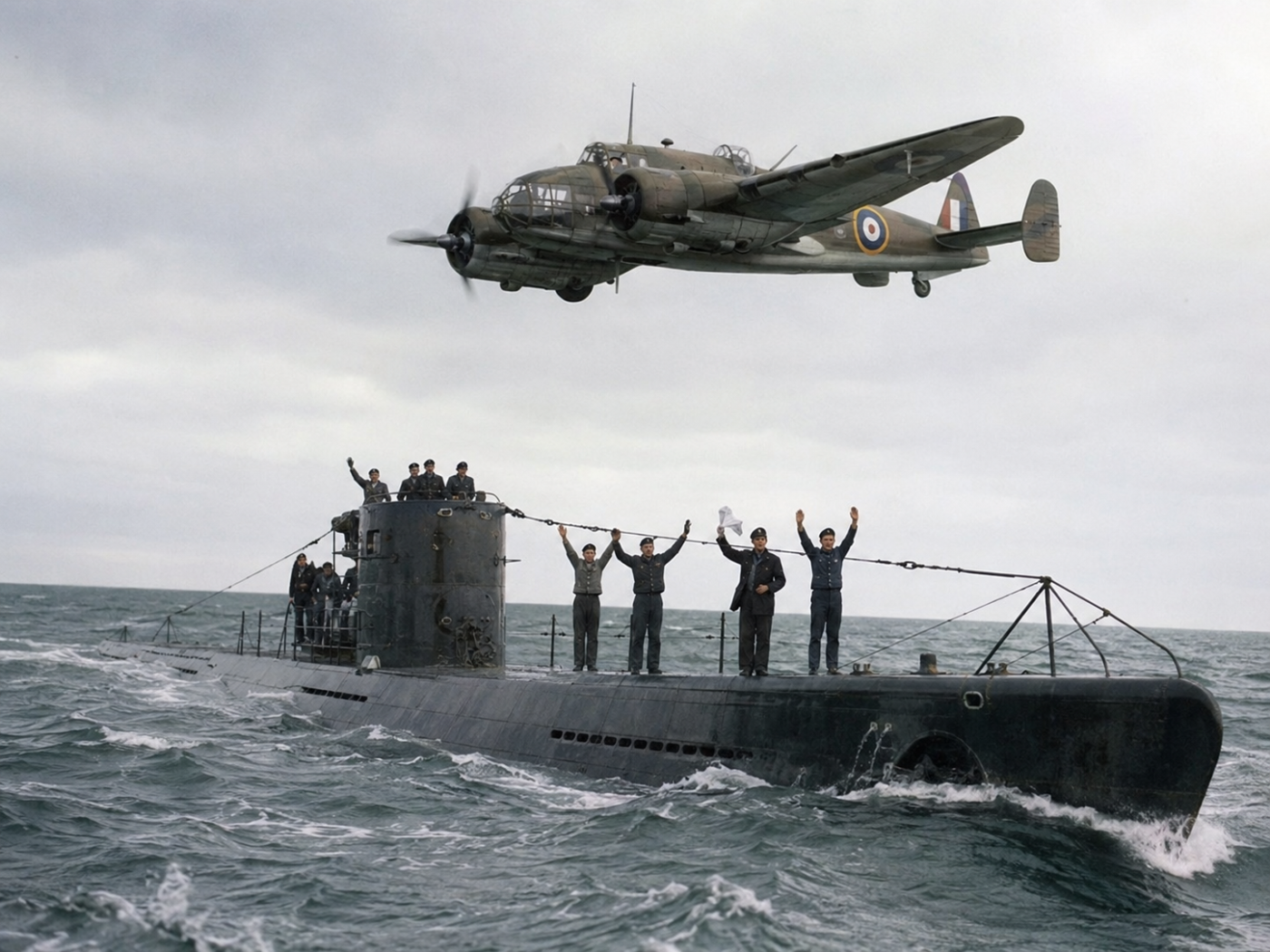
U-570 surfaced on 27 August and was spotted from the air. The Hudson immediately went into the attack. Thompson brought his aircraft down towards the submarine and released depth charges around it before the German crew could successfully escape beneath the surface. The explosions caused serious damage and created considerable confusion inside the boat. U-570 was left unable to continue normal diving operations and her inexperienced crew believed their submarine might be lost.
What happened next astonished the RAF crew. Men appeared on the submarine's conning tower and displayed a white flag. Instead of attempting to fight the aircraft or scuttle their vessel, U-570's crew were surrendering to an aeroplane circling overhead.
It created an extraordinary problem for Squadron Leader Thompson. An aircraft could force a submarine to surrender, but it could hardly board it and take prisoners. The Hudson therefore continued circling U-570, effectively standing guard over the German boat from the air. The RAF crew repeatedly passed over the submarine while the Germans remained on deck beneath their white flag. Eventually other aircraft arrived, including a Coastal Command Catalina, and British naval vessels were directed towards the position.
There were 44 survivors from U-570 and no members of her crew were killed during the capture. British forces took control of the submarine and arranged for her to be towed towards Iceland. Keeping the captured boat afloat was important because the British immediately recognised that they had obtained something far more valuable than another U-boat destroyed at sea. Sitting in front of them was an almost complete example of the German submarine upon which much of the Battle of the Atlantic depended.
The capture offered British intelligence and naval engineers the rare opportunity to examine a German Type VIIC submarine in detail. Equipment, construction methods, machinery, weapons and diving arrangements could all be studied. The boat consequently provided valuable information about German submarine design and capabilities. The Royal Navy would also gain experience of how a U-boat actually handled at sea, rather than relying solely on intelligence reports and the interrogation of captured submariners.
U-570 was brought into Iceland and salvaged before eventually being transferred to Britain for further examination and repair. Rather than simply dismantling the submarine, the Admiralty decided upon a far more unusual course of action — the former enemy vessel would become a Royal Navy submarine.
The captured U-boat was renamed HMS Graph and commissioned into the Royal Navy on 5 October 1941. The swastika and Kriegsmarine identity disappeared and the White Ensign now flew from a submarine that only weeks earlier had sailed to attack Allied shipping. British submariners had to familiarise themselves with German controls, machinery, instruments and operating procedures, while equipment and fittings were altered where necessary for Royal Navy use.
Graph was not merely retained as a static intelligence exhibit. She became an operational submarine and went to sea with a British crew. During 1942 and 1943 she conducted operational patrols, including deployments connected with the Bay of Biscay, Arctic waters and the North Sea. This made her one of the most extraordinary submarines of the war — a German U-boat that had begun its career with the Kriegsmarine before subsequently fighting on the Allied side under Royal Navy command.
Operating a German submarine inside the Royal Navy inevitably presented difficulties. Spare components were not readily available, German machinery required specialist knowledge and maintaining an enemy-designed vessel became increasingly problematic. As the war progressed, the practical value of keeping Graph operational declined and she was eventually withdrawn from active service.
Her story nevertheless had one final dramatic chapter. In March 1944 the former U-boat was being towed when the tow parted and Graph was driven ashore on the island of Islay off the west coast of Scotland. With the submarine no longer considered worth recovering for operational use, her remarkable wartime career had effectively ended.
The capture of U-570 remains one of the strangest episodes of the Battle of the Atlantic. Normally the sighting of a U-boat by Coastal Command began a race in which the submarine attempted to dive before depth charges could reach it. On 27 August 1941 that familiar encounter ended very differently. A relatively small RAF Hudson had forced an entire German submarine and its crew to surrender in the open Atlantic.
For the men of No. 269 Squadron it was an extraordinary achievement. For British naval intelligence it was an unexpected opportunity to examine one of Germany's most important weapons almost intact. And for the Royal Navy it resulted in something even more unusual — a captured German U-boat repaired, crewed by British submariners, renamed HMS Graph and sent back to war against the nation that had built her.
From U-570 of the Kriegsmarine to HMS Graph of the Royal Navy, few vessels of the Second World War can claim a more extraordinary change of allegiance.