On this day in military history…
On 26 August 1914, only weeks after Britain entered the First World War, exhausted soldiers of the British Expeditionary Force turned to face their German pursuers near the French town of Le Cateau. What followed was a ferocious battle fought under enormous pressure, with British infantry and artillery attempting to hold back a powerful German advance long enough for the rest of the army to escape southwards. Although the battlefield was ultimately left in German hands and British losses were severe, the Battle of Le Cateau became one of the most important defensive actions of the opening weeks of the war.
The battle came just three days after the British Expeditionary Force had fought its first major engagement at Mons in Belgium. Faced by the advancing German First Army and with French forces also withdrawing, the BEF began what became known as the Great Retreat. For days the British soldiers marched south through intense summer heat, frequently short of sleep and uncertain of where the enemy might appear next. Units became separated, roads became congested with troops, horses, artillery and transport, and German cavalry and infantry remained dangerously close behind. Over the following ten days the BEF would retreat approximately 200 miles while repeatedly fighting rearguard actions.
II Corps, commanded by Lieutenant-General Sir Horace Smith-Dorrien, was particularly vulnerable. By the evening of 25 August many of his men were approaching exhaustion. Continuing the withdrawal while powerful German forces pressed closely behind risked turning an organised retreat into a rout. Smith-Dorrien therefore reached one of the most controversial decisions made by a British commander during the opening campaign: instead of continuing to retreat immediately, he would turn II Corps around and fight.
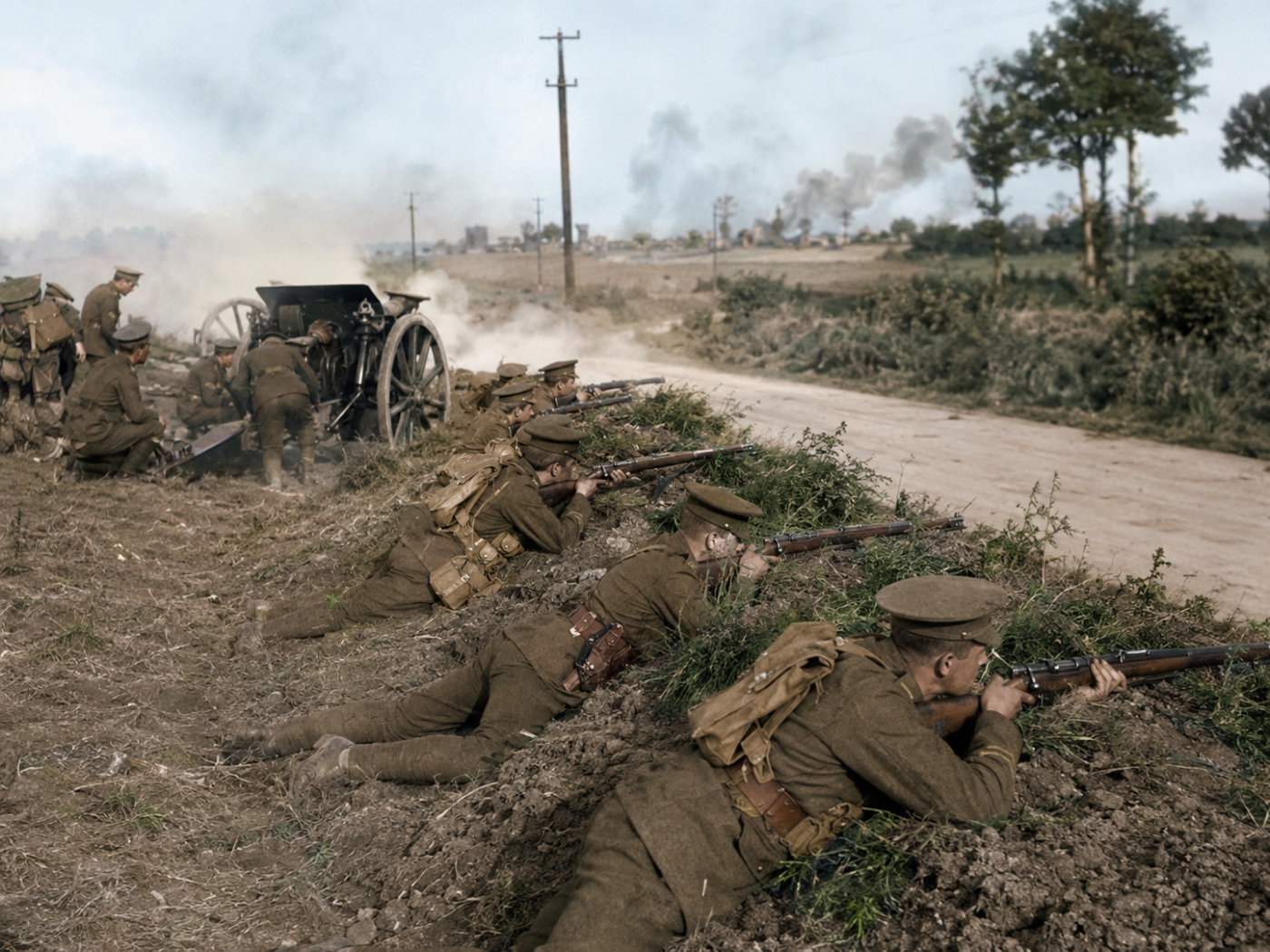
The British position stretched through the countryside around Le Cateau, with infantry occupying hastily selected positions while the Royal Artillery deployed its field guns behind and, in many cases, remarkably close to the infantry line. There had been little time to construct proper trenches. Soldiers scraped whatever protection they could from the earth, taking advantage of sunken roads, hedges, villages and folds in the ground. They knew that if the German forces broke through quickly, large parts of II Corps could be trapped.
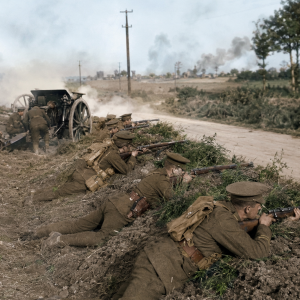
Soon after daylight on 26 August German artillery began ranging onto the British positions. The bombardment increased in intensity as German infantry moved forward. British field artillery answered with enormous determination, and the battle rapidly developed into one of the great artillery contests of the early war. Batteries of the Royal Field Artillery remained in exposed positions firing over open sights as German shells exploded around them.
The British infantry, many of them highly trained regular soldiers from the pre-war Army, poured disciplined rifle fire into the advancing German formations. Their speed and accuracy again demonstrated the professionalism that had surprised German troops at Mons. German infantry attacks were repeatedly checked, but the British line was subjected to growing pressure as more enemy forces arrived and attempted to work around its flanks.
Le Cateau was not a carefully prepared defensive battle. It was an emergency stand fought by troops who had already been marching and fighting for several days. Communications were difficult and commanders frequently had only a limited understanding of what was happening elsewhere on the battlefield. Nevertheless, battalions continued fighting from exposed positions as German artillery attempted to destroy the British gun lines and infantry strongpoints.
Some of the fiercest fighting occurred around the British artillery. Gun crews continued firing even when German infantry approached dangerously close. Horses required to withdraw the guns were killed by shellfire, while ammunition wagons and limbers were smashed. When the order eventually came to retreat, some batteries found it impossible to remove their weapons. Guns that could not be saved were abandoned after crews had continued firing until almost the last possible moment.
By the afternoon Smith-Dorrien realised that the stand had achieved as much as could reasonably be expected. Remaining in position risked the destruction or encirclement of II Corps. Orders were issued for the troops to disengage and continue their retreat southwards. With German forces pressing hard and artillery fire covering roads and withdrawal routes, breaking contact was extremely dangerous.
French cavalry under General André Sordet helped protect parts of the British withdrawal, while surviving British units pulled away from the battlefield in groups. Thousands of exhausted soldiers marched south once more, some having fought throughout much of the day before beginning another long night on the road.
The price was enormous. Traditional British figures record approximately 7,800 men killed, wounded or missing and 38 field guns lost, although later historical studies have produced lower estimates for British casualties. Whatever the exact figure, Le Cateau was one of the bloodiest engagements experienced by the small professional British Army during the opening campaign of 1914.
Tactically, the Germans controlled the battlefield when the fighting ended. Yet judging Le Cateau simply by possession of the ground misses its wider importance. Smith-Dorrien had never intended to hold Le Cateau permanently. His objective was to stop the German pursuit long enough to allow the BEF to regain distance and organisation. In that respect, the battle achieved its purpose. The German advance was delayed and the surviving formations of II Corps were able to continue south. Contemporary regimental histories and later assessments have therefore regarded the battle as an extremely costly but vital delaying action.
The decision to fight nevertheless caused controversy. Sir John French, Commander-in-Chief of the BEF, believed Smith-Dorrien should have continued withdrawing and later criticised his subordinate's decision. Smith-Dorrien maintained that his exhausted troops were too closely pursued to escape safely without first turning on the enemy. The argument continued long after the campaign, but the survival of II Corps provided powerful evidence in support of his judgement.
Le Cateau also demonstrated something important about the character of the British Army that went to France in August 1914. This was a relatively small force compared with the vast conscript armies of Germany and France, but it contained highly experienced professional soldiers. Infantrymen were trained to fire rapidly and accurately, artillery crews operated their guns with remarkable discipline and junior officers and NCOs frequently continued fighting after communications with higher command had broken down.
Many of those experienced soldiers would not survive the first year of the war. The original BEF suffered devastating losses during Mons, Le Cateau, the Marne, the Aisne and the First Battle of Ypres. By the end of 1914 much of Britain's pre-war professional army had been killed, wounded or captured, and the rapidly expanding wartime army was beginning to take its place.
The wider campaign also changed dramatically only days after Le Cateau. The German armies continued towards Paris while the British and French withdrew. Yet the Allied armies remained intact. In early September they turned and counter-attacked during the First Battle of the Marne, ending German hopes of achieving a rapid victory in France. The war of movement gradually gave way to trench warfare and the Western Front that would dominate the next four years.
Seen in that wider context, the significance of Le Cateau becomes much clearer. Smith-Dorrien sacrificed ground, guns and thousands of casualties to gain something desperately needed by the British Expeditionary Force: time. His men prevented the German pursuit from destroying an exhausted II Corps at one of the most vulnerable moments of the Great Retreat.
For the soldiers who fought there on 26 August 1914 there was little sense of participating in a famous defensive action. They experienced hours of shellfire, rifle fire, confusion and exhaustion before being ordered once again onto the roads leading south. Many comrades were left dead, wounded or captured behind them, while valuable artillery pieces had been abandoned on the battlefield.
Yet their stand had mattered. The British Expeditionary Force survived its retreat, remained capable of fighting and would soon turn north alongside its French allies at the Marne. Le Cateau therefore occupies an important place in British military history: not as a conventional victory, but as an example of a commander recognising that sometimes an army must stop retreating and fight simply to ensure that it can escape to fight again.