On this day in military history…
On 18 August 1965, United States Marines launched Operation Starlite against a powerful Viet Cong force on the Van Tuong Peninsula of South Vietnam. It became the first major offensive battle of the Vietnam War fought by a large American ground force and marked an important turning point in the rapidly escalating conflict. Until then, American troops had largely been employed protecting bases, airfields and installations while South Vietnamese forces conducted most offensive operations. Starlite demonstrated that this was changing.
Only five months earlier, on 8 March 1965, the first American Marine combat troops had landed at Da Nang. Further Marine units soon established a major base at Chu Lai, around 55 miles south of Da Nang in Quang Ngai Province. The newly constructed airfield and surrounding military installations rapidly became an important American position, but intelligence suggested that the Viet Cong were preparing to attack it.
During early August, American intelligence organisations began receiving reports concerning the movements of the Viet Cong 1st Regiment. Individual reports were often contradictory, but when plotted together they suggested that a substantial enemy force was concentrating approximately 12 miles south of Chu Lai around the villages and coastal settlements of the Van Tuong Peninsula. The situation became considerably clearer when information was obtained indicating that elements of the 1st Viet Cong Regiment were preparing an attack against Chu Lai. Radio intercepts provided further evidence that a major enemy concentration was present in the area.
Lieutenant General Lewis Walt, commanding the III Marine Amphibious Force in Vietnam, decided not to wait for the expected Viet Cong attack. Instead, the Marines would strike first. The operation was planned at remarkable speed. Its original code name was reportedly Satellite, but during communications the name became Starlite, and the altered version remained.
Approximately 5,500 Marines would ultimately participate. The main fighting force consisted principally of elements of the 3rd Battalion, 3rd Marines and 2nd Battalion, 4th Marines, supported by additional Marine units, artillery, armour, aircraft, helicopters and United States Navy warships. The Marine plan was essentially a large hammer-and-anvil operation designed to trap the Viet Cong against the coast.
Company M of the 3rd Battalion, 3rd Marines moved into a blocking position north of the battlefield. Other Marines would land from the sea on the eastern side of the peninsula while helicopter-borne troops landed farther inland. Once established, these forces would advance towards one another, hopefully surrounding the Viet Cong and preventing them escaping. The amphibious element was commanded by Lieutenant Colonel Joseph Muir of the 3rd Battalion, 3rd Marines, while Colonel Oscar Peatross played an important role in planning and directing the operation.
Before the assault began, Marine artillery and aircraft struck suspected Viet Cong positions. Bombs, rockets and napalm were dropped on selected targets while artillery batteries around Chu Lai fired into the landing areas and surrounding countryside. At approximately 06:30 on the morning of 18 August, Marines began coming ashore at a beach designated Green Beach. At almost the same time, helicopters began carrying Marines into landing zones known as Red, White and Blue inland.
Initially some landings met relatively little opposition, but it quickly became apparent that the Marines had entered an extensively prepared Viet Cong defensive area. The countryside surrounding Van Tuong was ideally suited to defence, with villages surrounded by rice paddies, hedgerows, tree lines and dense vegetation. Beneath the ground were bunkers, tunnels and concealed fighting positions that had often been constructed over several years. The Viet Cong had also prepared trenches, spider holes, mines and punji traps, many of which were extremely difficult to identify until they opened fire.
Some of the heaviest fighting developed near the village of An Cuong. Marines advancing through the area encountered intense small-arms and automatic-weapons fire from Viet Cong troops concealed in trenches and fortified positions. Fighting frequently took place at extremely close range.
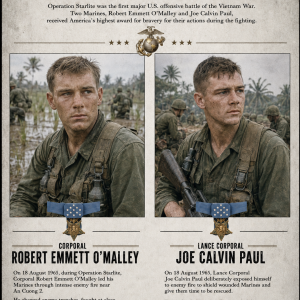
One Marine who distinguished himself during the battle was Sergeant Robert O'Malley of Company I, 3rd Battalion, 3rd Marines. When his unit came under devastating enemy fire, O'Malley repeatedly exposed himself to direct fire while organising his men, assisting casualties and attacking enemy positions. Although wounded several times, he refused evacuation until other wounded Marines had been removed. For his actions during Operation Starlite, Robert O'Malley became the first United States Marine to receive the Medal of Honor for actions during the Vietnam War.
Elsewhere the battle became equally violent. A Marine supply column travelling through the battlefield encountered a particularly serious ambush. The column included amphibious vehicles and other vehicles carrying ammunition and supplies when Viet Cong troops attacked from concealed positions. Several vehicles were disabled and the Marines found themselves surrounded. Repeated attempts were made to reach them while Marine aircraft, artillery and armoured vehicles attacked enemy positions surrounding the trapped column. The fighting continued for hours before the surviving Marines and vehicles could be recovered.
One of the unusual weapons employed during Starlite was the M50 Ontos, a lightly armoured tracked vehicle carrying six 106mm recoilless rifles. Originally developed as a tank destroyer, the Ontos proved extremely useful in Vietnam because its powerful recoilless rifles could destroy bunkers and fortified positions that were difficult for infantry weapons to defeat. Marine M48 Patton tanks and LVTP-5 amphibious tractors also provided heavy fire support.
Above the battlefield, Marine aircraft repeatedly attacked enemy positions. F-4 Phantom IIs, A-4 Skyhawks and other aircraft delivered bombs, rockets and napalm, sometimes extraordinarily close to friendly troops. Helicopters evacuated casualties and attempted to move ammunition and reinforcements through intense ground fire. United States Navy ships positioned offshore added their guns to the battle, directing fire against enemy concentrations and escape routes.
Despite the scale of American firepower, the Viet Cong fought aggressively. The 1st Viet Cong Regiment was not simply a collection of lightly armed guerrillas. Many of its soldiers were experienced fighters who had fought against South Vietnamese forces and were familiar with the terrain. They used concealed positions, tunnels and prepared defensive systems to offset American technological superiority. At several points Viet Cong troops allowed Marine units to move close before opening fire from previously hidden positions.
The Marines also discovered how difficult it could be to identify the enemy. Viet Cong soldiers frequently wore clothing similar to that of local civilians, while tunnel systems allowed fighters to disappear from one position and emerge somewhere else. By the evening of 18 August, however, American forces had penetrated deeply into the Viet Cong defensive area.
Fighting continued during the following days as Marines searched villages, tunnel systems and fortified positions throughout Van Tuong. The scale of the Viet Cong preparations became increasingly obvious, with Marines discovering bunkers, trench systems, communications equipment, ammunition, food supplies, propaganda material and command facilities. Evidence indicated that the area had served as an important headquarters and operating base for the 1st Viet Cong Regiment.
American commanders believed the operation had badly damaged the regiment. Marine reports credited their forces with killing more than 600 Viet Cong during the fighting, although later historical studies have questioned the exact figures, something common throughout the Vietnam War where enemy casualty totals were extremely difficult to verify. Nevertheless, there is little doubt that the Viet Cong force suffered substantial losses.
American casualties were also significant. Forty-five Marines were killed and approximately 200 wounded during Operation Starlite. Among those killed was Lance Corporal Joe Calvin Paul of 2nd Battalion, 4th Marines. During intense fighting on 18 August his platoon suffered numerous casualties and became threatened by enemy forces. Paul deliberately placed himself between the wounded Marines and the attacking Viet Cong, firing continuously to protect them while casualties were evacuated. Although mortally wounded, he continued fighting until he collapsed. Joe Paul was posthumously awarded the Medal of Honor.
By 24–25 August organised resistance in the immediate area had largely ended and Operation Starlite was brought to a close. The Marines had prevented the suspected Viet Cong attack against Chu Lai and temporarily shattered much of the enemy force operating around Van Tuong. It appeared to be a clear American victory.
For the United States Marine Corps, Starlite seemed to confirm that American troops could locate a large Viet Cong formation, surround it and defeat it using a combination of infantry, armour, artillery, helicopters, aircraft and naval gunfire. The battle therefore had enormous psychological importance. American commanders had entered Vietnam uncertain how their troops would perform against Viet Cong formations that had already defeated numerous South Vietnamese units. Starlite appeared to provide an answer.
The Marines had met one of the Viet Cong's strongest regiments in a prepared defensive position and forced it from the battlefield. There was, however, an important warning hidden inside the victory. Despite enormous American firepower and reports of devastating Viet Cong casualties, the 1st Viet Cong Regiment was not completely destroyed. Survivors escaped the encirclement, reorganised and later returned to combat. Only weeks after Starlite, American and South Vietnamese forces launched Operation Piranha farther south in an attempt to locate the remaining Viet Cong troops.
The pattern would become familiar during the Vietnam War. American forces could win individual battles and inflict severe losses, but Viet Cong and later North Vietnamese formations repeatedly withdrew, rebuilt and returned.
Operation Starlite nevertheless occupies an important place in the history of the conflict. The Battle of Ia Drang involving the United States Army's 1st Cavalry Division in November 1965 is often described as the first major battle between American and North Vietnamese regular forces, but Starlite had taken place three months earlier and represented the first large-scale offensive battle conducted by American ground troops against a substantial Communist formation in Vietnam. It was also one of the largest amphibious operations of the war.
The tactics used during the operation combined techniques that the Marine Corps had developed during the Pacific campaigns of the Second World War and refined during Korea. Marines came ashore from landing ships, descended by helicopter, advanced with armour and artillery and received support from aircraft and naval guns offshore. Yet they were now fighting a very different type of enemy.
Instead of attacking isolated Pacific islands or clearly defined defensive lines, the Marines faced soldiers who could disappear into villages, tunnel complexes and jungle before appearing somewhere else. Starlite therefore represented both the confidence and the problems that would characterise America's growing involvement in Vietnam.
The United States possessed overwhelming firepower, mobility and technological superiority. Its soldiers and Marines could defeat Communist forces whenever they could force them into conventional battle. The far greater challenge would be forcing the enemy to fight on American terms.
On 18 August 1965, on the dusty roads, rice fields and villages around Van Tuong, thousands of young Marines experienced that reality for the first time. Operation Starlite had begun as a pre-emptive strike designed to protect the Marine base at Chu Lai. It ended as the first major American battle of the Vietnam War and a warning of the long, costly conflict that was still to come.