On this day in military history…
Operation Gomorrah was the codename given to the devastating Allied bombing campaign against Hamburg in the summer of 1943, an operation that became one of the most destructive aerial attacks of the Second World War and produced one of the first great firestorms experienced by a major European city. Conducted primarily by the Royal Air Force at night and the United States Army Air Forces by day, the raids were intended to cripple one of Nazi Germany’s most important industrial centres, destroy vital shipyards and armaments factories, disrupt transport and communications and break the ability of Hamburg to contribute to the German war effort.
Hamburg was an obvious strategic target. Germany’s second-largest city and one of the busiest ports in Europe, it was a major centre of shipbuilding, engineering and heavy industry. The vast Blohm & Voss shipyards were located there, along with numerous factories producing aircraft components, engines, armaments and equipment for the German armed forces. The port was also closely connected with the U-boat war, with facilities involved in the construction, repair and support of submarines that were fighting the crucial Battle of the Atlantic.
The city had been bombed on earlier occasions, but Operation Gomorrah represented an entirely different scale of attack. The campaign began during the night of 24–25 July 1943 and continued through a series of major raids until early August. It formed part of the wider Combined Bomber Offensive agreed between Britain and the United States, under which RAF Bomber Command generally concentrated on large-scale night attacks while the American air forces attempted precision bombing in daylight.
The operation was named after the biblical city of Gomorrah, destroyed by fire and brimstone, a grim indication of the level of destruction that Allied planners intended to inflict. RAF Bomber Command, led by Air Chief Marshal Sir Arthur Harris, believed that the systematic destruction of German industrial cities could weaken enemy production, undermine civilian morale and force the German authorities to divert enormous resources towards air defence and reconstruction.
The opening RAF raid on the night of 24 July involved approximately 790 bombers. For this attack Bomber Command introduced one of its most important electronic countermeasures of the war, known as Window. This consisted of thousands of strips of aluminium foil dropped from aircraft as they approached Germany. The strips created large numbers of false radar echoes, confusing German ground controllers and radar-directed anti-aircraft systems.
British scientists had understood the principle behind Window for some time, but its use had previously been delayed because of fears that the Germans might quickly copy the idea and use it against Britain. By the summer of 1943, however, the potential benefits were judged to outweigh the risks. During the opening attack on Hamburg, Window proved extremely effective. German radar screens became filled with false signals, making it extremely difficult to identify the location and direction of the approaching bomber stream.
The result was a dramatic reduction in the effectiveness of German night fighter interception. Bomber losses during the first raid were considerably lower than might otherwise have been expected against such a heavily defended target. The success of Window represented an important change in the electronic air war over Europe and temporarily gave Bomber Command a significant advantage over German radar defences.
The first major raid caused widespread destruction across Hamburg, with large numbers of high-explosive and incendiary bombs dropped over the city. High explosives were used partly to destroy buildings, break water mains and open roofs, while incendiaries started thousands of individual fires. The intention was to overwhelm firefighters and emergency services, allowing smaller fires to merge into much larger conflagrations.
American bombers followed with daylight attacks against industrial and military targets. The USAAF targeted facilities including shipyards and aircraft-related industries, attempting to strike important elements of Hamburg’s industrial infrastructure. These daylight missions added further pressure to a population already enduring repeated night attacks and left little opportunity for emergency services to recover between raids.
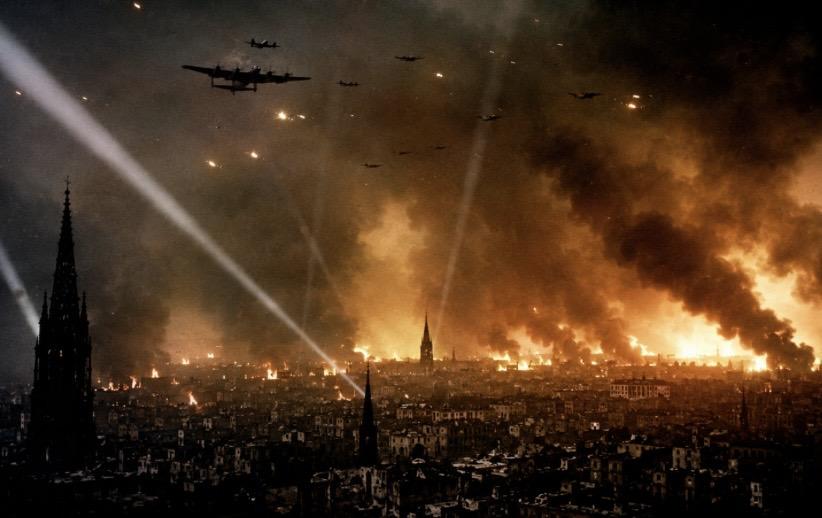
The most infamous attack of Operation Gomorrah took place during the night of 27–28 July 1943. More than 700 RAF bombers were sent towards Hamburg carrying a mixture of high-explosive bombs and enormous quantities of incendiaries. Weather conditions over the city were unusually hot and dry, and many buildings in the densely populated working-class districts were highly vulnerable to fire.
The main concentration of bombing fell on areas including Hammerbrook, Hamm and Borgfelde. Thousands of fires broke out within a relatively small area. As the individual fires spread and combined, they created an enormous firestorm.
The phenomenon was far more violent than an ordinary urban fire. As intensely heated air rose rapidly above the burning city, cooler air was sucked in at ground level to replace it. This created hurricane-force winds that fed oxygen into the flames and drove the fire forward through streets and buildings. Temperatures in the centre of the firestorm became extraordinarily high, melting materials, setting buildings alight through radiant heat and making survival almost impossible in some areas.
People attempting to escape were confronted by extreme heat, thick smoke, collapsing buildings and violent winds. Some were killed by blast or falling masonry, while others died from burns or carbon monoxide poisoning. Air raid shelters that had protected civilians from bombing could become death traps when fires consumed the oxygen outside or heated the shelters to unbearable temperatures.
The destruction was particularly severe in Hammerbrook, a densely populated district that was almost completely devastated. Streets disappeared beneath rubble and burned-out buildings, while entire residential areas were reduced to ruins. The intense heat damaged roads and vehicles and turned sections of the city into landscapes of ash and twisted metal.
Approximately 40,000 people are generally believed to have been killed during the wider Operation Gomorrah campaign, although estimates vary, and many more were injured. The firestorm raid of 27–28 July accounted for the majority of the fatalities. Hundreds of thousands of people were made homeless, and an estimated one million civilians eventually fled or were evacuated from Hamburg.
The scale of the disaster overwhelmed the authorities. Bodies could not always be recovered immediately because some areas remained dangerously hot for days. Emergency workers entered streets filled with rubble, unexploded bombs and unstable buildings. Identification of many victims was extremely difficult.
The psychological impact on Germany was enormous. News of the destruction spread rapidly despite attempts by the Nazi authorities to control information. Refugees arriving in other parts of the country carried accounts of the firestorm, contributing to fears that similar destruction could be inflicted on other cities.
For the German leadership, Hamburg demonstrated the growing power of Allied strategic bombing. The city had possessed strong anti-aircraft defences, radar systems, shelters and experienced emergency services, yet these had been unable to prevent catastrophic destruction. The effectiveness of Window also exposed a serious weakness in the German air defence system.
Further RAF raids followed on the nights of 29–30 July and 2–3 August, although poor weather reduced the effectiveness of the final major attack. By the end of the operation, vast sections of Hamburg had been destroyed or seriously damaged.
Tens of thousands of buildings were lost. Industrial facilities, warehouses, transport links and residential districts suffered extensive damage. The port and shipyards were hit, although some important industrial facilities proved more resilient than expected and production was eventually restored in many locations.
One of the continuing debates surrounding Operation Gomorrah concerns its military effectiveness compared with the enormous civilian cost. The raids undoubtedly caused severe disruption to Hamburg’s industry and transport system. Production fell, workers were displaced and resources had to be diverted towards rescue operations, reconstruction and civil defence.
However, German industrial recovery was often surprisingly rapid. Some factories returned to production within weeks or months, while machinery from destroyed facilities could sometimes be transferred elsewhere. The bombing therefore did not permanently eliminate Hamburg as an industrial centre, although the disruption was substantial.
The impact on German resources extended beyond the physical damage to the city. The wider Allied bombing offensive forced Germany to maintain thousands of anti-aircraft guns, night fighters, radar stations and large numbers of personnel in the defence of the Reich. Weapons and manpower used to protect German cities were therefore unavailable for service on other fronts.
Operation Gomorrah also became an important example of the increasingly controversial policy of area bombing. By 1943, Bomber Command was deliberately attacking large urban areas associated with German industry, based partly on the belief that destroying workers’ housing and city infrastructure would reduce industrial production and weaken morale.
Supporters of the strategy argued that Britain had few other means during the earlier years of the war to strike directly at the heart of Nazi Germany and that bombing was an essential element of the wider effort to weaken Germany before the Allied invasion of Europe. Germany itself had subjected Warsaw, Rotterdam, London, Coventry and many other cities to devastating air attacks earlier in the conflict.
Critics, however, have long questioned the morality and effectiveness of bombing densely populated urban areas in which civilian deaths were inevitable on a massive scale. Hamburg, along with later attacks on cities such as Dresden, became central to the historical debate surrounding the ethics of strategic bombing.
The operation was also significant in the development of bomber tactics. The combination of Pathfinder aircraft, concentrated bombing, electronic countermeasures and the carefully planned use of high explosives and incendiaries demonstrated the increasingly sophisticated methods being employed by Bomber Command.
Pathfinder aircraft played a vital role by marking the target area with coloured flares and incendiaries, allowing the main bomber force to concentrate its attack. The aim was to place the greatest possible weight of bombs into a limited area within a short period of time, overwhelming German defences and firefighting capabilities before they could respond effectively.
The bombing of Hamburg was not the first time a city had suffered a major incendiary attack, but the extraordinary conditions created during the July raids produced a firestorm on a scale that shocked even experienced observers. Later Allied attacks on other German and Japanese cities would demonstrate similar effects when large numbers of incendiaries were concentrated over densely built urban areas.
The Germans studied the Hamburg disaster closely. Civil defence authorities attempted to learn lessons about firebreaks, shelter construction and the evacuation of civilians, while radar specialists urgently sought methods of overcoming Window. German fighter controllers eventually developed new tactics allowing night fighters greater freedom to locate and attack bombers without relying entirely on ground radar guidance.
For the crews of RAF Bomber Command, Operation Gomorrah remained extremely dangerous despite the success of electronic countermeasures. Bomber crews faced anti-aircraft fire, night fighters, navigation problems and the constant danger of collision within the concentrated bomber stream. Aircraft damaged over Germany often faced a long and hazardous flight back across occupied Europe and the North Sea.
The American daylight raids were equally hazardous, with bomber formations exposed to fighter attacks and heavy anti-aircraft fire. The Allied air campaign of 1943 was conducted at enormous human cost, with bomber crews suffering some of the highest casualty rates of any branch of the Allied armed forces.
Hamburg itself eventually recovered as an important industrial and port city, but evidence of the destruction remained visible for years after the war. The dead were buried in mass graves and cemeteries, while surviving families attempted to rebuild lives among the ruins.
Operation Gomorrah remains one of the most dramatic examples of the destructive power of strategic bombing during the Second World War. In little more than a week, one of Germany’s greatest cities was transformed into a scene of devastation. The operation damaged important elements of the German war economy, displaced hundreds of thousands of people and demonstrated the growing ability of Allied air forces to penetrate and overwhelm the defences of the Reich.
Yet its legacy remains complex. Militarily, it showed the increasing dominance of Allied air power and introduced tactics and technologies that would influence the remainder of the bombing campaign. Historically, it stands as a stark reminder of the enormous suffering endured by civilians during total war.