
On this day in military history…
The attack by 2 PARA on Goose Green was one of the most famous and costly land battles of the Falklands War. It took place after British forces had landed at San Carlos Water on East Falkland on 21 May 1982 and were beginning to break out from the beachhead. Goose Green lay to the south of the British landing area, on the narrow Darwin-Goose Green isthmus. Although it was not on the most direct route to Stanley, it contained an Argentine garrison, an airstrip, and a settlement with civilian inhabitants. British commanders were concerned that the Argentine force there could threaten the southern flank of the San Carlos bridgehead or interfere with the wider advance across East Falkland. On 26 May, 2nd Battalion, The Parachute Regiment, was ordered to move south and attack the Argentine positions around Darwin and Goose Green.
The battalion was commanded by Lieutenant-Colonel Herbert “H” Jones. His force was relatively small for the task, and the ground strongly favoured the defenders. The Argentine troops, mainly from the 12th Infantry Regiment with supporting elements, occupied a series of positions around Darwin Hill, Boca House, the airfield, and Goose Green itself. They had machine guns, mortars, artillery support, anti-aircraft weapons, and the advantage of prepared defensive positions. The British had to advance over open, exposed ground with limited cover. Helicopter support was restricted because much of the British heavy-lift capability had been lost when the Atlantic Conveyor was sunk. As a result, 2 PARA had to march south from the San Carlos area before launching the attack.
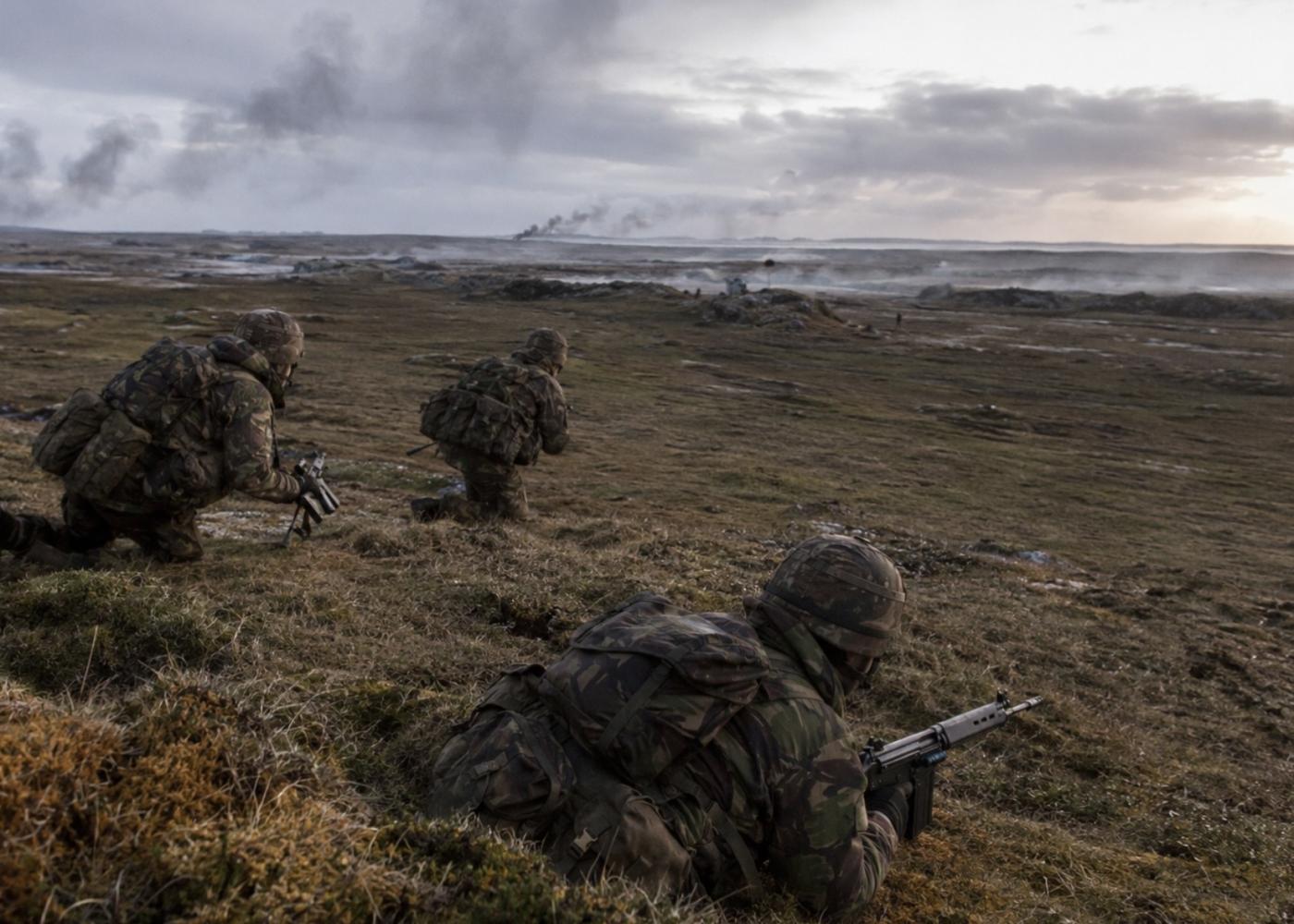
The assault began in the early hours of 28 May 1982. British fire support was limited but included artillery and naval gunfire. 2 PARA’s plan was to attack in phases, with companies clearing successive Argentine positions before pushing on towards Darwin, the airfield, and Goose Green. The attack opened in darkness, which gave the British some protection, but the ground was difficult and the Argentine defensive layout soon slowed the advance. The fighting became confused and intense as the paratroopers encountered trenches, machine-gun posts, and well-sited defensive fire.
One of the key early objectives was the area around Darwin Hill. Here the British advance became pinned down by heavy Argentine fire. The paratroopers were forced to cross open ground under machine-gun and rifle fire, and progress became extremely difficult. Lieutenant-Colonel Jones moved forward to try to restore momentum to the attack. During the fighting, he led an assault against an Argentine position but was killed. His death was a severe blow to the battalion. Jones was later awarded the Victoria Cross posthumously for his actions.
After Jones was killed, command passed to Major Chris Keeble, the battalion’s second-in-command. Keeble’s role was crucial. He had to reorganise the attack, maintain morale, and prevent the battle from stalling completely. The fighting continued through the day, with 2 PARA gradually forcing the Argentine defenders back from their forward positions. British companies pressed on against Darwin Ridge, Boca House, and the airfield area. The battle was not a quick or simple advance; it was a hard infantry fight in which small groups of soldiers had to close with enemy positions, often under intense fire.
The Argentine defenders fought stubbornly. Many of them were conscripts, but they were not simply swept aside. Some positions resisted fiercely, and Argentine artillery and mortars made the British advance more dangerous. The battle also saw Argentine air activity in the wider area, with aircraft attempting to support the defenders and strike British forces. However, the Argentine garrison was increasingly isolated as 2 PARA gained ground and the British fire plan and infantry attacks began to take effect.
By the evening of 28 May, the British had made significant progress, but Goose Green itself had not yet been fully secured. The presence of civilians in the settlement complicated the situation. Major Keeble chose not to launch a final costly assault into the settlement if surrender could be achieved. A message was sent to the Argentine commander, Lieutenant-Colonel Ítalo Piaggi, calling on him to surrender. Keeble’s approach combined military pressure with a clear warning that further resistance would lead to more casualties.
On 29 May 1982, the Argentine garrison surrendered. Nearly 1,000 Argentine prisoners were taken, a remarkable number given the size of the attacking force. The victory came at a heavy price. 2 PARA lost 17 men killed, including Lieutenant-Colonel Jones, and many others were wounded. Argentine losses were also significant. The battle demonstrated the determination and professionalism of the British airborne troops, but it also showed the harsh reality of infantry combat in the Falklands: exposed terrain, cold conditions, limited transport, and determined opposition.
The capture of Goose Green had both military and political importance. Militarily, it removed a threat to the British southern flank and secured the Darwin-Goose Green area. It also freed the civilian population there from Argentine control. Politically and psychologically, the victory was extremely important. It was the first major land victory of the campaign and helped restore confidence after the losses suffered at sea, including the sinking of several British ships. News of the victory was widely reported in Britain and became one of the defining moments of the Falklands War.
The battle remains controversial in some respects. Some have argued that Goose Green was not essential to the advance on Stanley and that the attack was ordered partly for political or morale reasons. Others argue that leaving a large Argentine force on the flank would have been dangerous and that the battle was necessary to secure the British position before the wider advance east. Whatever the debate, the courage of those who fought there is not in doubt. The men of 2 PARA faced a difficult and dangerous task against a larger defending force and succeeded through discipline, aggression, leadership, and endurance.
Goose Green became a symbol of the Falklands campaign. It showed that British ground forces could defeat Argentine troops in a set-piece land battle and confirmed that the campaign would not be decided only by naval and air power. The death of Lieutenant-Colonel H. Jones, the leadership of Major Chris Keeble, and the determination of the paratroopers made the battle one of the most remembered actions of the war. For 2 PARA, it was a costly victory, but it played an important part in the eventual British advance towards Stanley and the final Argentine surrender in June 1982.